









July 20 2026 - 10:55am
New York City
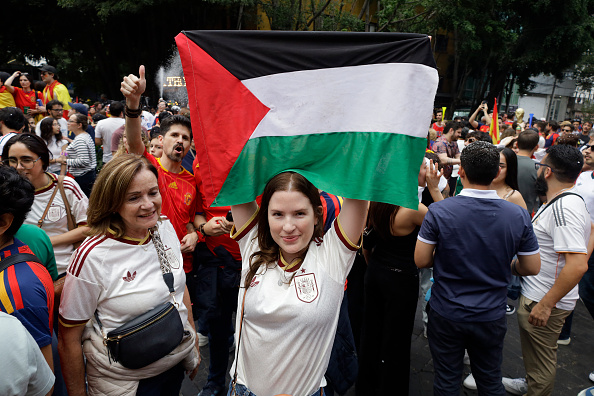
“Israel genocide type shit,” screamed a young Latino man on a Times Square subway platform to a group sporting Argentina jerseys. “Got a problem, eat my sack.” As dusk fell on Manhattan Spanish football fans chanted, “Free Free Palestine” to celebrate their team’s World Cup victory. The game had taken place just hours before, a few miles across the Hudson River at MetLife Stadium — or “New York New Jersey Stadium,” as it is now branded by FIFA.
In recent weeks, social media has settled on a curious narrative: Argentina as the pro-Israel team and Spain as the pro-Palestine one. The association is not entirely invented. Argentinian President Javier Milei has visited the Jewish state three times since taking office in 2023 and has claimed: “I am the most Zionist president in the world.” Spain’s Prime Minister, Pedro Sánchez, couldn’t be further from Milei. He has recognized Palestine as a state, pushed for arms embargoes on Israel, and condemned Israel’s assault on Gaza as genocide.
To see this divide play out, I visited Astoria, a Queens neighborhood with a large Muslim population. There, much of the community appeared to be backing Spain during the World Cup, drawn by the country’s outspoken criticism of Israel. Inside a hookah lounge on Steinway Street, a man wore a Palestine jersey. Outside, Palestinian flags lined the crowded street. Every Spanish attack drew cheers; every Argentine chance was met with boos.
The alignment had been visible long before kick-off. In the hours leading up to the match, numerous Israeli political figures openly declared their support for Argentina over Spain, including Foreign Minister Gideon Sa’ar, National Security Minister Itamar Ben-Gvir and Prime Minister Benjamin Netanyahu.
Stateside, Israel’s most vociferous defenders have taken a similar course. Mark Levin of Fox News tweeted: “Go Argentina!” Shmuley Boteach, a popular New York-based rabbi who goes viral online for his altercations with Palestine supporters, was at the final and posted a video of himself exclaiming: “Screw España.”
In contrast, on 14 July, the State of Palestine’s official X account posted: “Long live Spain,” once it became clear that the team was advancing to the final — but before it was certain whether Argentina or England would be the opponent. The image accompanying that tweet showed Lamine Yamal — Spain’s widely acknowledged star player — holding up a Palestinian flag. Israel’s harshest critics have followed accordingly. Candace Owens, eager to latch onto any conspiracy theories, released a video montage featuring Erika Kirk and Argentina’s Lionel Messi, the implication being that both are covert actors for Israel.
Yet the politics often felt imposed from above. Milei and Sánchez do not speak for every Argentine or Spaniard, let alone for the players representing their countries. Messi has visited the Western Wall and once posed wearing a kippah, details eagerly seized upon by online partisans searching for evidence that the final was really a proxy battle in the Israel-Palestine conflict. Beyond that, the case is thin.
In the second half of the game, I found myself on a sidewalk looking down the street. The same dynamic was at play there. One woman held a Palestinian flag in her hand, and there was another large flag hanging from the tree beside. But as I was leaving, I saw a woman clad in a full hijab and an Argentina shirt in front of me. It was a reminder, as much as this World Cup final has bizarrely become about a longstanding Middle Eastern conflict, that some Arab Muslims may just really like Messi. Life might increasingly resemble social media, but they aren’t the same.
