




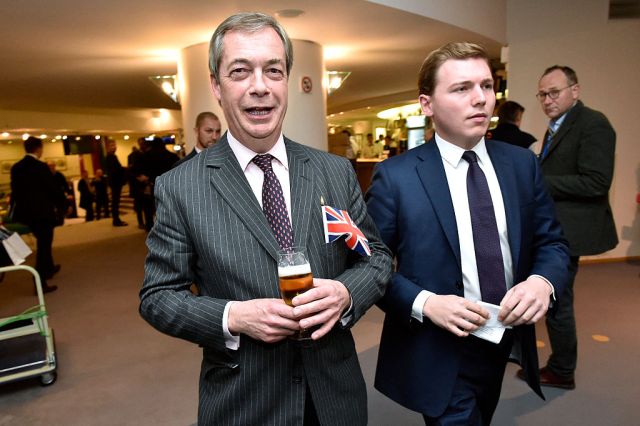
Nigel Farage with George Cottrell. (John Thys/AFP/Getty)





Seeking to avoid scrutiny over his failure to declare millions in donations, Nigel Farage is doing his utmost to keep the focus on his anticipated re-coronation as MP for Clacton-on-Sea, with Count Binface gobbling up most of the remaining column inches. But this very British scandal has an overlooked international dimension, linking Essex to a rather different coastal locale — tiny Montenegro, the Balkan nation where key Farage backer “Posh” George Cottrell has made a home and set up a network of companies.
Montenegro, a country of just 650,000, is unfamiliar to many Britons. Yet it’s an obvious choice for get-rich-quick and money-laundering schemes. I was once driven along the casino-studded Adriatic coastline by a former Montenegrin MP on his way to do penance at a monastery for his involvement in unspecified acts of immorality: he made no bones about describing his country, one of Europe’s poorest, as a “narco-state”. Since gaining independence from Serbia in 2006, the country has similarly been designated a “mafia state” and the “weak underbelly” of Europe, a loosely-policed entrepôt where luxury yachts ply the same coastline as smuggled cigarettes and shipments of cocaine stuffed in banana boxes.
The Balkans have long held a broader political fascination for the rising global Right. This relationship dates to the Nineties, when the region was wracked by what the radical Right perceived as civilizational clashes between Christians and Muslims. Today, a more populist Right is seeking to foster relationships across these sectarian divides, linking regional governments into a truly globalized network of crypto-fueled authoritarian strongmen.
Posh George himself moved to Montenegro after his release from US federal prison, having served eight months on major money-laundering charges. He was already the UKIP deputy treasurer after his arrest on his way back from attending the 2016 Republican National Convention alongside Farage, where the then-UKIP chief had spoken in support of Donald Trump. As we now know, Cottrell went on to funnel hundreds of thousands of pounds in donations and undeclared benefits to the man he calls “Daddy”.
Meanwhile, Posh George was also putting down roots on the Adriatic coast. As excellent investigative reporting has shown, Cottrell used his move to Montenegro to establish a network of companies and crypto projects registered in Tivat, a luxury holiday destination where super-yachts tower over terracotta houses along the Bay of Kotor. What’s more, Cottrell is only one of a number of Reform-linked figures to have links to Montenegro. According to the same investigation, Tivat hosts businesses belonging not only to Christopher Harborne — a crypto billionaire and source of a controversial £5 million ‘gift’ to Farage — but also several key figures in Farage’s former Brexit Party: Gawain Towler, Mehrtash A’zami, and Samee Bhatti.
Though the issue is domestically contentious, successive Montenegrin administrations — both anti- and pro-EU — have sought to establish their country as a crypto haven, attracting figures such as the founder of leading crypto-currency Ethereum and the man behind a $40 billion ‘crypto crash’. Crypto also has a wide base of appeal throughout the Western Balkans, a region known for low trust in traditional finance, high bank fees, and endemic money-laundering. I’ve even met locals dreaming of establishing a crypto-fueled libertarian micro-nation in unclaimed ‘terra nullia’ left behind as the region was carved up following the collapse of Yugoslavia, an unrealized dream which speaks to the ideological linkage between crypto and the radical neo-Right.
There’s an obvious parallel to be drawn here with Trump’s relationship to Nayib Bukele, the El Salvadorian ruler who sought to turn the Central American country into a Bitcoin hub — while cracking down on domestic opposition and housing people deported from Trump’s US. It’s possible to imagine a similar relationship developing between pro-crypto Montenegrin premier Milojko Spajić and a future Farage-run Britain, with Montenegro perhaps offering to host deported asylum-seekers after the pattern of other Balkan countries seeking closer ties with their European partners. After all, Cottrell and his associates have been accused of illegally lending support to Spajić’s electoral campaign by providing political campaigning and strategy advice, an accusation he firmly denies.
Yet the British and global Right’s interest in the Balkans dates back beyond the crypto boom. With the collapse of the multi-ethnic Yugoslav federation, local strongmen colluded with foreign backers in both East and West to establish a fragmented mosaic of half-a-dozen ethnostates. These wars came to define the modern term “ethnic cleansing”, and culminated in the massacre of Muslim Bosniaks by ethnic Serbs at Srebrenica, Europe’s worst mass killing since the Second World War.
“The global Right’s interest in the Balkans dates back beyond the crypto boom.”</pullquote]The Muslim Bosniak forces became a focal point for global Islamist networks, as thousands of mujahideen flocked to the fight and linked up with networks that would later bring militants from around the world to join other holy wars in Iraq and Syria. On the other side of the line, institutional and radical Right-wing figures back their Christian opponents across Croatia, Serbia, Montenegro and Bosnia, similarly establishing networks that would underpin a generation of hard-Right militancy. One good example is John Kennedy, a Tory-turned-Brexit Party candidate who developed close links with Radovan Karadzic, the Bosnian Serb politician convicted of genocide and crimes against humanity. Kennedy became a familiar face on TV, enthusiastically lobbying against the Muslim cause and disseminating what Bosnia’s de facto governor Paddy Ashdown frankly termed “bullshit”.
Though the days of open warfare are over, the fringe Right continues to view the Balkans as a training-ground and ideological frontline between Christendom and the Muslim hordes beyond. Jim Dowson, Britain’s “most influential” far-Right activist, has been implicated in providing financial, practical and media support to anti-Muslim groups in Serbia, the region’s largest Christian nation and which retains close ties to its smaller Montenegrin cousin. While the far-Right uses Serbian nationalism as a vehicle for its fantasies of race war, the populist Right movement developed more substantial links with neighboring Hungary under Viktor Orbán, on the basis of similar narratives of civilizational struggle at the frontiers of Christian Europe.
Not that the situation is so simple as a binary split between evil, Christian, Right-nationalist countries on the one hand, and liberal, pro-Western Muslim nations on the other. Rather, the region remains a battleground, one where Putin’s Russia and the European Union compete for influence, as when Russian intelligence officers allegedly attempted to carry out a pro-Moscow coup in Montenegro back in 2016. Canny local politicians profit from this fragile peace, keeping inter-ethnic tensions alive while presenting themselves as the only figures tough enough to keep the region’s criminality, ethnic conflicts and illegal migration under control — a phenomenon known as “stabilitocracy”.
These figures can style themselves as nationalists or socialists, and be pro- or anti-Western, or more often a complex combination of the two. Montenegro is a case in point. Spajić’s centrist Europe Now! Movement (PES) heads an exceptionally broad coalition encompassing both pro-European and pro-Russian parties, even as it seeks to push ahead long-stalled EU accession processes while retaining his country’s historically close ties with Serbia, long seen as the bête noire of Brussels liberalism. And it’s this very pro-European party which is allegedly being backed not just by Cottrell, but also a number of other figures with links to the Brexit Party, with figures like Towler and Chris Bruni-Lowe allegedly devising PES’s electoral slogan and offering other advice.
The same seemingly contradictory dynamics are at play throughout the region. For example, another political controversy is boiling in traditionally pro-Western Albania, where the government has greenlit a Trump and Jared Kushner-backed mega-development set to concrete over a nature reserve, sparking the country’s largest protest movement for decades. Yet Kushner’s Affinity Partners firm also backed an equally controversial development in the Serbian capital Belgrade: in that case, building a luxury hotel on a site memorializing Nato attacks on the city. Here, then, are two governments at ideological and political loggerheads — yet happy to establish relationships with the global Right. In both cases, too, the powers-that-be were met with fierce domestic opposition, with locals tired of being shunted aside to make room for the mega-rich global Right.
The migration factor is also telling here. Farage has clashed with Albanian premier Edi Rama over illegal migration from the impoverished, Muslim-majority country, with the latter accusing Farage of touting false statistics over Albanian criminals in the UK and bizarrely sharing an AI-generated image of the two men wrapped in their national flags and sipping wine on an Albanian beach. Yet Rama has also colluded with Giorgia Meloni to tout his country as a potential holding pen for migrants deported from Italy. Forget Farage: even Keir Starmer sought similar arrangements, hoping to outsource Britain’s deportation centers to Albania, Serbia or Kosovo. At any rate, regional ethnic and political divides don’t neatly map onto global divisions. Rather, self-serving politicians of all stripes are united in their pursuit of lucrative relationships with the rising global Right.
In another light, then, the Right’s vision for Britain might offer a distorted reflection of the long-term prospects for Montenegro and its fellow Balkan nations. Like Montenegro, Britain will remain practically reliant on trade and migration flows with Europe to survive, even as it engages in its own hostile tussles with Brussels. But elites in both countries, each in their way at the edge of Europe, will also seek new relationships with the crypto-funded, globalized Right. Tightly-patrolled borders will combine with unregulated investment opportunities, as luxury developments jostle for space with offshore migration detention centers. From the Adriatic to Clacton-on-Sea, an international coterie of flashy Right-wingers will grow richer by the day, without offering local populations any substantial return on their promises of an alternative European order.
Matt Broomfield is a freelance journalist, PhD researcher, co-founder of the Rojava Information Center, and author of Hope Without Hope: Rojava and Revolutionary Commitment (2025).
 MattBroomfield1