




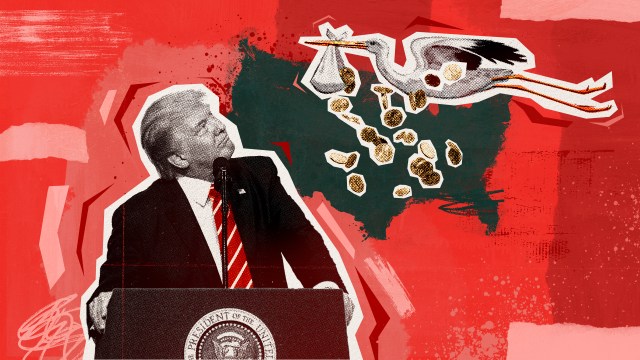





“I’m really opposed to Trump, vehemently, but it’s a free $1,000,” says Hannah, age 31, a freelance arts professional and mother of a 9-month-old in Brooklyn, New York, of her decision to open a so-called Trump Account — the new government investment account for children, which, like all things Trump, puts his name on it in order to promote his brand. Hannah also likes the initiative because, “I hear they’re trying to incentivize births because the birth rate is dropping and I think it is a good thing to provide any type of support for parents.” Hannah describes herself as “medium financially-organized,” but says that setting up a 529 — a college savings account whose earnings are tax-free — might have been “the kind of thing I thought about but never actually did.” The free money incentivized her.
The Trump Accounts went live on July 4, and Hannah’s daughter is among the 6 million children whose parents have opted in, so far, but they may not be getting what they bargained for.
Most parents, like Hannah, are thrilled to have an opportunity to invest in their child’s future. Tax attorney and retirement-planner Adam Bergman, founder of the IRA Financial Group, claimed his children will “be tax-free millionaires.” Others are a little skeptical of the Trump connection. Hannah says her partner criticized her for setting up the account. “He was like, ‘Trump’s name is on it, you never know who they’re tracking with that,’” she says. Some, also, are worried that this will be yet another empty promise, like the savings from DOGE and tariffs.
In promoting this plan, Trump told the nation, “We’re doing something much better than giving the next generation a handout. We’re giving them ownership of America’s future.” But in January, Secretary of the Treasury Scott Bessent said the quiet part out loud. Trump Accounts, he proclaimed, would “render socialist notions moot by making every citizen a shareholder.” He called the program “the largest merger in history between Main Street and Wall Street,” and for once the hype was accurate, because a merger is exactly what the accounts are, and in a merger, somebody is always the acquirer.
All children under 18 can be enrolled, but a Trump bonus of $1,000 from the Treasury is reserved for every citizen baby born during Trump’s second term, roughly 14.3 million children, about $14.3 billion. The funds will be invested in S&P 500 index funds and held at Bank of New York Mellon until the child is 18, and then converted into an IRA. Parents open the account with IRS Form 4547 or at TrumpAccounts.gov; the activation notice arrives from no-reply@TrumpAccounts.Treasury.gov, which is its own small poem. The tracking app was designed in partnership with Robinhood, the firm that put confetti animations on stock trades until regulators objected, and the app’s projection screen shows a parent what patience purchases: $6,000 or so by 18, $243,000 by 55, assuming historical returns and no further deposits. Fifty-five: the horizon of reward offered to a person three weeks old is the far side of her working life.
Then comes the private money, stacked on top like a christening gift from people the child will never meet. Michael and Susan Dell have pledged $6.25 billion to put $250 into accounts for some 25 million children in ZIP codes below a median income threshold. Barbara and Ray Dalio, billionaire investor and founder of Bridgewater Associates, put up $75 million for Connecticut’s children. Micron announced $250 million, with the president himself relaying the news. More than 50 companies, SoFi and Charter and BlackRock and Charles Schwab among them, have promised to match the federal $1,000 for employees’ children, and the press releases all strike the same notes of opportunity, ownership, and the American Dream, in the cadence of a benefits enrollment packet. Which, structurally, is what the accounts are.
The offer is in many ways an old one. Every time American capital has faced a crisis of legitimacy, it has responded by offering the public a sliver of ownership instead. Not power over the enterprise. Not a claim on its governance, and certainly not a raise. There is no recognition of the labor. A share: the smallest unit of belonging that capital can issue without changing anything about itself. Shareholder democracy is the recurring ideology of wage defeat, and you can date its recurrences by the troughs of labor’s fortunes the way a geologist dates strata.
Consider the last time the phrase “every citizen a shareholder” ran this hot. In 1954, the New York Stock Exchange, under its then-president G. Keith Funston, launched a campaign called “Own Your Share of American Business.” The Exchange had a problem: hardly anyone owned stock. A Brookings census commissioned by the NYSE itself had found only about 6.5 million adult shareowners in 1952, a small percentage of the population. So, the Big Board went into mass-merchandising mode. Its Monthly Investment Plan let a family buy into the market for as little as $40 a quarter, stock on the installment plan, like a Frigidaire.
Theodore Repplier of the Advertising Council, back from a world tour and convinced that “capitalism” carried an unpleasant odor abroad, rebranded the American system as “people’s capitalism,” and Eisenhower endorsed the phrase for worldwide use by the United States Information Agency. The campaign was test-marketed on Americans themselves at a 1956 exhibition in Washington, in cheerful defiance of the Smith-Mundt Act’s ban on domestic propaganda, before being shipped to trade fairs on several continents. The exhibit’s message was that the United States had dissolved the class question: here the worker was a capitalist, and so there was nothing left to fight about. Yet a 1958 American Economic Review article found that stock ownership remained radically concentrated at the top. The campaign was a success: not at making workers rich, but at its real aim of making the question of who got what sound obsolete.
That is the ancestry Bessent was claiming in January, whether he knew it or not. The people’s-capitalism campaigns flourished in the 1950s precisely because the wage question had been settled, temporarily, by the thing the campaigns never mentioned: a third of the workforce in unions, and contracts with wages high enough to afford the suburbs. Ownership talk was the dessert, not the meal. The next recurrences, however, came when the meal was being taken away.
Peter Drucker, business and management guru, announced in 1976 that “pension fund socialism” had arrived: workers would own American industry through their retirement funds. Yet at almost exactly that moment, the industrial order that funded those pensions began to be dismantled. The rise of globalism, coupled with neoliberalism, created an economic order that saw American manufacturing offshore at an alarming rate. By the next decade, companies like GM had more pensioners than employees. Two years later, Congress wrote section 401(k) into the Revenue Act, a technical provision for deferring executive bonuses, and by the early 1980s, a benefits consultant named Ted Benna had convinced employers that it could become the replacement for the pension itself. The defined-benefit pension was a claim on an employer. The 401(k) is a claim on the market. The transition was narrated, throughout, in the language of ownership, empowerment, and choice, and it moved decades of market risk from firms onto households, which is not a side effect of the design but the design itself.
Each new scheme came with changes to other retirement plans or Social Security, in addition to changes in other benefits. In the long term, they were never pure additions. So, while the Trump Accounts do not mention a bait and switch, we should be mindful of the history lesson behind these efforts.
George W. Bush gave the pattern its most candid name. He proclaimed the “ownership society” as manufacturing employment cratered and the union share of the private workforce slid toward single digits. His centerpiece, unveiled in 2005, was the plan to partially convert Social Security into private accounts. That campaign failed. The Trump Account is the same proposal approached from the other end of life. You could not persuade a 60-year-old to trade her guaranteed benefit for a portfolio, but a newborn needs no persuasion. Michael Lind, no man of the Left, has already made the blunt version of this point: accounts like these will furnish politicians with a standing excuse to cut the universal programs.
The honest counterargument deserves its paragraph, though. Compounding is real; $1,000 at historical equity returns genuinely becomes a meaningful sum over five or six decades, and universality is nothing to sneer at, since the program reaches the children of parents who would never open a 529, with no means test and no stigma. A baby in the poorest ZIP code in Memphis could now hold the same instrument as a baby on the Upper East Side. All true, and all beside the structural point, because the instrument is identical, but the machine attached to it is not. Contributions can run to $5,000 a year, which means the account compounds family wealth wherever family wealth exists and compounds the initial $1,000 wherever it does not. The projection screen shows every parent the same curve. The curve will be climbed by the children whose grandparents can feed it, which is to say the account does not offset the existing distribution; it is a multiplier sitting on top of it.
And notice what the multiplier runs on. The heartbeat of this plan is the S&P 500’s returns; thus, the very returns the app so cheerfully projects are in meaningful part the earnings that firms retain by holding labor costs down, automating when possible, and buying back their own shares. The newborn shareholder’s interests have been enrolled, from the crib, on a particular side of a particular ledger. This is the part of the program that deserves the word ideological, used precisely. American elites rarely bother suppressing opposition when they can reorganize identification instead. The Trump Account redistributes almost no wealth; the Treasury’s own thousand is a rounding error against the contribution architecture above it. What it redistributes is a point of view. The child will grow up checking a balance whose health depends on the market’s side of every fight she might otherwise have joined. Welfare capitalism used to do this with company stock and a company picnic; the historians among us wrote books about it. Now it arrives by app, with an employer match announced in a press release, and the company picnic is a push notification.
Meanwhile, hold the offer up against what is not on offer. Real wage growth is flat, and prices are still too high for the average American. No one in Washington is proposing that the newborn’s father be paid more, or that his schedule be predictable, or that his warehouse recognize a union. The proposal on the table is that his daughter own 11 basis points of the warehouse’s landlord. There is a genuine political theory in this, and Bessent stated it without blushing: make every citizen a shareholder. Thus, ownership talk answers the wage question by changing the subject, as it has now changed the subject four times in 70 years.
Which returns us to the child. Civics used to be a set of claims about what citizens owe each other; the Trump Account is a claim about where security comes from, installed before one has the ability of speech. She will learn, from the first time her parents check the app, that her future is a balance; that the balance moves for reasons no one around her controls; that patience is the whole of virtue and 55 the horizon of reward; and that the government’s founding gift is a trading position. A position must be held. Holders do not strike, do not agitate, do not ask who set the terms; they wait, and check the screen, and hope. That is the citizen the account is designed to produce, and the design will work on many. The $1,000 is real, the compounding is real, and so is the lesson.
We have decided to tell American children where they stand by opening the market to them at birth. They will spend the next 55 years watching an app to check their standing, but will find out that the market was never the thing that stood for a decent or happy life. It was simply the thing that got there first.
And parents, of course, don’t have a better option, or aren’t aware of one. “Real parents, Left or Right, don’t have time to get involved in labor activism,” Hannah says. “We’re just working and investing and trying to set our kids up for the best success rate.”
And so, the republic, in its 250th year, has settled its account with the newborn. Not a nursery, not a clinic, not a school, not her father’s raise; a custodial 530A, managed by Bank of New York Mellon, gamified by the makers of the confetti trade app, topped up by a chip company’s press release. She is three weeks old and already long the S&P. Her first civic document arrived from no-reply@TrumpAccounts.Treasury.gov, which is the entire social contract in a sender field: here is your stake, do not write back.