




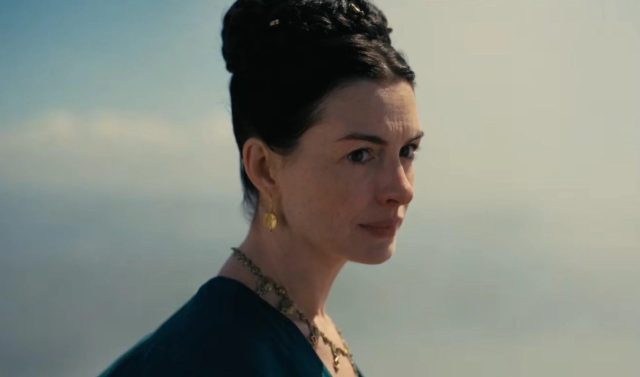
Anne Hathaway as Penelope in The Odyssey. (The Odyssey/IMBD)





When an enormous Hollywood blockbuster is extruded, the actors cast in it are employed to put on a sage voice and discuss its importance. Lupita Nyong’o took up the challenge to promote the latest version of The Odyssey, declaiming to an appropriately awed interviewer: “When you read the Iliad and the Odyssey, very little time is spent in the perspective of the women. It’s told from a very masculine side of things.”
Nyong’o is an educated woman, who holds a bachelor’s degree in film and theater studies from Hampshire College, Massachusetts. She is a very 2020s figure, and naturally, roaming around in search of something to say, wasn’t satisfied until she found a class of people who she might be able to present in the light of Victimhood. As for the lack of “the female perspective”, she might have forgotten for the moment that the Victorian writer Samuel Butler was so struck by the highly feminine character of the Odyssey that he wrote an entire book on the subject. It was dedicated to the proposition that if a man called Homer wrote the Iliad, it was quite a different writer from the one who set down the Odyssey. This author was familiar with the Iliad, but the approach, the psychological framework, the patches of intense knowledge and total ignorance led the very learned Butler to one conclusion. The Odyssey, far from being “told from a very masculine side of things”, was strongly suggestive of being written by a woman. Butler’s book was called The Authoress of the Odyssey and was published in 1896.
Butler was a wonderfully intelligent and puckish mind, quite indifferent to generally accepted conclusions — he was homosexual, and skeptical of conventional proprieties. In 1863, he published an essay entitled “Darwin Among The Machines”, wondering what would happen to the human race if machines acquired the ability to build themselves, and acquire the processes of intelligent self-improvement — a remarkable warning about AI from 160 years ago. His excellent short novel The Fair Haven is a grossly sarcastic religious treatise that first fooled everyone who read it, and then utterly enraged them. He withheld his outrageous novel The Way of All Flesh to be published after his death in 1902, one of the funniest eviscerations of religious hypocrisy ever written.
Unlike a Hollywood actress putting on the voice of a great thinker at work, he didn’t care what people thought. The Authoress of the Odyssey is a brilliant mounting up of evidence, and a compelling and complex set of ideas about what animates male and female writers. Whoever wrote the Odyssey, it argues, had very little idea about the construction of boats, putting rudders at both ends, about how sheep feed their young, about the sound of wind at sea, about hawks tearing prey apart, and evidently believed that “dry and well-seasoned timber can be cut from a growing tree”. On the other hand, though evidently barred from practical matters that men would have no difficulty with, the author realizes immediately what it would mean to kill a large number of suitors in a banqueting hall, and that the first thing that “Homer” thinks of after the bloodspilling is “the dining room carpet”.
Butler notices, too, that it is exclusively the men who are mocked in the poem. Excuses are constantly found in a sympathetic way for the women, and laughter never falls upon them. In other Greek tellings of the story, Odysseus’s wife, Penelope, has her scandalous behavior condemned. Butler notes how “Homer” “whitewashes” Penelope, and puts it down to sex-based fellow feeling. It is an ingenious and very learned book, which rests on the knowledge that, in fact, there were plenty much-admired women poets in the pre-Athenian age of Greek poets — not just Sappho, but Damophila, the Paphylian and Erinna of Telos among many others. Butler’s marshalling of evidence suggests that, even if his premise isn’t true, there is, at the very least, a “perspective of women” in the Odyssey. So why say something so evidently absurd as “it’s told from a very masculine side of things”?
In Kingsley Amis’s 1978 academic comedy Jake’s Thing, an angry English don reports an encounter with an undergraduate essay on Shakespeare. “Her case was roughly that since Hamlet is far too nice and intelligent to be a man, he must be a woman because there’s nothing else to be.” Things have moved on: that undergraduate would these days be hauled over the coals for ignorance of non-binariness and accused of transphobia. But the underlying sense that the attitudes of the past, and the quality of their writing too, were appallingly limited until some present-day enlightened figure came along to put things right has only sharpened in the last half century of increasing orthodoxy. Of course, we can improve on Homer, and Shakespeare too!
The duty of improvement is so imperative, moreover, that we no longer need to read the great epics we’re improving on, let alone books of commentary by someone as intelligent and well-informed as Samuel Butler. Butler foresaw ChatGPT in 1863. He had no difficulty whatsoever in telling us about the limits of people many decades in the future, talking confidently about one of the great classics of literature. “Every scholar has read a Book of two of the Odyssey here and there; some have read the whole; a few have read it through more than once; but no one that I have asked have so much as been able to tell me whether Ulysses had a sister or no — much less what her name was.” So, Lupita, did he have a sister? I mean, before you start ticking off one of the greatest poets in world literature about his interest in women, presumably you took so important a question into account?
Philip Hensher is the author of 11 novels and a Professor of Creative Writing at Bath Spa University. His new book, A History of the Novel in Britain, will be published by Pelican in September.
 PhilipHensher