




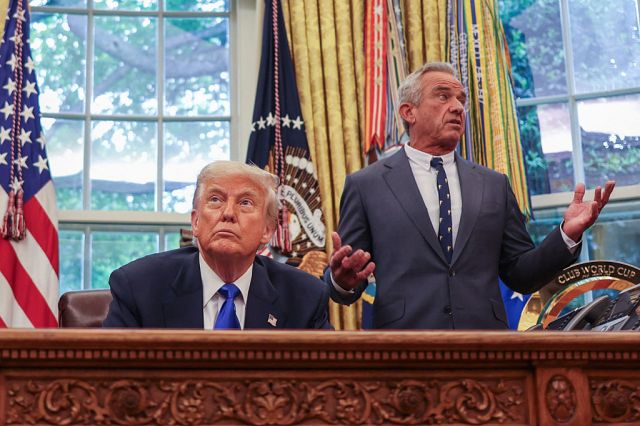
President Trump and HHS Secretary RFK Jr. exemplify populist dysfunction. Credit: Getty





The rise of President Donald Trump has transformed the Republican Party, moving it in a populist direction. On the Left, we see the rise of figures like Maine senatorial candidate Graham Platner and other DSA-affiliated candidates, indicating that the Democrats might not be far behind.
While much has been written about the rise of populism from the American perspective, what we are witnessing in the United States is part of a global phenomenon.
Just months before Americans first elected Trump, the British public voted to leave the European Union, a move that had practically no support among media, academic, and political elites. The Populism in Power database shows an approximately fivefold increase in the number of populist leaders and parties ruling over democracies between 1990 and 2019.
An analysis of six major democracies — the UK, the US, Australia, Germany, France, and Canada — reveals a significant decline in support for traditional center-Left and center-Right parties, dropping from about three-quarters of the vote share in 2000 to just over half in 2024.
Latin America is also seeing one of its perennial populist waves, and populism is even making inroads into Asia. Ruling elites even in nondemocracies, such as Putin’s Russia, are adopting aspects of populist rhetoric as legitimization strategies.
Beyond how we feel about any particular candidate or party, perhaps the political question of our time is whether we should embrace or reject this trend. Approaching this topic from a social science background, my inclination is to first look for data. Practically all of it points to the lesson that countries should avoid populist leaders if they want to maintain freedom and achieve economic growth. How do we know this? Ideally, you’d have randomized experiments where you assign some countries to be ruled by populists and others by normal leaders.
Since we can’t do that, we have to go by theory and observation. When theory and observational outcomes point in the same direction, then we might think we know something about the world, though it depends on the plausibility of the theory and the strength of the relevant correlations. There have never been randomized controlled trials establishing that smoking causes lung cancer, but I would bet my life that it does.
Before we even begin on this topic, however, the first thing we have to do is ask: what even is populism? The political scientists Cas Mudde and Cristóbal Rovira Kaltwasser settle on the definition of “a thin-centered ideology that considers society to be ultimately separated into two homogeneous and antagonistic camps, ‘the pure people’ versus ‘the corrupt elite,’ and which argues that politics should be an expression of the volonté générale (general will) of the people.” This seems like it would lead to a lot of debates. Was President Barack Obama a populist because he talked about rich people and the working class? Did he present each class as “homogenous” enough and did he do enough to declare them “antagonistic”? Maybe you can make a case that every major politician this side of retired US Sen. Mitt Romney (R-Utah) is populist according to this definition.
In practical terms, however, when scholars make lists of populist leaders, they basically agree on who qualifies, and examples come from the Right and the Left, which means we can’t tell a simple story of political bias. Trump, former Hungarian Prime Minister Viktor Orbán, former Venezuelan President Hugo Chávez, and former Bolivian President Evo Morales all count, no matter who you ask. Standard definitions of populism are fuzzy and create edge cases, and often disagree with one another, but this is a common issue in politics, and one can say similar things about concepts like democracy and nationalism.
“I know it when I see it” can be fine as a standard in social and political analysis. There is definitely an essence that Trump and Venezuelan President Nicolás Maduro, currently in US custody, share, which former US President Joe Biden and current German Chancellor Friedrich Merz do not. Since analysts agree on who populists are, we can undertake observational studies and see whether such leaders being in power is associated with worse outcomes. Perhaps the most comprehensive paper to do this is “Populist Leaders and the Economy”, published in the American Economic Review, arguably the most respected journal in economics. The authors found that between 1990 and 2020, a country being ruled by a populist is associated with a 10% lower GDP after 15 years relative to a reasonable counterfactual.
Left-wing populists do worse, which is not surprising, given that they have a deeply flawed understanding of economics. So ideology as traditionally understood matters a lot, but populist rule still has its own independent negative effect.
What about non-economic indicators? Here the news seems to be even worse. In a report for the Tony Blair Institute, journalists Jordan Kyle and Yascha Mounk investigated the period from 1990 to 2018. Populists over that time degraded checks and balances, and were four times more likely than other leaders to preside over democratic backsliding. In fact, of the breakdowns of democracy that the world has seen since the end of the Cold War, excluding those involving foreign interference or in countries with a GDP per capita of less than $1,000 a year, two-thirds occurred under populist leaders. Such leaders were also bad for freedom of the press and civil liberties. Perhaps most remarkable of all: 40% of populist leaders ended up charged with corruption. This is despite the fact that they often try to stack institutions in their own favor.
When The Economist made a list of countries with the highest ratio of negative to positive years of growth between 1950 and 2023, the top eight were Libya, Argentina, Syria, Iraq, Chad, Congo, Sudan, and Venezuela. As I’ve previously written, “This is not a list anyone wants to be on. That’s six countries in Africa and the Middle East that have experienced civil wars, and two Latin American nations that did it to themselves through Leftist economic policies.” Venezuela and Argentina have mostly been democratic throughout this time period, without suffering anything close to the level of intrastate violence seen in the other nations on that list. Interestingly, most communist countries have shown a better ability to correct their issues than Venezuela and Argentina. Populist democratic socialism seems to be an unusually good way to keep a country economically dysfunctional in the long term, since communist regimes usually end up collapsing like they did in Eastern Europe or reforming as China and Vietnam have. Of course, when they don’t do either of these things — think North Korea and Cuba — their outcomes are worse than what you get with any form of populism even in the long term.
Another data point is what has happened in the UK since Brexit. Stanford economics professor Nicholas Bloom and his coauthors found that by 2025, simulations based on the performance of comparable countries indicate that GDP per capita was 6% to 8% lower in the UK than it would have otherwise been, with investment down 12% to 18%. Firms that were most exposed to European markets were hardest hit. The UK was at about the tenth percentile for growth among the 33 other countries analyzed since the second quarter of 2016. The authors note that their paper likely underestimates harms, since the countries they compare the UK to were themselves hit by Brexit, making the one that actually left the EU look better by comparison. Brexit did not involve the victory of a populist leader, but it was a shock that caused the enactment of a major populist policy, one that had practically no support among traditional elites. The results look similar in kind to what we get when publics elect populists into office.
That’s the empirical evidence. What about theory? It’s much easier to come up with a plausible story of why populism would be bad than one showing why it would be good. Let’s say you believe that elites have made a lot of mistakes. They are self-dealing and corrupt, the media is lazy and has a Left-wing bias, and intellectuals write to impress one another and are cut off from reality. That can all be true. The question is why anyone would think that a leader whose only claim to power is a direct connection to a mass audience would be better. Or that the kinds of people such a leader should be expected to mobilize would be preferable to old elites.
Experts who abuse their authority to push a political agenda should certainly be held to account. At the same time, it is impossible to deny that gatekeepers are usually right. There is a general tendency to focus too much on the man-bites-dog cases, such as claims made by credentialed elites that trans women have no advantage over biological women in athletic competitions, or that the US is a white supremacist nation. Most of the time, media and academic elites are gatekeeping views that are clearly false and often harmful. Among these, to take a handful of examples of beliefs promoted or given a respectful hearing on The Joe Rogan Experience, the most successful podcast in the country, are the following ideas: there is an ancient city beneath the Giza pyramids; HIV doesn’t cause AIDS; there were advanced human civilizations that predated those accepted by archaeologists and historians; 9/11 may have been a government operation; mind reading is real; Covid vaccines are more dangerous than the disease itself; and humans became more susceptible to polio due to vaccination.
You might oppose elites on completely reasonable grounds, but creating a political culture in which expertise is rejected as a general matter leads to a decline in intellectual and moral standards, as we’ve seen happen in populist movements across the world.
Sometimes, the elites of a country truly are bad enough to justify grabbing onto almost any alternative. We have seen this in the case of Argentina. It is the one nation that has such a deep history of populism that populists themselves became the establishment. And we have seen the results: a country that, in the early 20th century, was as wealthy as major European powers is now no longer even in the category of advanced nations. So President Javier Milei comes along as a populist with a libertarian agenda, and is probably worth supporting. Even though he is surrounded by the kinds of scandals that dog other populist leaders, the combination of his sensible economic views and the degree to which Argentine elites have failed makes this an unusual case. Populism usually being bad doesn’t mean it is always a negative, and we have to exercise judgment in individual cases.
More typical than Milei is someone like Trump, whose critique of the establishment of his country is that they are too pro-market and globalist. While Milei slashes tariffs, Trump enacts new ones and goes beyond any previous president in taking ownership stakes in major corporations. Even if Trump enacts more sensible economic policies than his opponents on average, that has to be balanced against the costs of higher levels of corruption and institutional decay, along with generally opening up the government to cranks, from anti-vaxxers to nativists who believe that America belongs to white Christians alone.
Populist movements don’t simply reduce the power of elites, but raise the status and influence of a new group of people. Ten years ago, it would have been rational to criticize The New York Times for getting things wrong and to not worry too much about what conspiracy theorist personalities were saying. Today, the Joe Rogan Experience and other low-quality sources of information have influence comparable to that of the mainstream media. Independent journalist Nick Shirley’s video on Somalis in Minnesota ended up having major policy consequences, leading the Trump administration to open investigations and begin a crackdown on illegal immigrants in Minneapolis. This made little sense as a policy matter, since Shirley’s shoddy reporting had nothing to do with the immigration status of people living in that state, and few Somalis are here illegally. But this is the kind of policy-by-word association you get under populist rule.
The fact that alternative media and influencers are increasingly powerful means that you now have to apply a more critical eye to their beliefs and behaviors. Is US Health and Human Services Secretary Robert F. Kennedy, Jr. more or less important than the American Medical Association? The latter might still matter more in the long run. But their power levels are at least in the same ballpark. Same thing if you are weighing the virtues and flaws of The Wall Street Journal versus political commentator Tucker Carlson, or Federal Bureau of Investigation Director Kash Patel versus the American Civil Liberties Union. Conservatives could once laugh off these comparisons, adopting the argument that the establishment had more power so its flaws are the only ones that matter — ironic, given conservatives’ hatred of these types of arguments when made by postmodernists. One can imagine them adopting the mantra: “misinformation is poor journalism plus power.” But we’re not in that world anymore, and sometimes populism achieves so much success that its figures must be judged by the same standards we once applied to organic elites.
We have now arrived at that moment. And the historical record is clear. Whatever problems your country is facing, populist parties and candidates are rarely the answer.
This essay was adapted from the author’s book, Kakistocracy: Why populism ends in disaster, published July 7 by Broadside Books.
Richard Hanania, an UnHerd columnist, is the president of the Center for the Study of Partisanship and Ideology and blogs at Substack.
 RichardHanania