




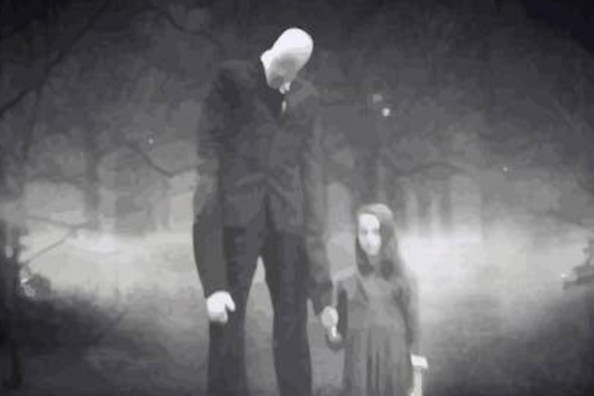
Slenderman: If only you hadn't looked back. (Creepypasta)





Imagine a portal you can pass through at will. On the other side, there’s a world that resembles this one in many superficial ways, but there’s an uncanny distortion to it. The rules of physical space have been suspended. It’s populated by corrupted facsimiles of people, their humanity doubtful. The longer you spend here, the more you, too, will be corrupted. And though there’s a pervasive feeling of unreality, the harms you undergo will be very, very real.
This could be a metaphor for the internet; but it’s also the set-up for the horror movie Backrooms. Three things make the film notable. First, it’s phenomenally successful: it has just broken $300 million in global box-office takings. Second, its director is phenomenally young: Kane Parsons was 20 when the film was released in May. And third, Backrooms marks the moment that creepypasta crossed definitively into the entertainment mainstream.
What, you might be asking, is creepypasta? And can you eat it? Well, no. Creepypasta is sometimes used as a catch-all term for any horror story published online, but a more precise definition is that it’s a kind of horror story that could only exist online: a collaborative venture into the uncanny that deploys the structure of the internet to generate fear. Creepypastas grow on message boards and wikis, usually created in-character (with users posting as though the fictions they’re describing are real), and are expanded in videos and podcasts.
The term derives from “copypasta”, itself a corruption of the term “copy-paste” that emerged on the image board 4chan in 2006 to refer to blocks of text posted there (copied and pasted) by internet users. A year later, the word creepypasta emerged to specifically designate scary copypastas. That makes them sound like a 21st-century spin on the old chain letters — the ones that instructed you to forward this message to 10 other people, or suffer a horrible fate. But creepypastas have a power to disturb that goes far deeper.
They feed off the glitchy, uncertain way that information is reproduced online. Distortion might be the result of saving and reuploading a picture multiple times, or it might have been deliberately tampered with; or it might, if you’re feeling susceptible, be an authentic document of an unnatural event. Whole horror lores can even be spun out of innocuous bits of media which become sinister purely because they’ve been shorn of their context — like the photograph that inspired the Backrooms creepypasta.
In 2002, an old furniture store was being renovated; because it was 2002, someone decided to document the process on a blog, with photos of the cavernous, yellow-wallpapered space. And that was the end of that, until 2019, when a poster on 4chan put out a call for “disquieting images that just feel ‘off’”. Someone responded with one of the sickly pictures of the empty store, taken at a slightly odd angle: not scary, but definitely unheimlich. (It would be 2024 before the source of the picture was identified.)
Someone else replied with a brief but vivid horror scenario that would set the terms for everything that the Backrooms mythos would become: “If you’re not careful and you noclip out of reality in the wrong areas, you’ll end up in the Backrooms, where it’s nothing but the stink of old moist carpet, the madness of mono-yellow, the endless background noise of fluorescent lights at maximum hum-buzz, and approximately six hundred million square miles of randomly segmented empty rooms to be trapped in. God save you if you hear something wandering around nearby, because it sure as hell has heard you.”
From this germ, a whole fictional universe proliferated across Reddit, wikis and Discord. There was even a split in the community between those who were interested in roleplaying and lore-building, and those who declared themselves “truebackrooms”, with an interest in the specific aesthetic that gave the Backrooms image its sinister charge. In 2022, Parsons began uploading his Backrooms series to YouTube — an incredibly accomplished “found footage” horror, which became the genesis of the Backrooms feature film.
One of the particularly unsettling aspects of the Backrooms creepypasta is the idea of “noclipping out of reality”. Noclipping is a concept taken from video games: when an error in the programming allows a character to pass through a seemingly solid object, they’re said to have “noclipped”. So while the concept of being lost in infinite backrooms is pretty horrific, there’s also the unpleasant implication that the real world has begun to behave like a video game. The physical and the digital bleed into each other in the Backrooms.
That’s also true with one of the other breakout creepypastas. Slenderman is a hauntingly tall, skinny and faceless figure who is said to control his victims’ minds. That is, he infects his target’s consciousness as a computer virus does. Like the Backrooms, Slenderman has a known origin: another image challenge, this time on the board Something Awful in 2009. A user called Victor Surge (real name Eric Knudsen) posted two pictures of children with an elongated, faceless form lurking in the background.
The first was captioned: “we didn’t want to go, we didn’t want to kill them, but its persistent silence and outstretched arms horrified and comforted us at the same time…” The caption on the second claimed it had been recovered from a library fire, and implied an authority cover-up. It also coined “the Slender Man”. This was explicit, deliberate storytelling using established horror and folklore tropes: with echoes of the Pied Piper, Beowulf’s giant monster Grendel and Jack Skellington from The Nightmare Before Christmas, Slenderman felt horribly familiar.
Consequently, he captured something in the collective imaginary: it was almost as though he had always already existed, and was just waiting to be named. (When I was a child in the Eighties, I had a recurring nightmare about a character who looked a lot like Slenderman.) Slenderman inspired a long-running YouTube mockumentary series called Marble Hornets; multiple alternate reality games using clues scattered across media and a character in the video game Minecraft. You can take questionnaires to learn if you have the “slender sickness”: headaches, nosebleeds and fatigue are all signs that Slenderman has fixed his malevolent attentions on you.
In 2014, Slenderman was also implicated in the attempted murder of a 12-year-old girl in Wisconsin by two of her friends who believed that they could become Slenderman’s proxies (and protect their families from him) by providing a sacrifice. The stabbing of Payton Isabella Leutner by Anissa Weier and Morgan Geyser generated, inevitably, an international moral panic, some of it justified: just how much were parents aware of the content their children might be consuming unsupervised in their devices? (YouTube, where Weier and Geyser absorbed much of their Slenderman media, did not launch YouTube Kids until 2015. When Weier and Geyser went on their tablets, there was no delineation between age-appropriate and inappropriate videos.)
Some of the coverage around the attempted murder, though, appeared to be under the impression that Slenderman really did have the occult powers of mind-control that Weier and Geyser had credited him with. Overheated commentators acted as though a demonic force had been unleashed into the brains of children by the internet. In reality, though, the two perpetrators were sadly vulnerable girls. Geyser had untreated early-onset schizophrenia with vivid delusions. Meanwhile, Weier had been bullied and isolated until she met Geyser: in her police interview, she explained her actions by saying she hadn’t wanted to lose the friendship.
Weier and Geyser, then, had noclipped out of reality. They were lost in the Backrooms of their shared fantasy. When they were arrested, they had been attempting to walk to “Slender Mansion”, the supposed home of Slenderman which they had decided was actually located in the Chequamegon-Nicolet National Forest. In footage of them after their arrests, they earnestly describe Slenderman’s abilities. Within their private game, Leutner had been reduced to the status of a non-playable character — a prop without her own inner life.
Each generation creates the monsters it needs, or perhaps the monsters it deserves: the horror genre is a kind of collective nightmare, where cultural anxieties are given grotesque form. In the 2000s, the idea of being stalked by a faceless humanoid who could manipulate your brain made instinctive sense to internet users: by placing yourself online, you created a digital version of your own psyche that could be rifled through by malicious anons, and abused. Slenderman stole children, and the internet seemed to be stealing them too.
In the film Backrooms, the monster isn’t a character — it’s a place, and what happens to you when you’re in there. Our current contemporary nightmare isn’t the creature that stalks you. It’s the possibility of slipping into a parallel dimension and never being able to come back. Everything that exists in the Backrooms is an echo of something outside them, but distorted, like degraded digital copies, or AI hallucinations. The characters who enter the Backrooms are initially repulsed by their strangeness, but some end up seduced by them: the Backrooms feel more real than the real world.
For the director, who is young enough to have grown up fully online, this must be a very recognizable kind of horror. Like the Backrooms, the internet is a place designed to make you lose your bearings, as you click from link to link or scroll from post to post until you’re deep down a rabbit hole with no way of retracing your steps. It’s also a place where you can lose yourself, psychologically and morally: an infinite version of the Overlook Hotel in The Shining, where every corridor draws you deeper into your own corruption.
Maybe it’s not a coincidence that, as well as birthing creepypasta and myriad other forms of internet culture, 4chan and SomethingAwful have been the factories for some of the most heinous online tendencies. The writer Dale Beran (in his book It Came From Something Awful) describes these boards as incubators for the memeified far Right. 4chan in particular became characterized by a deep nihilism, where anything — from child pornography to suicide to school shootings — could be treated as a joke.
For most, this was edginess without intent. For others, it was a staging ground for real world violence: in multiple cases, mass shooters or murderers have announced their intentions or documented their crimes on 4chan. The distorted norms of the site meant that they expected, and sometimes received, applause for their acts. Maybe the fellow users cheering for killing were evil by nature. More likely, their absorption into the parallel world of message boards had fractured something in their sense of right and wrong.
Though it’s set in 1990 (and its characters consequently use no technology more advanced than a fixed-line telephone), Backrooms is probably the most accurate film about the internet ever made. It’s terrifying, not because its world is frighteningly alien, but because its world is frighteningly familiar: like the characters of the film, we are all constantly being seduced by what’s on the other side of the portal. The online realm is real, even if it doesn’t exist as space or matter. We’re all lost here, and the longer we stay, the more monstrous we become.
