




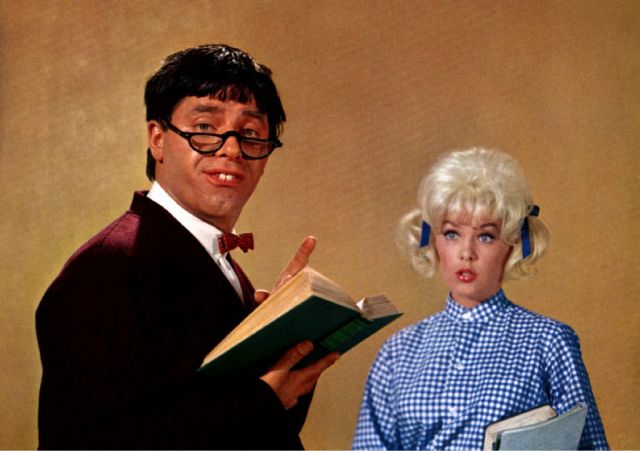
Students are fleeing education — for good reason. Credit: Getty





The movie The Nutty Professor, both the original 1963 version starring Jerry Lewis and the successful remake by Eddie Murphy in 1996, is about a genius professor, obese but kind, who develops a potion that turns him into a handsome, manipulative womanizer.
Today, the education industry is no longer marginal and the university faculty no longer fits the awkward-brainiac stereotype. Professors have become powerful politically — they are the core of the progressive wing of the Democratic Party, and they predictably hold Leftist views, treating us to spectacles such as the University of Michigan faculty senate accusing Secretary of War Pete Hegseth of “war crimes.” Much of the Leftist elite, in fact, comes from academia — for example, Sen. Elizabeth Warren taught at Harvard Law School for 20 years, and New York City Mayor Zohran Mamdani is the son of a famous radical academic, who teaches at Columbia University.
Meanwhile, Luigi Mangione, the Left’s favorite alleged assassin, has two degrees from the University of Pennsylvania, an Ivy League institution. The parents of Katie Wilson, Seattle’s new socialist mayor, are both professors. Globally, elite university graduates have been the primary promoters of the most hysterical climate change theses, epitomized by British politician Ed Miliband, an Oxford graduate and Labour MP, who has served as the UK’s Secretary of State for Energy Security since 2024, and who is clearly oblivious to the economic consequences of his “net zero” fanaticism.
However absurd its beliefs, what academia thinks and how it imposes its ideology matters. Leftist professors are shaping generations, sending youth into the world spouting the standard progressive script and displaying proud ignorance of the achievements of Western Civilization.
Virtually no major job category is more uniform in ideology. In 1990, 42% of professors identified as “liberal” or “far Left,” according to survey data by the Higher Education Research Institute at the University of California, Los Angeles. By 2014, that number had jumped to 60%. Today, roughly three-quarters of faculty are left of center, a trend that feeds on itself in hiring; even moderates are rare. Since 2002, at least 70% of political contributions from academics have gone to Democrats; the University of California faculty and staff sent $10 million to Democrats in 2004, but less than $300,000 to Republicans. Even at DePaul University, America’s largest Catholic university, almost 90% of contributions went to the Left.
This political skewing has the effect of turning universities into ideological re-education camps. For example, prominent schools of journalism, including those at Columbia and the University of Southern California, have moved away from teaching the fundamentals of reporting and now openly advance a social justice agenda. This enforced conformity isn’t good for students, or the quality of the pedagogy. Even some progressives, like the legal scholar Cass Sunstein, recognize that “students are less likely to get a good education, and faculty members are likely to learn less from one another, if there is a prevailing political orthodoxy.”
At the university level, students coming to class, particularly in the liberal arts, are deficient in knowledge of such things as the failure of socialism in the USSR or the repressive nature of contemporary China. After all, socialism’s lethal failures are inconvenient facts for Marxist professors, who have, notes author Hussein Aboubakr Mansour, “surrendered to revolutionary kitsch.” Progressives would rather accuse Israelis, Americans, and Britons of genocide, while ignoring the fact that the greatest mass murderers in history did so under the Red banner.
In this sense, today’s academics resemble Medieval clergy — or Marxist propagandists in the old USSR — more than open-minded and flexible intellectuals. Church authorities in the Middle Ages trained clergy in the defense of orthodox doctrine in order to combat heresies, a trend that also infected the universities of the time. The University of Paris became a staunch guardian of religious orthodoxy, and in the 1300s, it held a conclave to affirm the supposed reality that demons were afflicting society.
Just as medieval universities resisted many of the ideas of the Enlightenment, today’s academics increasingly seek to banish the great liberal traditions that underpinned their own institutions’ ascendancy. And just as the medieval clergy preached against materialism, leading figures in today’s academia look askance at the idea of a dynamic economy, a spirit of innovation, and a commitment to improving everyday life. Some even suggest that progress is a myth.
These approaches have consequences. Many college students who embrace socialism do so uninformed. Graduation speakers chosen with student preferences in mind are overwhelmingly from the Left, and those few non-Leftists who haven’t been canceled, such as Jonathan Haidt, are heckled. Yet when I taught a class on socialism at Chapman University, where I teach, only one student in 30 could identify a picture of Lenin. The exception was an Armenian who grew up in Moscow.
The academy’s unwillingness to teach the failings of Marxism helps explain why a recent Yale Buckley Institute poll found that a majority of all American college students express sympathy with socialism. In a global survey covering 28 countries and almost 21,000 respondents, half of respondents at least “somewhat agree” with the statement “at present, socialist ideals are of great value for societal progress,” including 39% of American respondents.
Increasingly, university professors see their mission “to promote” a particular set of beliefs rather than “to teach,” notes British author, architect, and urban-planning expert Austin Rhys Williams. Not surprisingly, according to recent studies of cognitive behavior, today’s university graduates are inclined to maintain rigid positions on various issues. Confident of their own superior intelligence and perspicuity, students tend to be intolerant of other views. One recent study found that only 47% of people ages 18 to 34 said speech that might offend minorities should be allowed, compared with 70% of those over 55.
Yet even as academia sticks to its radical agenda, the relevance of higher education becomes increasingly dubious, particularly due to artificial intelligence, which has turned schools into factories for slop, and displaced the remaining vestiges of intellectual formation. Professors, in their turn, have been slow to recognize the threat. They often seem in their own world, more like a guild or religious cult, with arcane rituals and folkways. Half a century ago, the Russian sociologist Pitirim Sorokin called this tendency “a frantic eagerness to know ‘more and more about less and less.’” The vast majority of academic articles — so crucial for getting tenure — are almost never cited, especially in the social sciences and humanities.
After decades of surging enrollment at American colleges, the numbers are beginning to drop, a trend hastened by the shrinking population of college-age potential students. Since 2010, undergraduate enrollment has dropped from 18.1 million to 15.4 million, and the percentage of BAs headed to graduate school has fallen precipitously over the past two decades. Over the past decade, 500-plus US private colleges have closed, three times the rate of the previous decade.
In addition to the demographic reasons for the decline, students also appear to be concluding that academia is less valuable to them. At Harvard, 60% of grades are As, compared to 25% two decades ago. But this is no measure of student accomplishment: a recent NIH paper asserts that college students’ cognitive abilities are increasingly diminished by time spent online. And employers report that recent graduates are short on critical thinking skills. Overall, Gallup reports, the percentage of Americans who express “a great deal of confidence” in education has fallen in the past decade from around 60% to around 40%.
In particular, liberal arts majors are deciding their degree isn’t worth it. Producing such degrees has been a fertile source of employment for academics, but has also seemed oddly removed from basic reality. There are very few choice jobs in academia for such graduates, particularly at the tenure level. Roughly half of all faculty members today are part-timers, compared to one-third in 1987. Tenured positions have dropped from about 40% of all university teaching jobs in 1987 to around half that number in 2021. And capture by the ideological Left seems not to be helping: high-capture fields like history, English, and philosophy tend to be those that are losing the most students.
In contrast, less radicalized fields such as business, engineering, and hard sciences, although also under pressure to conform to such things as racial quotas, generally offer more promise both for students and society. And, for many, an increasingly likely option is to go to a trade school or simply get into the workforce. Both the federal government and companies such as Google, IBM, Apple, Ernst & Young, Starbucks, and Hilton, among others, are de-emphasizing credentials in favor of skills. It is in the skilled trades, as well as engineering, that the great opportunities of the future will be found. America is running low on skilled workers, doctors, and aerospace engineers; it faces no such problem with postmodernist English teachers.
These shifts may ultimately weaken the current academic elite, but they also generate a potentially dangerous class of underemployed and overeducated people. Educated professionals, particularly younger ones, have replaced blue-collar workers as the radical constituency. We are seeing what one Marxist scholar described as a “swelling population of college graduates caught in a vise of low-paying jobs.” Historically, since the popularization of higher education, such people have played a role in revolutionary upheavals in Europe, Russia, and Latin America — and, potentially, they could do so in the United States as well.
What happens at universities matters, and correcting the current situation requires a revised approach. To succeed, colleges need to focus less on activism and more on the basic task of imparting skills and educating young people as critical thinkers. Fortunately, there are some signs of a shift back to basics. This is occurring in schools such as Chapman, as well as numerous universities in the South, such as the University of Texas, the University of Florida, the University of North Carolina at Chapel Hill, and Vanderbilt University.
Simply put, we must rescue academia from the academics. This is particularly true in the humanities, where the number of doctorates has fallen by 15% in the past two decades. Rather than radical agitprop, students need a curriculum rich in classic literature and history, which naturally stresses eternal values and inspires debate.
Today, university policies on curriculum largely ignore writers such as Homer, Confucius, Shakespeare, Milton, de Tocqueville, and the Founding Fathers. Some books are scorned for having been written by dead white males, who as a group are linked to such horrors as slavery, the subjugation of women, and mass poverty.
Any return to basics will be fought bitterly. The academic establishment, as well as the serfs struggling to get any university-level teaching job at all, will fight like dogs over a bone, and will mount a rearguard action to preserve the regime, including DEI, until the end of President Trump’s term. In some places, notably the Northeast and California, they might even prevail, although perhaps at the cost of their own region’s economic prospects.
Ultimately, the fate of higher education will determine the future of the West. If students come out of college despising their own culture’s past successes and the value of merit, there is little hope of competition against societies where education is controlled by a state that values skills, even if such regimes aren’t strong in intellectual curiosity. Independence of thought may be the greatest strength of Western societies but, unless the academy changes, it will continue to recede, to the detriment of us all.
Joel Kotkin is a Presidential Fellow in Urban Futures at Chapman University and a Senior Research Fellow at the Civitas Institute, the University of Texas at Austin.
 joelkotkin