




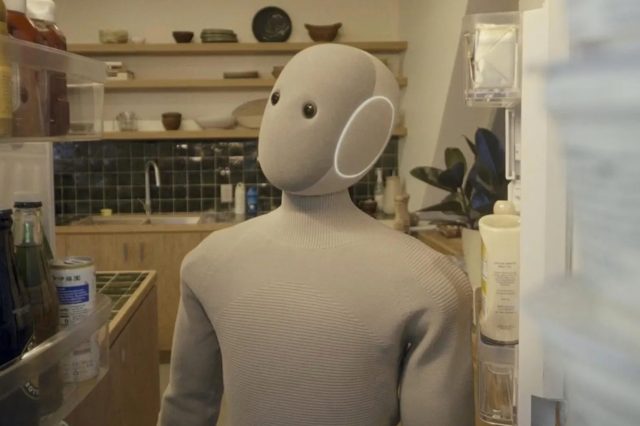
The 'Neo' robot deliberately falls short of realism. (Handout)





At Cooper’s Brewery in Adelaide, the largest family-owned brewing business in Australia, forklifts glide around the sizable factory floor. With ease, they shelve boxes of lagers and ales. But nobody is at the wheel. In fact, there isn’t a wheel at all. Or a seat. These forklifts are automated guided vehicles (AGVs), a pretty old form of robotics that uses lasers, floor markers or other navigation systems to follow pre-planned paths.
People had always imagined that robots would look like us, but these forklifts hint at a different future — one in which robots are made in the image of the work, not the worker.
For the question of whether robots will be the same shape as humans is not a settled one. In fact, it is a point of some debate in the robotics sector. Elon Musk promises legions of humanoid Tesla robots, poised to take over manual labor and build a colony on Mars. And his is not a particularly wacky view; other executives, including those less given to overconfident predictions, have made similar forecasts. In his lecture delivered to the Cosmos Institute last month in Oxford, the Anthropic co-founder Jack Clark predicted that, by April 2028, bipedal robots will “begin to do useful work in the real world in partnership with human tradespeople”. While being bipedal does not mean a robot is identical to a human, it certainly denotes it being closer in form to us than to a forklift.
As recently as this time last year, a wide rollout of electronic colleagues looked unlikely. Even in China, the world leader of the humanoid robotics market, the stumbling and malfunctioning first cohort of robot competitors in the Beijing half-marathon were treated as more of an entertaining sideshow than a serious sign of things to come. Clark himself appeared relatively pessimistic about the capabilities of humanoid robots at the time; in response to an Amazon research paper about the performance of a specialized robotics system for stowing items in the company’s warehouses, he noted that state-of-the art automation was coming from designing highly specific hardware and “carefully structuring your system around a few core tasks”. The experiment, he wrote, “should temper our expectations for bipedal robots leading to some massive improvement in automation — at least in the short term.”
What changed? It may simply be that this massive improvement has arrived. At this year’s Beijing half-marathon, several robots outpaced human participants, even breaking records. This feat had serious implications, demonstrating the kind of durability that might soon make the technology suitable for industrial applications.
On that basis, Clark’s prediction — that more human-like machines will start trickling into the workforce next year — starts to sound plausible, though we can expect humans would still be on-site to correct for their defects. Manual labor will be slowly automated. Or it may be that Clark believes the underlying AI systems are becoming so powerful, so fast, that the obstacles will be swept away. The robots’ cognitive abilities will catch up with their strength and dexterity. Manual labor will be rapidly automated.
“Truly general intelligence would obviate some of the flaws,” Clark wrote in his sceptical 2025 missive. “So if bipeds arrive at the same time as a generally capable intelligence, I’ll need to eat my words.”
This is now the precipice at which we find ourselves. As AI improves, those in the field say robots will become more capable of learning for themselves, of adapting to new environments without pre-programming, and even employing reasoning. They’ll be easily able to work in an Amazon warehouse — and then some. The ultimate prize, as Clark says, would be truly general intelligence: a system that can turn its hand to any task without specific training. Many imagine that, in this scenario, the machine most suited to carrying around a general, human-like intelligence would be in the shape of a person. After all, the world is built for humans, and humans have the dexterity to adapt to a vast range of manual tasks.
Many industrial robots, by contrast, are made to complete one specific task from a set point. Or else they operate entirely inside facilities built for them: look, for example, at the fulfillment centers of British grocery delivery giant Ocado, where a “hive” of robots roll across a grid system, picking and packing orders.
The question is whether the economy will demand robots that can venture into unexpected environments. For this, humans are far more adaptable, taking on stairs and uneven terrain. We climb ladders and traverse scaffolding and even rooftops. It’s hard to imagine a machine able to do all that if it isn’t shaped like us.
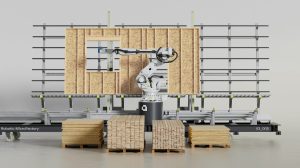
Clark is probably correct that the bipedal assistants will arrive sooner rather than later, precisely because they might be a stopgap between human work and a totally different way of making things. The trades of the future could look more like the work of British startup Automated Architecture, which makes mobile, robotic micro-factories that can build pre-fabricated components of a house quickly and closer to its final site. Inside the micro-factory, one large robotic arm performs tasks that might typically require several different production lines, producing floors, walls and roofs. Human workforces are still needed to assemble the timber-frame panels, but the process minimizes how much construction is needed on-site by pre-making all the elements for the shell of a building. Think of it like buying a gingerbread house kit instead of baking all the pieces from scratch.
In this way, the robotics of industry can go beyond the human approach to a task. Why climb a ladder when you could send a drone? These are already used for surveys and roof inspections. With the right dexterity, perhaps they will be able to perform the fixes as well.
Humanoids, argues Josef Chen, the founder of London-based restaurant industry robotics firm Kaikaku AI, are like the equivalent of a pick-up truck on a construction site. “Even though it’s not used for any serious work, people just have it for optionality.” In this analogy, you turn to a digger for digging, a crane for lifting. You wouldn’t expect the truck to do those specialist tasks, even though it can be useful for transportation, towing, or navigating tricky ground.
Those who believe in the utility of the human-shaped robot, though, believe that getting it right could unlock huge gains — and huge threats to the human workforce. As Clark wrote back in 2023, “true economic growth from AI happens when you don’t need to design for robots”. If an army of person-shaped droids start arriving in human workplaces, with no adjustments needed for them, it is easy to envision how this would accelerate workforce displacement.
Matvey Boguslavskiy, a hardware researcher and director of the Society for Technological Advancement, doesn’t buy that. “I think the future economy is going to have robots with many different form factors, doing many different things,” he says. Indeed, if robot arms or vehicles or dog-like quadrupeds prove vastly more efficient than humans, the argument about whether the world has to be redesigned for robots falls flat: the economic incentive will be enough to justify a redesign.
So if applications in the workplace favor the specialized machinery end of the robotics scale, then perhaps the promise of the humanoid robot is in the home. Whereas a factory might have space for several machines, each built for a different purpose, homes are more cramped. It would be difficult and expensive to accommodate an ironing robot, a cooking robot, a gardener robot, and so on — but what if they were all rolled into one? .
But here the robots will encounter another obstacle: human disquiet. There is something freakish about Tesla’s Optimus, or Boston Dynamics’ Atlas. The way they are lined up like an army in some promotional videos doesn’t help. It’s also in how close they are to being human-shaped, yet how far, almost like there’s a real person under there wearing a creepy costume. It’s the almost-ness that gets you. The heads are almost the right size, the hands almost lifelike — if often clothed in serial killer black gloves.
It may be that we’re too conditioned by science fiction horrors to accept humanoid robots. But the reason those fictional visions terrify us in the first place is because they tap into a primal fear — of a monster, or döppelganger.
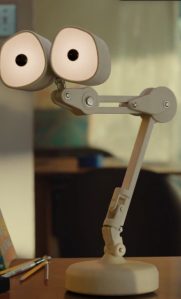
To make robotics more palatable in the home, many companies are making devices less threatening by ramping up their apparent cuteness. Pixar has a lot to answer for here. Everyone I speak to on this subject cites Wall-E and the success the animation studio had in making a boxy, metal robot into a lovable character. One startup robotics lab even brought in Toy Story screenwriter Alec Sokolow as creative director when developing Ongo, a smart desk lamp with big, Disney-worthy eyes.
There seems to be strong consumer demand for such devices, at least among gadget obsessives. There are countless Kickstarters for small robotic companions and widgets that receive hundreds of thousands of dollars in advance orders. However, an interactive paperweight can only do so much. To load the dishwasher, you need grip, spatial reasoning, and a way to get high enough to open or close it. If we really want a smoother life with no chores, there would seem to be few options beyond either hiring another human to help or letting humanoids into the home.
What’s the way forward? Boguslavskiy thinks one of the most useful forms will be the small, wheeled vehicle. We have already seen these catch on for vacuuming and mowing lawns autonomously. Why not for other tasks too?
Or if the human shape proves useful, the most acceptable forms might be some compromise between the humanoid and the cute. Take a look at Fauna Robotics, a New York-based company which was acquired by Amazon in March. Their products are deliberately fun to look at, with bright colors and jaunty eyebrows. Crucially, they avoid uncanny valley reactions by not trying to make the robot — named Sprout — look too human. It has Lego-like hands and a head that resembles a Wi-Fi modem. It looks like what it is: a machine. Sprout is also small, at 107cm tall, so won’t tower menacingly over a child.
Or there’s Memo, from California-based Sunday Robotics. Sometimes described as humanoid, the robot nevertheless does away with cumbersome feet, instead rolling around on wheels. With its permanent baseball cap, it looks more like a character in a children’s film than a chilling centurion of the future.
These non-threatening interfaces serve a deeper purpose than just saving children a fright. They strive to make it possible for us to live alongside intelligent machines. Though AI continues to seep into life and work, there are still many people who avoid using the technology or even encountering it as much as possible. When AI enters the physical world, it becomes less easy to ignore, and triggers in some people a sense of revulsion and anger. We have seen this in the repeated attacks on delivery robots and driverless cars.
People in the tech industry who delight in the miracle of creating motion, who have fun hacking together hardware projects on the side, perhaps underestimate how far there is to go on public acceptance of robots. Creepy, faceless, six-foot Cybermen are probably not going to help.