




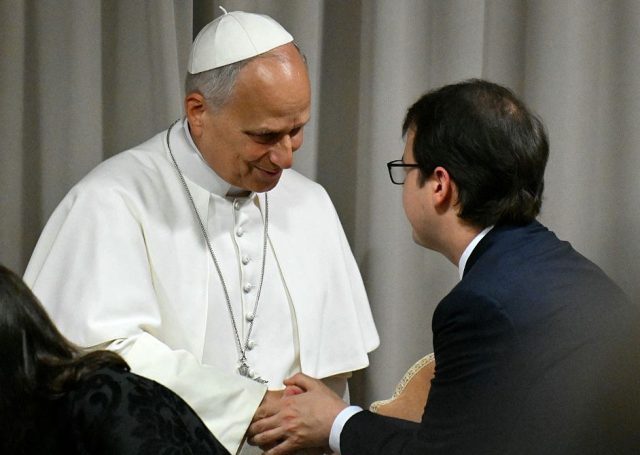
Anthropic’s Christopher Olah shakes hands with Pope Leo XIV. Credit: Getty





A two-millennia-old institution with one foot in the Roman Empire challenges Silicon Valley’s masters of AI and automation to do better. That’s the generic read on Pope Leo XIV’s debut encyclical, Magnifica Humanitas, dramatized by photos from the Vatican of the pontiff shaking hands with Anthropic co-founder Christopher Olah. And that’s true enough: “artificial intelligence” is right there in the encyclical’s subtitle, and many of its 245 paragraphs are devoted to the topic.
Yet Magnifica Humanitas only incidentally concerns the promise and peril of the AI revolution. A closer examination reveals that Leo’s ultimate project is nothing less than a defense of moral and political universalism — the collective struggle for “a universal truth about the good, knowable by human reason,” as the pope puts it — just when universal reason is menaced on every side by various irrationalisms.
Put another way: amid the ruins of modernity’s great emancipatory universalisms — liberalism, socialism, “positive science” — Leo is reminding us that there is a much older mode of universal reason, blending revelation and classical philosophy, preserved by the Catholic Church. And that Rome, with its “dynamic approach to the Gospel,” isn’t afraid to acknowledge the achievements of exhausted modernity, nor to collaborate in its renewal today.
That collaborative element — Leo’s tipping of his mitre to the United Nations, multilateralism, abolitionist and labor movements, and the like — renders the encyclical supremely unfashionable. Not least among neo-traditionalists within the Church, for whom the document harks back to the heyday of Vatican II and the midcentury moment that saw theologians and hierarchs embrace projects like global governance.
The Christian malcontents are already tsk-tsking the document for a supposed failure to cite Aquinas (there are several citations to the Angelic Doctor, in fact). They are labeling the pope a UN-besotted “Boomer” (is there a worse epithet today?) and griping that he isn’t radically anti-modern enough.
The pope appears to have anticipated the backlash. Blind faith in markets and technology, he suggests, is far from the only latter-day irrationalism. Others include “fundamentalist, identity-based, and nationalistic reactions” that have been stoked by the failure of capitalism and technocracy since the end of the Cold War to “generate prosperity, democracy, and stability.” It isn’t hard to imagine Leo classing ultra-trad Catholics — the type who use the latest iPhone to post online laments about such “modernist” innovations as the Luminous Mysteries of the Most Holy Rosary — as one more species of insurgent fanatic.
Yet like it or not, the pope’s approach — combining a classical and Christian account of the human person with openness to modern means for social emancipation — goes back to the previous Pope Leo, Leo XIII, who inaugurated modern Catholic Social Teaching with his 1891 encyclical, Rerum Novarum.
For starters, Leo XIII recognized that the organization of social and economic life implicates the salvific mission of the Church and therefore the Church can’t stand neutral in relation to it. Writing in the teeth of the Industrial Revolution, that earlier Leo beheld around him “the enormous fortunes of some few individuals and the utter poverty of the masses” and a resulting “moral degeneracy.”
More fundamentally, Leo XIII saw modern market societies as characterized by a constitutive antagonism: “social antagonism [that] erupted not in spite of, but as a result of people acting rationally within the rules of the game,” as I’ve written elsewhere. Under industrial conditions, a handful of firms dominated most sectors, giving employers nearly all the bargaining power, with the result that workers didn’t enjoy the freedom promised to them on paper.
On paper, the employee could always find a better wage or better working conditions elsewhere. In reality, most workers found themselves coerced and cornered as a result of the disparities in power generated by markets. “The richer class have many ways of shielding themselves,” Leo observed, “whereas the mass of the poor have no resources of their own to fall back upon.”
Here Leo XIII’s classical and Christian anthropology came in: workers aren’t just another production input, but human beings with rights due them as a matter of “justice.” These rights, not least the right to a family wage, must be upheld by the state and promoted by associations, the “most important” of which are “workingmen’s associations” — i.e., labor unions.
Note: a living wage under Catholic Social Teaching is not a matter of charity or the personal virtue or feudal honour of the employer. I mention these other possibilities — charity, virtue, honour — to highlight the way in which the Leonine teaching combines classical and Christian anthropology with modern politics.
It’s classical in its anthropology: the worker is a human being with a family to maintain and the natural imperative to participate in civil society; if he’s materially desperate, his family falls to immorality and he can’t take part in other societies like church and politics.
It’s modern in that Leo XIII notably didn’t decry industrial production as such. He didn’t hanker for the restoration of feudal relations or a return to the land or small-producerism or other such fantasies of the Tweed Jacket Class. At some level, he accepted that there is no “going back behind” of modernity.
The answer for Leo XIII, rather, lay in just wages enforced by the state and in labor organizations mounting what he called “united action” (what we now call “collective action”). In this way, Leo XIII, decades before Vatican II, brought the Catholic Church into conversation and collaboration with modern universalist emancipatory movements: the US New Deal, the British Labour party, and social and Christian democracy in continental Europe all bear his imprint.
His later successor Benedict XVI, often inaccurately framed as an arch-conservative, would bring this synthesis of the classical and the modern to its culmination with his famous 2006 assertion that “in many respects, democratic socialism was and is close to Catholic social doctrine and has in any case made a remarkable contribution to the formation of a social consciousness.”
Leo XIV is perhaps more cautious. Nevertheless, the same general pattern — an insistence on the human person as possessed of divine dignity; a willingness to engage with modernity in protecting that dignity — is easily discernible in Magnifica Humanitas.
Citing Leo XIII, the American pope begins with the insistence that “the proclamation of the Gospel cannot overlook the concrete lives of people.” While there is an “autonomy of worldly affairs” and two distinct communities — the secular and the ecclesiastical — nevertheless the people of God are called to “promote structural reforms.” Why? Because the Church can’t extricate her activities from “social relations,” nor “consider herself a stranger to the forces shaping society.” In short: “There is no authentic evangelisation that does not also affect the structures of human society.”
Scanning the social horizon of the 21st century, Leo XIV doesn’t see only horror and decline. He doesn’t think that ours is a uniquely accursed age: “I am convinced that the concrete way of living out social relationships in the light of the Gospel is not established once and for all, but remains a task entrusted, from generation to generation, to the Christian community. . . For this reason, I encourage all members of the Church not to be afraid of the present challenges.”
The present challenges, to his mind, are AI and what he calls the “normalization of war” (a geopolitical phenomenon he worries might be exacerbated by AI and other developments in so-called defence-tech). AI, he warns, could lead to the logics of efficiency and profit crowding out all others — a radical acceleration of the “technocratic paradigm.” The symptoms include screen addiction, the potential for mass joblessness, and the imposition of tech bosses’ worldview on the masses under the facade of “objective” information.
At the deepest level, he fears, AI could strengthen an “anti-human vision.” Meaning one in which “the fullness of life is equated with having more, reducing weakness, eliminating uncertainty, and exerting total control.” The problem with this is that weakness, uncertainty, and finitude are central to what makes us human. They are a source of creativity and of empathy for the vulnerable other (who is finally vulnerable, as we ourselves are).
“A technology that merely classifies and optimizes what already exists can … become an obstacle to change and growth,” he notes in my favourite passage. “For an algorithm, an error is a flaw to be corrected; for a person, however, an error can be a catalyst for profound change.”
In the face of these threats, however, you won’t find any calls for a general ban against AI in this encyclical, no fatwas launching a Butlerian Jihad. On the contrary, Magnifica Humanitas is full of praise for AI’s potential to eliminate “arduous, repetitive or dangerous tasks and to provide intelligent support for human activity.” In this, Leo XIV follows Pope Francis, who in one of his final statements as pontiff, was hopeful that AI might “introduce important innovations in agriculture, education, and culture, an improved level of life for entire nations and peoples, and the growth of human fraternity and social friendship.”
As with manufacturing in Leo XIII’s time, the question is how to orient these “new things” to the dignity of the human person and the common good of the whole. Here, just as Leo XIII didn’t rest content with the virtue of the factory owners, so our Leo insists that a few men in California can’t have unchallenged say-so. Rather, Leo XIV envisions a role for the states as well as the “transnational institutions” that took shape in the wake of the last century’s horrors. The Catholic principles of subsidiarity holds that when a problem is too large for national authorities, it must be addressed at a higher level by some sort of “world authority,” as Saint John XXIII envisioned it in his Cold War encyclical Pacem in Terris.
Such a problem, Leo XIV feels, is AI. Hence, the new encyclical’s unfashionable emphasis on transnational governance and political universalism. Contrary to his critics on the American Catholic Right, neither is a quaint relic of the pope’s Boomer generation. Both, rather, go to the heart of his Catholic political rationality. This is the Church, as Augustine described her: tam antiquam, tam nova!
Sohrab Ahmari is the US editor of UnHerd. His next book, on The Triumph of Normal, is forthcoming from HarperCollins.
 SohrabAhmari