




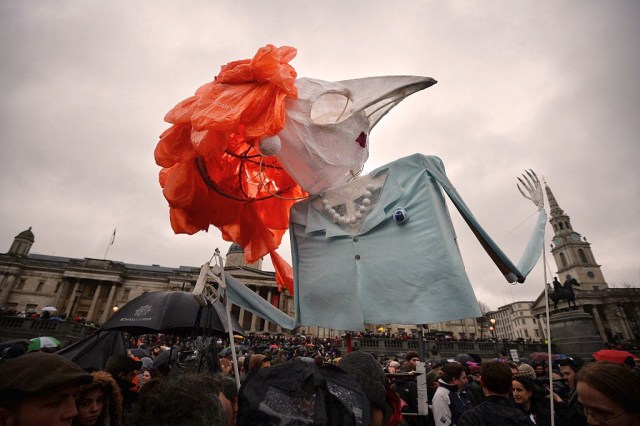
'At least I knew who the enemy was.' (Ben Stansell/AFP/Getty)





In 2013, I attended a Margaret Thatcher death party in Brixton. At the age of 23, perhaps I should have known better. Politically, I was in an extended-adolescence phase of edgelordism — jumping chaotically between anarchism and a post-ironic Stalinism, with teenage rebellion stuck on permanent default mode, fueled by high London rents, low London pay, and a nagging sense of self-righteous, insufferably graduate-class grievance. The post-2008 economy could no longer provide a ticket to middle-class security for the near-50% of school-leavers then going to university. Thatcher, who had died, aged 87, of a stroke at the Ritz, served as a convenient scapegoat. It was she who could be blamed for every ill that had befallen both the British Left and Liverpool, my hometown, in the prior 35 years.
Today I find the idea of drinking cans of Polish lager to mark the passing of a former prime minister rather pitiable. From a solely political perspective, of course, it is counterproductive, for it tells the general public that the contemporary Left resembles little more than a misanthropic, detached subculture found mainly among the younger, over-educated denizens of gentrifying urban enclaves. But beyond any strategic consideration, it also signifies the strength of Thatcherism, against which my fellow Brixton revelers and I were pathetically impotent.
In contemporary discourse, Maggie’s enduring legacy is taken to be something called “neoliberalism”, a system of political economy apparently dominant for the last 40 years, and now undergoing a critical appraisal, not least because of certain Labour leadership hopefuls blaming it for British decline. In his slick Makerfield campaign video, Andy Burnham says he “saw what Thatcher’s government did to places like this”, citing “deindustrialization” and “the draining away of economic, social and political power” from provincial Britain. As Reform positions itself as the party of the Northern working class, in alliance with small traders and the Home Counties’ petit bourgeoisie, the Left delivers dire warnings of a Thatcherite revival — the better to hold onto those working-class Northerners. Farage and the Reform leadership clique are, after all, longtime disciples of the monetarist creed.
None of this is to say that my opinions on the Iron Lady have altered much. Even from a purely conservative standpoint, she caused a lot of harm to the country, much of it perhaps irreparable. Though her project invoked a parochial conservatism, it nevertheless radically altered our mode of production according to an imported set of continental (namely Austrian) ideologies. It projected a vision of British patriotism that sold off national assets by the pound, exposing a relatively coherent and regionally balanced national economy to all the volatilities of globalized, financialized capital and international trade flows, as well as leaving us dependent on the kindness of strangers and cap-in-hand foreign patronage. And while its libertarian streak was applied ruthlessly to “free market” actors, an authoritarian traditionalism and throwback Victorian morality dominated in the socio-cultural sphere and in law and order — as exemplified by the battle of Orgreave.
Thatcher, then, is as significant a figure in discourse as she was when she died. In that sense, it is an auspicious time to be putting on a play about her. At Liverpool’s Everyman Theater, an adaptation of Hilary Mantel’s novella, The Assassination of Margaret Thatcher, is nearing the end of its first run. It’s a fitting venue: 13 years ago, as I drank cans of Tyskie in Brixton, groups of fellow Scousers spontaneously emptied out of the dockers’ pub The Casa just yards from the Everyman to mark Thatcher’s death. It’s a fitting time, too, as a famous son of Liverpool promises to reverse the legacy of the city’s — and the play’s — bête noire (Burnham the Scouser has spent around a decade posing as a Mancunian — a rare boon for someone born in the nether regions between the North West’s two great metropoles, with a shifting dual identity that mirrors his political oscillations).
Mantel’s original story attracted controversy at the time of its publication in 2014. For all the brouhaha, one would have expected it to be historical fiction in the philosophical tradition of Frantz Fanon — the French psychoanalyst whose writing on the efficacy and superior morality of Left-wing political violence is still a bookshelf stalwart of many a LARPing student revolutionary. Conservative MPs led the chorus of condemnation, but, in all likelihood, they had never read the text, despite its short length. For Mantel was no frothing-at-the-mouth extremist advocating the progressive or, like Fanon, mentally rehabilitative, qualities of revolutionary murder. Her epic on the French Revolution, A Place of Greater Safety, reveals no sympathies for the cold, utilitarian, socially cleansing properties of the guillotine. Instead it focuses on some of the human costs of political upheaval.
In that vein, the Scouse IRA sniper featured in The Assassination of Margaret Thatcher is fundamentally more melancholic than heroic. He seeks a personal catharsis in his act, as well as political change, but it’s highly questionable whether he will attain either. The play adaptation carries this mood forward — the assassin portrayed more as a sad, disturbed reject than a hardened, cocksure ideologue. The terrorist tricks his way into the home of a single widow, whose bedroom window happens to overlook a hospital entrance on the day of a prime ministerial visit. The widow tries gently to persuade him of the errors of his ways — and it is she who carries the audience’s favor in this two-person performance.
Nor is Mantel’s choice of terrorist surprising. Such is the hold of the Thatcherite decade over the collective Liverpudlian imagination that local politicians still frequently invoke the Toxteth riots along with Maggie’s supposed plans for Merseyside’s “managed decline”. It was, in fact, her chancellor Geoffrey Howe who suggested the policy of allowing a city-wide gradual atrophy, rather than attempting to guide water up a hill in what was known as “the Bermuda Triangle of British capitalism”. Eventually, Howe’s plan was rejected in favor of a Heseltine-branded plan of city-center-focused urban regeneration. But since then, the “managed decline” epithet has stuck — a Scouser never forgets, of course.
The cultural influence of the era is still broad. The industrial wastelands and mass unemployment portrayed in the Liverpool-based TV series the Boys from the Blackstuff was apparently what inspired Burnham to go into politics by joining the Labour Party aged 14. It is as if our local political elites (all Labour, still, for now) are afflicted by a collective, 40-year hangover induced by the transition from a bustling, Tory-voting, mercantile port (the “Second City of Empire”) into a belligerent poster child of urban decay (“Smack City”). Though admittedly the anti-Thatcher finger-pointing might also help redirect attention from the likes of “Chippy tits”, a recent mayor who awaits trial over charges of bribery and conspiracy to commit misconduct in public office. Many in the audience of The Assassination of Margaret Thatcher will no doubt hope that Makerfield’s Labour populist can prove the final antidote — the acetaminophen and bacon sandwich — to cure the lasting Thatcherite headache.
The rich nuance of the play is undermined by the limited-edition tote bags proclaiming “REJOICE! REJOICE!” on sale behind the theater bar. They will have sold well. But how much can we still claim to live in Thatcher’s world when the tax burden is at a 70-year high? Where is the Thatcherite free market when a bureaucratic welfare state takes ever-increasing tax revenues from productive labor and investment, redirecting it toward the ever-expanding army of the indigent and indolent? Certainly, few business owners will see in today’s stagnant Britain a portrait of laissez-faire nightwatchman governance.
Two political tribes offer opposed diagnoses for the UK’s dismal situation, with each identifying different starting points for the Fall. For the Burnhamite Left, the decline began in 1979, when Thatcher came to power. For the Right, decline began in 1997, on Blair’s arrival. The Right posits that the source of our ills is the lingering effects of too-much-state, of an overbearing, Cool Britannia lanyard socialism. This is a story of radical constitutional renewal and the empowerment of quangos, arms-length bodies, international organizations and the judiciary at the expense of executive ministerial authority and the Crown-in-Parliament. The result is an omnipotent regulatory deep state that hampers individual initiative and state capacity alike.
But what we’re really seeing is a grotesque blend of the worst of Thatcherism with the worst of Blairism: bad aspects of “neoliberalism” coexisting with bad aspects of bureaucratic statism. The result combines top-down statist nitpicking with Thatcherite ownership models; corporate, Whitehall and town hall management structures amalgamating into a public-private-partnership blob, administered and lobbied by armies of LinkedIn-posting hangers-on. Blairism is, after all, a development of Thatcherism, as Thatcher herself recognized when she described New Labour as her greatest achievement.
The consequences of this Frankenstein blend are clear to see. Utilities, critical industries and infrastructure are in the hands of privateers, many of them foreign. Collective bargaining outside the public sector is virtually non-existent, contributing in no small part to a 20-year stagnation in real wages. We suffer from an over-reliance on financial, corporate, and legal services, low levels of public and private investment, and an extremely open, low-wage, low-productivity economy addicted to imported cheap labor and foreign direct investment. But we’ve matched that with a vetocracy that stymies development; with rule-by-NIMBY; with a New Labour-style dispersal of executive power across bureaucracies and professional bodies; and with often excessive meddling in the private sector. Our emasculated politicians are engaging in after-the-fact distributionism, doling out the proceeds of an old, broken growth model without knowing how to kickstart a new one. This is the legacy of Blair: a legalistic, top-down progressivism rather than anything resembling the very British socialism which Thatcher set out to destroy.
It was the One Nation Tory Ian Gilmour who held that Thatcherism had more in common with the free-trading Gladstonian Whigs than with the patrician tendency of his own party. No doubt Britain’s postwar social democracy was in a sorry state by the Seventies, requiring fundamental reform, not least a compromise with the realities of profit and loss. But the grocer’s daughter, steeped in a low-church Methodist ethos, took a polity rooted in the communitarian institutions of mass democracy, million-member political parties, the trade unions, churches, industrial mass production and security in work, housing and therefore family life, and replaced it with a rugged, dog-eat-dog, atomized individualism.
In trying to alter what she called “the object” of man’s soul through “the method” of rigid economism, she initially attempted to model Britain on her native Grantham — a staid Lincolnshire market town full of people who embodied the sturdy, middle-English values of thrift, self-reliance, respectability and quiet, Christian philanthropy. Instead we got the economy of the spiv, the City slicker, the consultant, the agency, with every job outsourced, every project put out to tender, a vast network of email-senders and middle managers vying for a procurement contract, a teat on the underbelly of our swollen PLC state.
Thatcherism’s pivot towards the great circuit of Mammon invited the criticism of even the conservative philosophers, such as Roger Scruton, for whom “the emancipation of the market from the constraints of small communities, territorial loyalty and the jurisdiction of the nation state” had more than an air of deracinated cosmopolitan liberalism.
After watching The Assassination of Margaret Thatcher, I thought back to 2013, getting too drunk on Tyskie. The futility is obvious now: we’ve had Corbynism, Brexit and much else besides, but none has brought us true deliverance, and the debate on Thatcherism has never been settled, instead congealing into two different tribal mythologies. The Left hope that a charismatic mayor with a warm smile will exorcise Thatcher’s ghost, and with it that of her New Labour successors, while the Reformist Right prays that it will one day complete her unfinished revolution.
Any genuine savior, Burnham or otherwise, will have to topple the mongrel system we currently inhabit, which displays neither the features of efficient entrepreneurialism nor those of state competence and capacity. We have neither the comforts of collectivism nor the dynamism of the market, neither the cradle-to-grave carer nor the sovereign individual. Mantel understood this better than most; her assassin seeks a personal and political redemption through violence, but the lead man can’t find salvation by killing what has already metastasized. There are no easy escape routes. At least in 2013, drunk on cheap lager and high off my own supply, I knew who the enemy was.
Jonny Ball is a Contributing Editor at UnHerd. He formerly wrote under the name Despotic Inroad.
 DespoticInroad