









May 14 2026 - 6:00pm
It was quite something to see Marco Rubio prowling excitedly around the Great Hall of the People in Beijing this week. This is the same Marco Rubio who, as a senator, spearheaded hundreds of initiatives to address challenges posed by the Chinese Communist Party and was famously sanctioned for it by China.
Beijing’s answer to the problem of Rubio’s visit? Just change his name. The US Secretary of State’s name in Chinese is 盧比奧 (lú bǐ ào). The new version is very subtly different: 魯比奧 (lǔ bǐ ào). The Chinese government can therefore keep its sanctions on Rubio (盧比奧), while allowing Rubio (魯比奧) to visit.
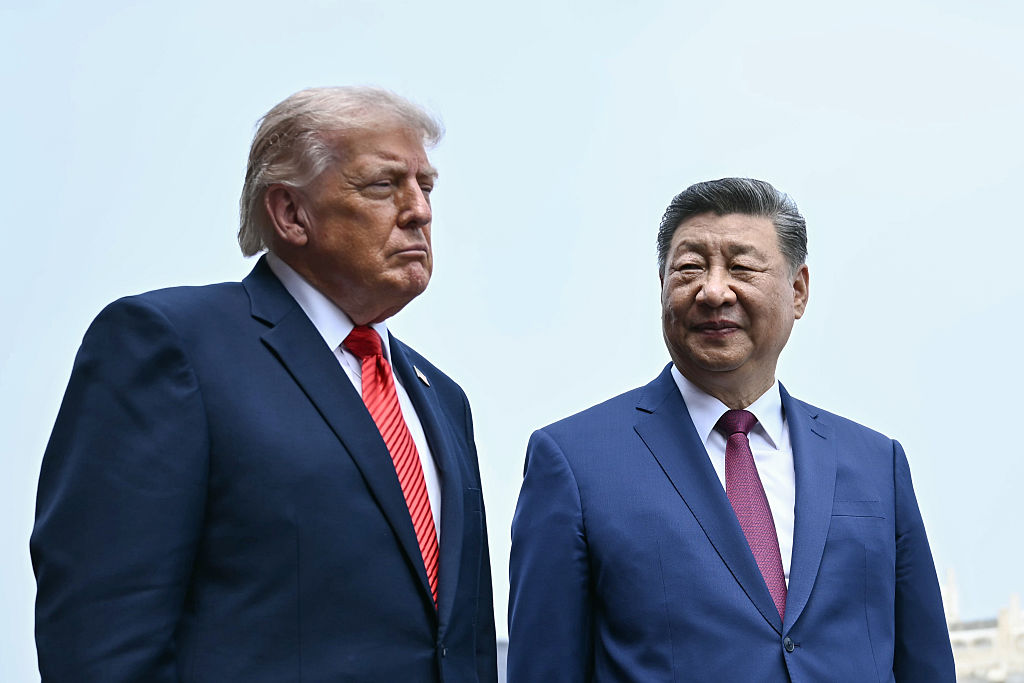
This charade reveals much about the Trump-Xi summit that tends to flummox Western onlookers. The war in the Middle East is a red herring here. Beijing has little incentive to help the US in Iran, save for using it as leverage to extract concessions on trade or Taiwan. Conflict in Iran depletes the US war chest, distracts from other military involvements around China’s periphery, and increases global dependence on Chinese renewables. China’s dependence on Hormuz oil is comparatively negligible, and Beijing has been on a stockpiling binge for years anyway.
Of course, both the US and China want trade compromises. Donald Trump needs to deliver on his promise of a booming, tariff-protected economy without triggering a global depression. Xi Jinping needs to liberate exports and stop the Chinese economy from looking increasingly like a house of cards — dependent on exports, illusory foreign direct investment, and a collapsing property market. They aren’t seeking friendship, only to prevent their respective economic engines from seizing, and stability is clearly a shared interest.
But even economics isn’t the main course at this summit. The meeting is not so much about tariffs and tech as it is about Taiwan, a fact which Xi himself made clear earlier today. If the US does not deal with Taiwan in the way Beijing wants, Xi said, it would precipitate an “extremely dangerous situation”. In case of doubt, he clarified that this was indeed a threat: “If handled poorly, the two countries could collide or even enter into conflict.”
Taiwan is the metric that truly matters to the CCP. Beijing officials are watching Trump’s “America First” posture with a mix of opportunism and dread, calculating whether the US still has the stomach for a kinetic conflict over a chip-producing island. Every concession Xi makes on trade or fentanyl is a down payment on the hope that Washington will eventually look the other way in the Pacific or, better still, agree to stop selling arms to Taipei.
The question is: what price stability? Any concession on Taiwan would be a historic mistake likely to accelerate rather than deter cross-Strait escalation. Neither the United States nor any other country can afford the catastrophic economic consequences of regional supply-chain disruption. Signaling tolerance for Beijing’s treatment of Taiwan would be interpreted as a green light for more of it, and tacit acceptance of Beijing’s ahistorical and unlawful claims to sovereignty.
Stability at the price of complicity is no stability at all. It is merely the calm before the storm. There are enough realists in the Trump administration to understand that when Beijing representatives talk about win-win cooperation, they mean that China wins twice. If the US fails to hold its nerve on Taiwan and other key values-related issues, history may look back on this summit as the tipping point: the moment when the US became a stepping stone on the road to the “Great Rejuvenation of the Chinese Nation”.