




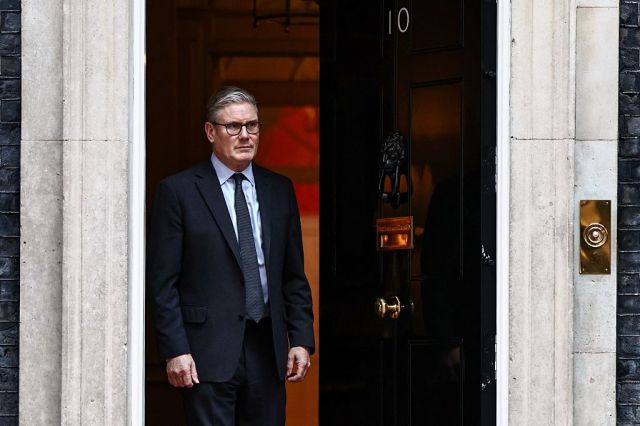
Britain is burning through prime ministers faster than Italy. (Henry NICHOLLS / AFP via Getty Images)





The scenes were chaotic, verging on slapstick. Was this real life — or another episode of The Thick of It? As camera crews and presenters jostled and exchanged banter outside No. 10, waiting for a hapless politician to quiz, you’d have been forgiven for thinking you were watching farce.
Every 30 seconds or so, a minor Minister would emerge blinking through the familiar Downing Street doorway, only to be heckled by the chaotic bunch of hacks who sounded more like creditors demanding their money in small-claims court than esteemed veterans of Britain’s press. Most of the representatives of His Majesty’s Government managed to ignore the questions being shouted at them and scuttled off. But a few stopped to impart their wisdom. They did that British-politician thing, repeating the same line, over and over, no matter the query: “Our job is to carry on, as the public expects . . . to carry on . . . as the public expects.” Is there a God? Can historicism survive itself? Should young men take up balls-maxxing? “Our job is to carry on, as the public expects.”
Astonishingly, these scenes were playing out in real time on Sky News on Tuesday afternoon. For over in London, the British political and media class are staging a parody of themselves as the Labour Government totters and the Prime Minister is urged to commit Harikiri over a bad set of local election results.
Viewed from the other side of the Atlantic, Britain’s almost comedic political chaos can prompt smug self-satisfaction — based on our stronger American presidency and more stable party duopoly of Democrats and Republicans. But, really, it should inspire dismay in Washington — and not a little internal anxiety.
Britain is supposed to be a serious power. Its nuclear submarines prowl distant waters, carrying the threat of global mega-death. It’s the world’s fifth or sixth largest economy (depending on which measure you use). It is home to a world financial capital and a banking system whose stability has been the envy of the world going back to the 19th century. A seafaring island people with a preternatural knack for harmonizing hierarchy and liberty.
The special relationship is enduringly important for Americans for these reasons and more. But these, in turn, have rested upon the stability, state capacity, and political moderation that characterized Britain at its imperial zenith in the 19th century and survived the collapse of the Empire in the immediate postwar years.
To take one example, in confronting the challenges of industrial modernity — the squalor and poverty of the working class, the chaos of market life — Britain succumbed to neither French-style radicalism nor German or southern European authoritarianism. Instead, social compromises were struck within the give-and-take politicking of Parliament; and one of the world’s most rigid class systems invited the full participation of a labour movement and its associated party; trade unionists could be, and would be, made lords (miraculous, if you think about it).
Yet in the early decades of the 21st century, stability, state capacity, and creative moderation are scarcely in evidence. No British prime minister, it seems, can be permitted to finish a full term: not if “the bond markets” disapprove or local elections go badly. The British public and political classes, it seems, have exempted themselves from H.L. Mencken’s democratic maxim: the people have voted, and now they should it get it good and hard. (Yes, yes, it’s parliamentary parties that win mandates; but something’s gone terribly when Italian premiers last longer in office, on average, than their British counterparts.)
The collapse in British state capacity is less cartoonishly visible, but no less serious. The upshot is a state bureaucracy that is at once bloated and increasingly incapable of coordinating economic activity and delivering on core functions. My colleague Tom Ough has described modern Britain as starved of the “agentic” initiative: both at the level of the state and of individual actors (compare this with the Foreign Office of old and its individual spies and diplomats who’d create new Mideast states by day and compose Arabic poetry by night). The upshot for America: a Britain that would struggle to field a single carrier — even if motivated to do so in a less foolish operation than President Trump’s Iran war.
As for moderation: taking a cue from Orwell, the American intelligentsia has long viewed Britons as somehow naturally immune to spittle-flecked political fanaticism of every stripe. British liberty rejected the yoke of every Nosey Parker, as Orwell observed (while getting bombed by the Luftwaffe), and arch British humor mocks every would-be Lord Haw-Haw.
But I’m not sure I share this confidence anymore. More and more, one encounters in British political culture, Left and Right, some of that same unblinking earnestness which renders Americans all too susceptible to barmy visionaries. American culture is, after all, partly the work of Puritans who found Caroline England insufficiently miserable and sought a new land in which they could make each other even more miserable.
Now, owing to US material and cultural domination, the tendency has traveled in the reverse direction. Even as the racial and gender craze of 2020 came and went in America — we’re visionaries but also have short attention spans — the same seem to have greater staying power in Britain. The English Right, meanwhile, increasingly views its own country through the distorted lens of America’s online Right: “This is what they took from you” runs the caption to AI slop videos showing Victorian and Edwardian England with the industrial misery neatly cropped out. This trend, too, has grave foreign-policy implications for Washington. To wit, a Britain racked by severe cultural incohesion — if not “Balkanization” — is likely to be internally distracted, struggling to project power even in its own near abroad.
Which brings us to American internal anxiety prompted by the current Starmerpocalypse. The US-UK special relationship isn’t just about British troops joining Americans in the trenches (a comradeship the Trump administration has too often callously denigrated). It’s also about those “mystic chords of memory” that perhaps throb more sentimentally in too-earnest American hearts than in British ones. Even the Trump administration, after all, concedes that “our legal system, our culture, and values is very much an offshoot of what was going on the British Isles for hundreds of years”, as JD Vance told me in an interview last year.
America has been exporting its recent anxieties and mad enthusiasms to its much older cultural predecessor. At the same time, we tell ourselves that the United States, for all its trigger-happy daily violence, has done a better job of overcoming the problems that wrack Britain and other European states in the wake of globalization and mass migration. But is that really true? Don’t some of America’s deeper crises of identity — those that go beyond the recent culture wars — resemble British crises?
Britain, as Enoch Powell observed in an encounter with William F. Buckley, never quite resolved what it meant to go from a globe-spanning empire to an ordinary country: what claims did the former subjects of the Empire have upon the home islands after decolonization? There’s a case to be made that America’s post-1965 immigration — the Asian, African, and Latin wave that made me an American by choice — was an equally momentous transformation, giving rise to a similar tangle of problems having to do with representation, cohesion, and belonging.
These are discomfiting questions. Get it together, Brits, so we can take comfort once more in our Churchill mugs and “Keep Calm” T-shirts.
Sohrab Ahmari is the US editor of UnHerd. His next book, on The Triumph of Normal, is forthcoming from HarperCollins.
 SohrabAhmari