




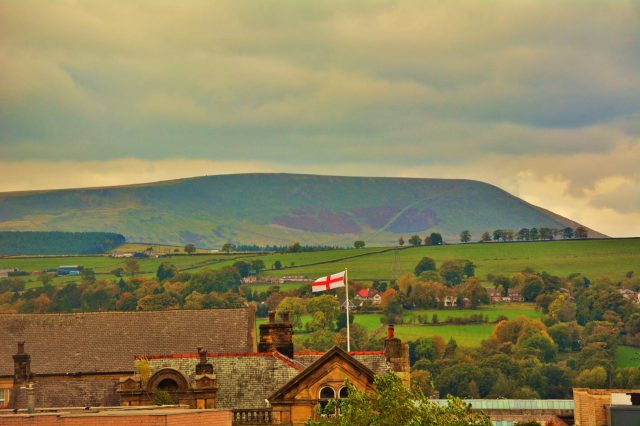
Pendle Hill in Lancashire (Michelle Thompson/Getty)





The best place for taking in the whole of England’s most divided constituency is from its highest point: Pendle Hill. Even the Lord God thought so. Back in 1652, he sent George Fox clambering up its flowered banks to have a vision: that, down below, there was a great people to be gathered. Fox rushed back down and founded the Quaker movement.
Fox believed that England could be a united and peaceable land, almost a preview to heaven. But some four centuries on, we have Pendle instead. A council area in eastern-most Lancashire, it contains all the failings of modern Britain. In the top 10% of most deprived areas in the country, it also suffers a 53% employment rate. Yet as it elects new councilors today, its story is anything but local. Its atomization and apathy portents, perhaps, of England’s future too.
Last year, the Mail called Pendle “Britain’s valley of strangers”, mostly on account of the town at its center. Nelson is a place with one pub and 19 mosques. The high-street shops are either shuttered or bear Urdu script (of people whose first language isn’t English, 38% of the borough’s residents speak little-to-no English). And yet drive a mile or two out of the town, towards the hill, and it’s quixotically different — an “undiscovered” Cotswolds, frequented by travel supplements, with “quaint” limestone cottages and “cozy” inns.
This was once a placidly apolitical bellwether seat, a testament to the two-party system. But today, its fractured political landscape houses everyone from middle-class Starmerites and Restore-curious farmhands to long-established British Asians and more recent migrants — to say nothing of Nelson’s beleaguered white working class. Out of work and in despair, the latter are often in the town’s last remaining pub: the Station Hotel, a detached and convoluted late Victorian building on the edge of a carpark.
“It’s just a dying town,” Sean tells me, dragging on his cigarette in the pub’s carpeted portico. It’s mid-afternoon on a Friday, and it’s raining emetically. Sean has lived in Nelson all his life and eagerly rehearses the statistics of its decline. “Loads of mills, 13 pubs, and six nightclubs,” the best of which hosted the Stones, Beatles, and Jimi Hendrix. Now there’s only karaoke night at the Station. “Can’t hate them for it, but Asians don’t drink,” he says. “That’s why there’s no pubs or nightclubs and so many mosques. Getting robbed of our culture; I don’t mean it nasty.” He drops his cigarette on the carpet, and slouches inside towards the bar. “This place is just too old to bother.”
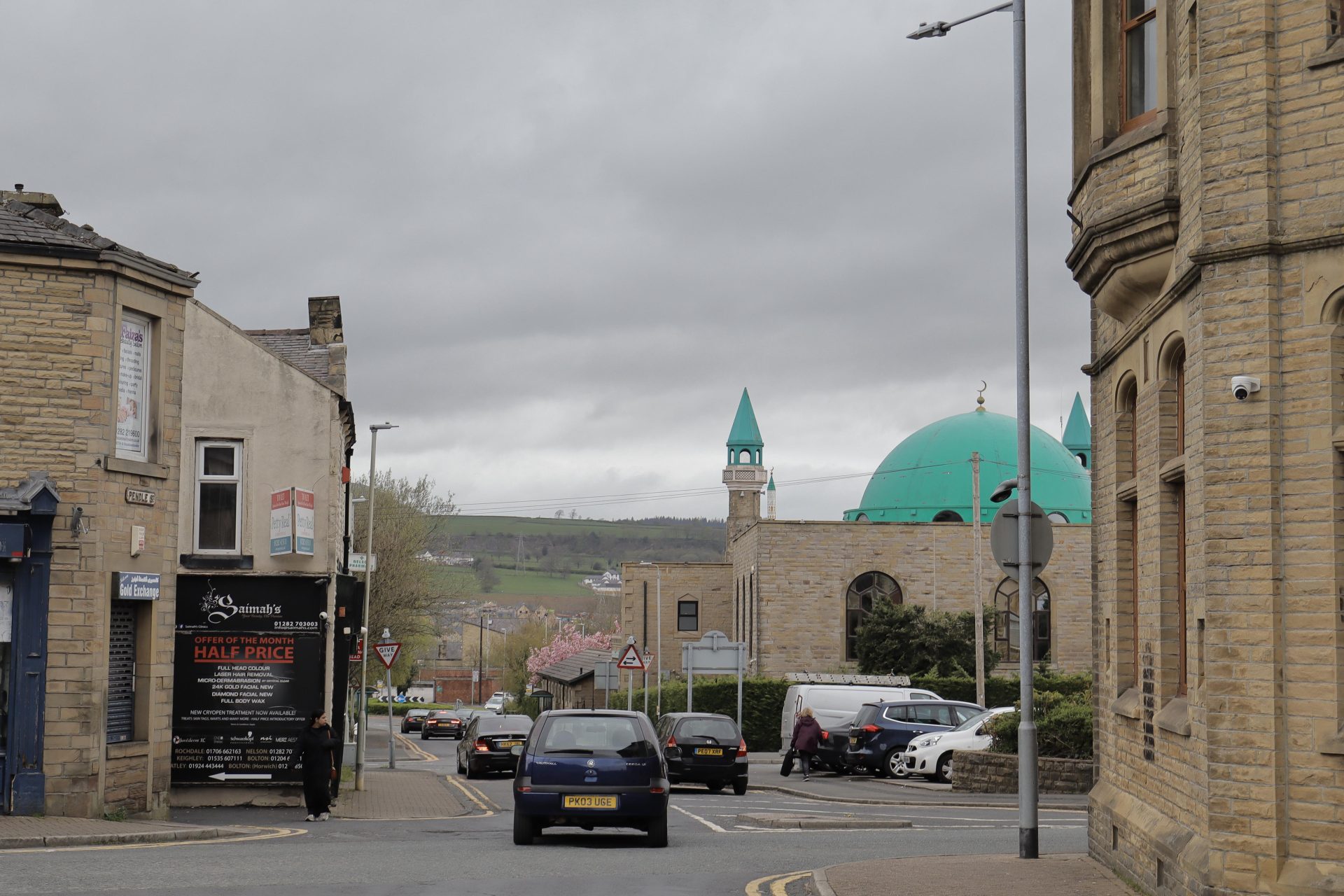
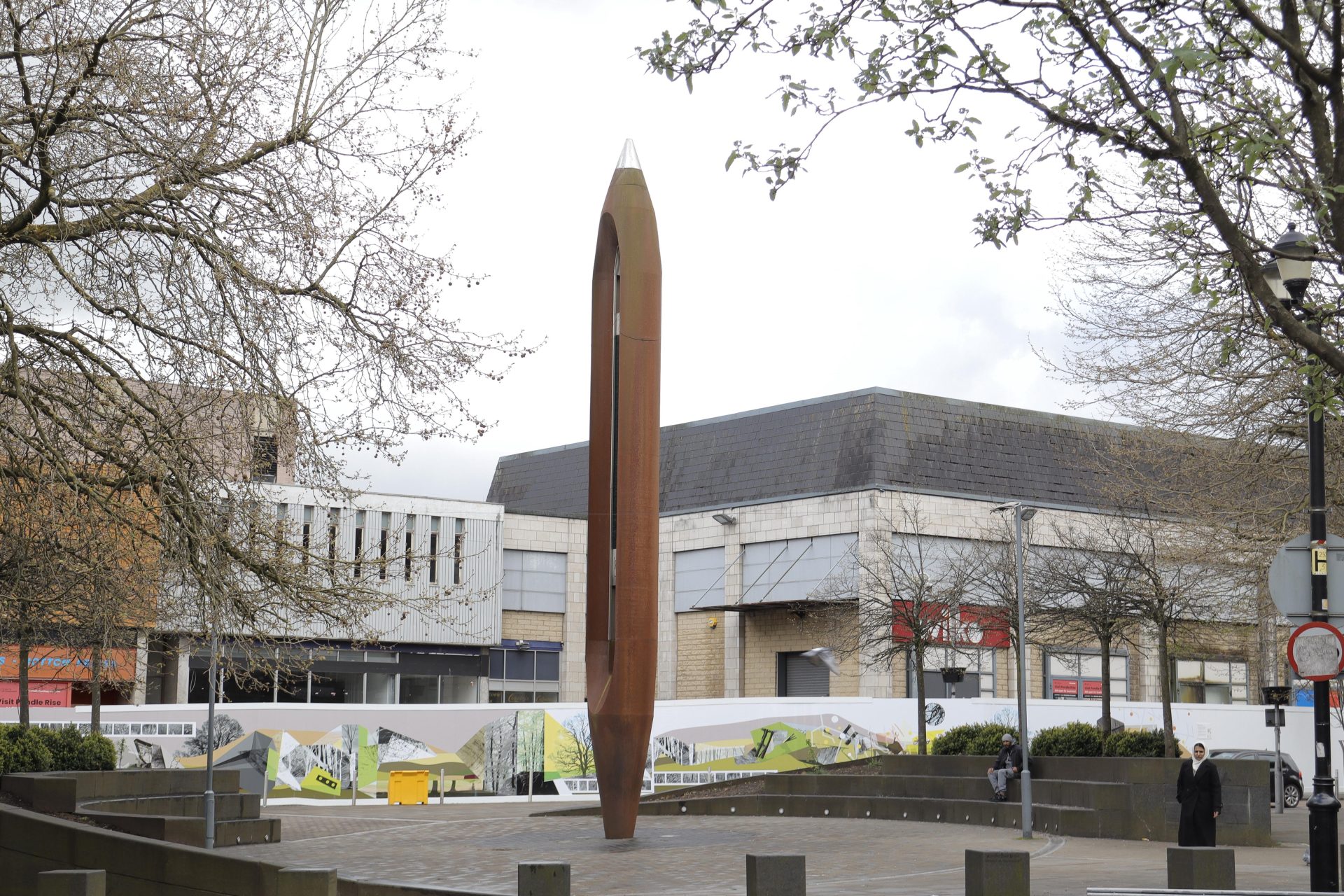
Sean was born in 1960, by which point Nelson had already stopped bothering. The town, which had sprung up to accommodate local millworkers in the mid-19th century, had little to offer once the mills closed. And as Britain’s cotton industry died, the number of looms in Nelson dwindled in sympathy, from 22,000 to 10,000 in the half-decade to 1964. To cut costs, the few remaining jobs were filled by an influx of lower-wage, skilled laborers from Gujrat in Pakistan, who moved here in the Sixties for a better life. All that remains of Nelson’s former glory is a statue of a weaving shuttle, which some kids scrutinize like an alien object. “It’s a pencil,” one says. “No, it’s a Muslim thing,” chimes another. According to the 2021 census, certain wards in Nelson have populations over 85% British Asian.
“I don’t know whether I would use the term ‘divided constituency’,” Jonathan Hinder, the local MP, tells me as we walk through Nelson. Almost everything we pass — the mall, the roads, even the pavements — is scaffolded, awaiting demolition, or else under construction. Hinder was born on the other side of the hill, in a village near Clitheroe. He’s still getting to know Nelson, but Nelson resists knowing him. Only one man, who works at the train station, stops him to talk, grumbling about the timetables.
Whatever Hinder might claim, that struggle to be heard hints at Nelson’s deep divisions. With the town already split between a demoralized white rump, and the Sixties Pakistanis and their children, the past 15 years has seen even greater change. Between 2011 and 2021, Nelson’s population increased by 14.8%, its Asian population climbing especially. This growth was largely driven by newcomers the locals call “Europeans” — migrants of Pakistani heritage, who moved from Portugal, Italy and elsewhere in southern Europe to join their families in the last days of EU free movement.
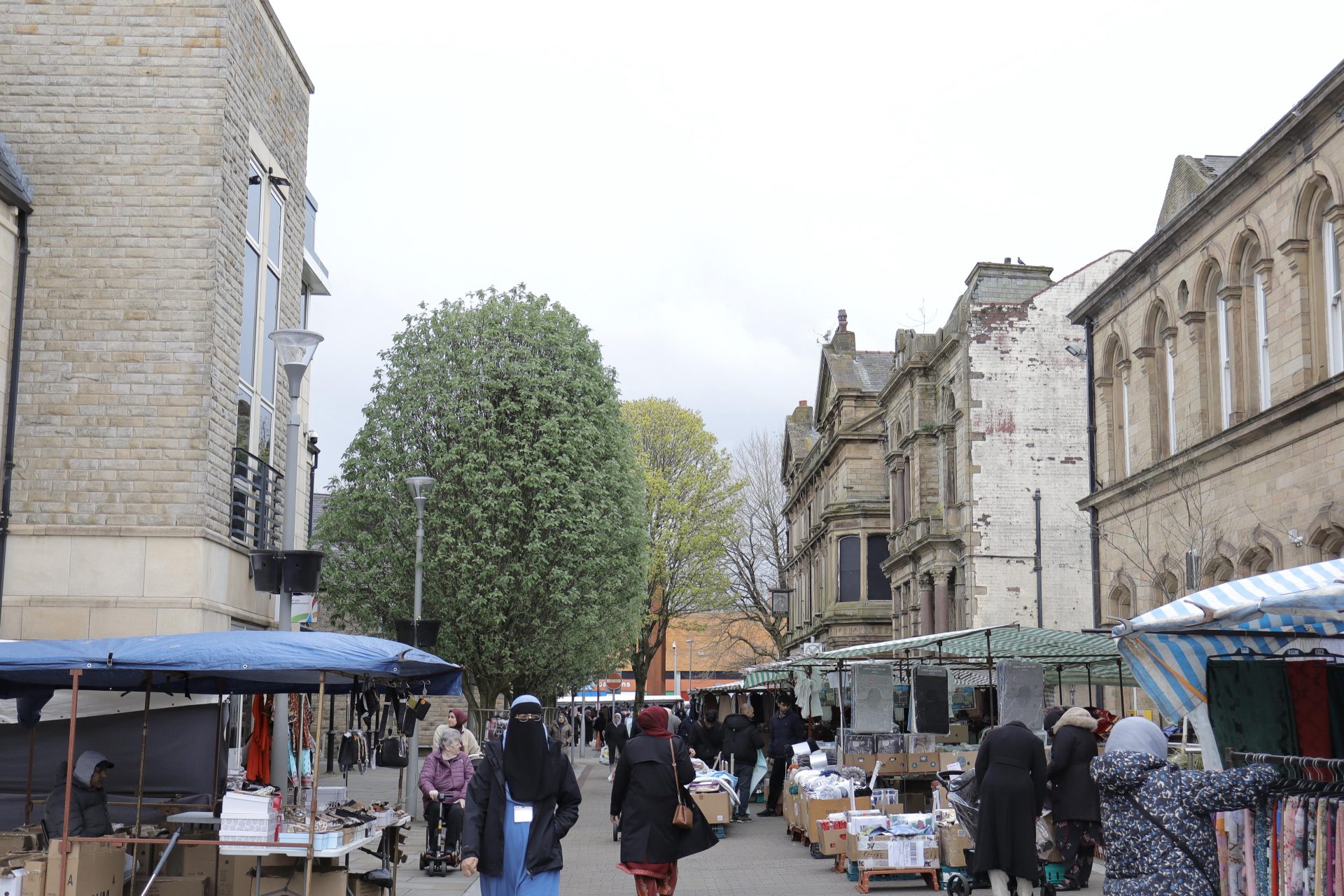
These latest arrivals were not met kindly by the more longstanding British Asian community, yet another tear in Nelson’s social fabric. “They are nothing,” says Fozia, 44, who sells pakoras in Nelson Plaza, one of two neighboring bazaars on Scotland Road. “They are originally from Pakistan, but they’re not really educated people… They are claiming new benefits in the UK, which is not fair on us.” They have, she insists, changed the character of the town. “It used to be more like an English town,” Fozia says, “now it’s more like an Asian one.” According to the 2021 census, certain wards in Nelson have populations over 85% British Asian, which accounts for the number of mosques in the town — one of which is the Masjid Sunnah Nelson, attended until recently by the Manchester synagogue attacker Jihad al-Shamie. In 2024, it was reported for “fuelling antisemitism” after the imam Abul Abbaas Naveed linked the Gaza conflict to “the plotting of the kuffar against Islam”.
There are louder tensions too. The noise starts at 6pm most days: a murder of sportscars rumbling down Regent Street. Sometimes, there’s drag races, other times it’s just showboating. Pete, lounging at the bar in the Station Hotel, shrugs: “Ferraris, Lamborghinis — I don’t know where they get them, but they hire them and scream around.” In the past few weeks alone, two Lamborghinis have crashed — one in Nelson, the other in nearby Blackburn. Pete says he could cope if it were just the cars, but it’s not. A little later the fireworks start. “It’s not meant to aggravate anybody,” Pete says, as he explains that they’re being let off at wedding parties. Others disagree. “It’s the younger Asians,” says 64-year-old Karl. “They have no respect for their own culture.”
Little wonder, given such animosity, that Hinder believes controlled borders are essential if Britain’s fragile civic nationalism is to endure. But he worries: this town has challenged his previous faith in integration. He describes how he sometimes knocks on doors in Nelson which are opened by young Asian women who can’t speak English. “A young Asian woman,” he says, hesitantly. “That’s the key thing for me; it’s not the elderly, who you might be more… kind of…expecting to be… kind of… unable to speak English or whatever. It’s people that are more recent… um… who have come over and haven’t necessarily… really… kind of… integrated.”
Pendle’s politics splits sharply along the community fractures. Since 2024, the local council has been run by Gaza independents in coalition with the Liberal Democrats, which seems likely to remain the case after today’s elections. Before that, though, it was the last stronghold of the BNP, with councillor Brian Parker presiding over the Marsden ward for 12 years until 2018. More recently, it’s been flagged as one of the places in Britain most vulnerable to Right-wing extremism.
Today, though, there’s little sense of a pending nationalist revolt in the town of Nelson. A solitary St George’s cross hangs limply from a streetlight on Scotland Road. Most people I meet are like John, a former publican who hasn’t voted since the Nineties. He tells me that they’re all the same — even Reform, which is “corrupt” and “piss in the same pot”. Few people I speak to seem unaware local elections are on. Even fewer know Hinder is their local MP.
But not everyone in this valley is similarly apathetic. Five miles from Nelson, in the hilltop village of Trawden, locals are struggling with a profusion of boy racers. A blacked-out BMW nips past the Trawden Arms, a community-owned pub that serves smoked pheasant chips. One man, an army veteran, spills his pint as he angrily launches himself from his picnic table to chase after the car, shouting: “Fuck off! Fuck off! Fuck off!” He then returns to his seat, only to be set off again by another passing car. He won’t say his name, but he does tell me that Nigel Farage is a “faggot”. (He tells me I’m one too.)
Strikingly, though, people here seem energized by politics. The former soldier tells me he’d like Rupert Lowe to be the prime minister because he’d bring back “hangings for murderers and rapists”. He smiles. “Better make sure I don’t kill someone myself then.” Once a predictably Tory electorate, Trawden’s wealthier voters now split between the Liberal Democrats and Restore Britain. There is, though, a begrudging acceptance of the area’s British Asian community. “There’s not hatred here,” says one man at the Trawden Arms. “Just two ways of life.” One woman said that Nelson’s existence was handy. After all, it means there’s a supermarket open on Christmas Day.
To be fair, Hinder does have some grudging supporters — or his party does anyway. These centrist dads can be found at — where else? — the Parkrun on the hill above Colne, a well-to-do town up the road from Nelson. One run marshal, stretching by the course, is bemused by the clash between Nelson’s longer-standing migrants. It’s always been the same, he tells me. “People always complain about migrants taking their jobs.” Having said that, he never goes there. When I press him, he explains: “because of the shops. They have their own shops.” He doesn’t know who he’d vote for if Labour axed Starmer. Maybe the Lib Dems, he says over his shoulder as he trots off.
In his 1977 essay “The English Enigma”, Tom Nairn foresaw the death of Britain’s ancien régime, squeezed between the “combined pressures of external collapse (e.g., breakdown of currency) and internal upheaval (whether as national or as social revolt, or as the two at once)”. But what Pendle suggests is something more concerning — that the ancien régime will stumble on for some time yet. More than that, it’ll be bolstered by the very upheavals Nairn foresaw: sequestered communities, begrudgingly tolerating one another, their flirtations with radical politics canceled out by their neighbors. Come the General Election, it seems unlikely that any single politician will muster the popular strength to patch together enough support to rule these varied and intractable tribes — whether in Pendle or anywhere else.
* 7 May 2026: This article has been amended to correct the statistic on English speakers in Pendle.
