




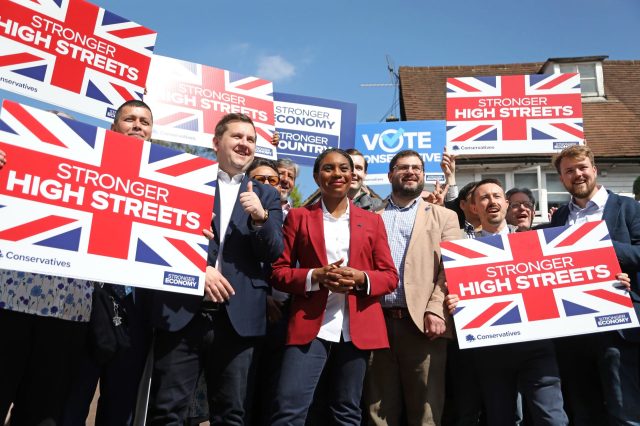
Kemi Badenoch campaigns in Old Bexley and Sidcup. (Alishia Abodunde/Getty)





It’s practically become an annual ritual. For almost two decades, from Blair to Starmer, politicians and journalists have asked the same urgent question: “Will the Prime Minister survive the local elections in May?” Will the results from far-off wards change the occupant of 10 Downing Street?
One forecast suggests Labour could lose almost 2,000 councilors this week, almost three-quarters of the local seats the party is defending. Translated to national politics, the vast majority of Labour MPs would lose their seats at the next general election. By the weekend, indeed, the Prime Minister may be so humiliated by a slew of town-hall debacles that he feels he has to resign — before his cabinet colleagues revolt.
The truth, of course, is far less dramatic. If Starmer is finally ejected from office, the locals will merely have been the straw that broke the Labour’s back. Even so, this intense springtime focus on councilors and wards really does matter, if not in the way Westminster thinks. By diverting resources away from the national crucible of government in London, as they frantically try to ensure a good performance in council polls, parties severely undermine the status and work of local government — harming everyone, whatever their politics.
That was clear enough last week, on the day the Commons voted on whether Starmer should be referred to the Privileges Committee. To guarantee victory, Labour whips summoned MPs back to Westminster from councils all over the kingdom — before dispatching them back to the campaign trail after marching through the Commons lobbies. To put it differently, then, many MPs, who are paid roughly £2,000 a week to be national figures, had been given permission by the Commons whips to skive off their normal Westminster work: to become foot-soldiers in council campaigns, and all at the state’s expense.
If the Westminster system is partly to blame here, the media is too. Indeed, I confess I was often guilty of emphasizing the national dimension of local politics during my long years as a TV reporter. Even so, it does feel as if things are getting worse. To give one example, the Green leader Zack Polanski was recently interviewed for almost 20 minutes on ITV’s breakfast show. Presenters Ed Balls and Susanna Reid asked Polanski at length about a whole string of national matters — drugs, speed limits, borders and immigration, fuel duty, and several other issues which have nothing to do with local councils. The Today program spent most of its local election interview with Nigel Farage asking him about his policies on welfare, again the opposite of a local authority matter.
In a sense, this nationalization of municipal elections is an inevitable consequence of how politics has changed. As councils face more and more regulations from Whitehall — over a dozen national bodies expect town halls to enforce hundreds of laws — it’s unsurprising that national debates on education or social care muscle into local elections. That’s especially true when Treasury constraints give councilors ever-less room for maneuver, with social care alone taking up 65% of their budgets.
Equally important is the depressing decline of local media. Even 30 years ago, many communities boasted several newspapers, with the local press feeling it was their duty to report matters in town hall and its council chamber. But now, there is no local media to speak of across 37 local authority districts, and the gap isn’t adequately filled by social media, let alone council websites. It’s therefore now quite hard for voters to know how a local council is performing — beyond their own personal experience — or to discover what plans it has for the future.
Taken together, anyway, this national obsession is grossly unfair to the principles of local government — to say nothing of those hundreds of thousands of people who work in town halls. British local government was developed over the centuries to promote accountability between governors and governed. Through regular votes at the ballot box, citizens would decide who should run their local services, with the power to eject them if they performed badly.
Increasingly, though, that process of accountability has broken down — and if national trends are largely responsible, voters hardly help themselves. After all, almost everyone now casts their ballots for national reasons, severing the vital link between the performance of local politicians and whether they deserve to stay in power.
There are exceptions, of course. The year-long bin strike in Birmingham, England’s largest local authority, may lose the ruling Labour group many votes, or anyway more than elsewhere. In general, though, Labour council leaders will be thrown out of office on Thursday not because they’ve run their plot badly, but because their electors are horrified by the performance of Keir Starmer and his colleagues in London. The same could apply to some Conservative council leaders, given the Tories’ equally low popularity under Kemi Badenoch.
And if this is bad for democracy in theory, it also discourages effective local governance in practice. Council leaders have little incentive to perform well, knowing their fate at the next local election will almost certainly depend on the ebbs and flows of their party’s national support. In some areas, meanwhile, voters will oust their councilors next week — even though they actually think the council’s doing a pretty good job. For them, giving Starmer or Badenoch a good kicking will take precedence.
What a sense of injustice that must create for councilors who have devoted years to public service. No wonder parties from Labour to Reform have so much trouble finding talented people to stand for council contests, even as the quality of those who do get elected invariably declines.
What, then, of the future? One solution is surely to exclude political parties from local government, as effectively happens with most parish councils where candidates generally try to secure election on their own personal merits. And, to be fair, there are still some remote corners of Britain where independent councilors remain a powerful force. In Pembrokeshire, for example, independents have run the council for decades, with a similar situation in the Western Isles of Scotland.
Paradoxically, national politicians are always telling us how much they’re committed to devolution, to letting local people decide at the lowest level. In that case, party leaders should stop getting involved in any local elections other than those in their own constituencies. More than that, Westminster MPs should be much tougher in not taking on local casework from constituents when the problem is often the responsibility of the local council. Their centralizing instincts aside, that might actually help MPs, shielding them from the public’s wrath when the pothole down the street isn’t filled in. Nor would this be anything new. Well into the postwar period, parliamentarians saw the Commons, not the town hall, as their place, understanding that their role was to represent their constituency — and not be distracted by every local challenge.
That, of course, would require a shift among voters. For while electors seem happy to see the locals as a great national opinion poll, they increasingly also seem to want their Westminster MPs to be local. Many electors equally insist their national representatives should be born and bred in the constituency, and preferably live there too. Until that changes, expect this country’s politics to struggle, wherever its representatives are based.
Michael Crick is a broadcaster and writer whose most recent book is One Party After Another: The Disruptive Life of Nigel Farage (Simon & Schuster). His Selections Twitter feed is @Tomorrow’sMPs
 MichaelLCrick