









May 1 2026 - 4:30pm
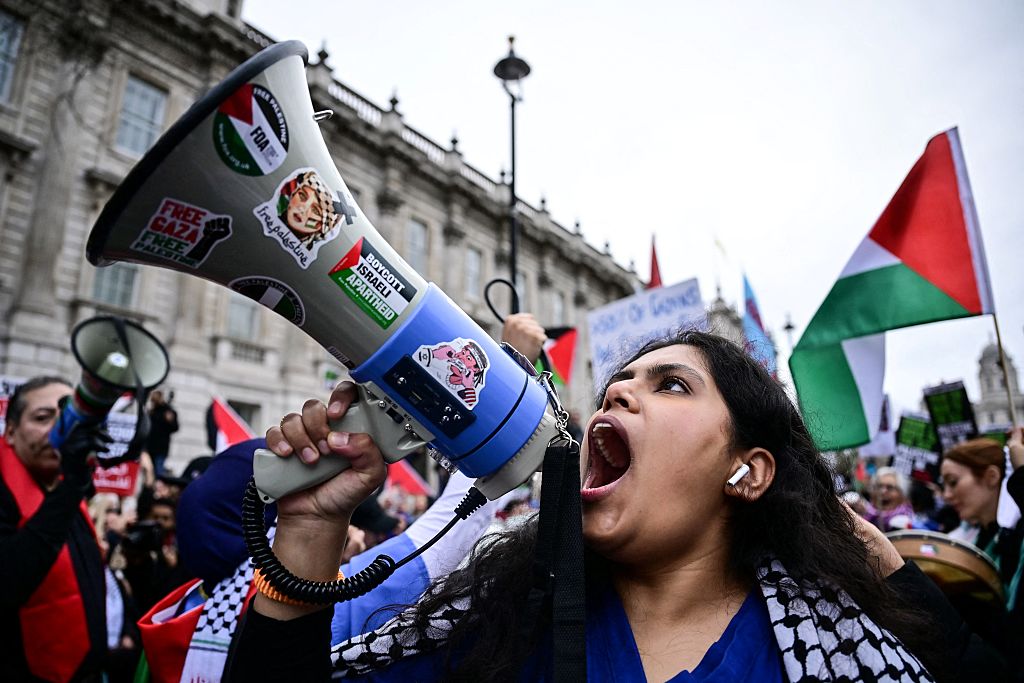
In the two and a half years since the beginning of the Gaza war, pro-Palestine marches — and the debates they generate — have become a mainstay in British politics. Supporters insist they are demonstrating for a righteous cause, defending the rights of a dispossessed people who are under siege by an expansionist apartheid state that is backed by a global superpower. Opponents decry the marches as a space where antisemitism is at best tolerated and frequently embraced, dressed in the guise of “anti-Zionism”, and where Islamist terrorist organizations such as Hamas and Hezbollah are glorified as valiant “resistance” fighters.
Following the stabbings of two Jewish men in Golders Green in north London on Wednesday, Jonathan Hall, the Government’s independent reviewer of terrorism legislation, called for a “moratorium” on pro-Palestine marches. The logic used here is that these marches and the sentiment behind them create an antagonistic atmosphere that normalizes antisemitism and, at the extreme end, offers a permission structure to those willing to murder Jews in the name of “resisting Zionism”. This week’s attack, as well as a recent spate of arson attacks against Jewish buildings in London and last year’s Manchester synagogue stabbing, appears to give credence to that view.
Yet, while there is much within the pro-Palestine movement which is deeply unsavory, including anti-Zionism which strays into genuine antisemitism, it would be unwise to ban the marches. Such a move would be lazy, illiberal and ineffectual. It allows politicians to present themselves as “tough” on antisemitism without tackling its roots, all while chipping away at the civil liberties of the population.
What’s more, the arguments in favor of a ban rest on faulty assumptions. An Iranian group with ties to the regime in Tehran has claimed credit for several of the recent antisemitic attacks in London, yet there’s no serious evidence that the Iranian state has played a part in organizing the pro-Palestine marches through the capital. Likewise, the Golders Green suspect has a history of mental illness, had been referred to Prevent in 2020, and was convicted of stabbing a police officer over a decade before that. In other words, his violence long predated the marches.
Crucially, any “moratorium” won’t protect Jews in the way its proponents hope. There is a real distinction between antisemitism and anti-Zionism, and many British Jews from across the political spectrum have publicly opposed the actions of the Israeli government. A blanket ban will bolster the false idea that to criticize the actions of the Israeli state is to engage in slander against the Jewish people. It will likely be interpreted as a demonstration of Jews being a “privileged” minority, a ward of the state, whose communal grievances are given a special hearing compared to other groups. This will make Jews more dependent on the very state that has failed to prevent numerous attacks on them, as well as fueling further resentment against the community.
In the aftermath of an attack like the one which took place in Golders Green on Wednesday, it’s tempting to demand “decisive” action. But one must always draw a firm line between the principle of the freedom to protest and the content of that protest. To give the state the right to suppress primarily law-abiding protests in the name of “security” is to surrender our ability to demand change. Inevitably, supporters of this view will create a rod for their own backs. The right to protest must apply to views we find objectionable. Otherwise, it’s nothing more than a privilege granted by the state.
Ralph Leonard is a British-Nigerian writer on international politics, religion, culture and humanism.
 buffsoldier_96