




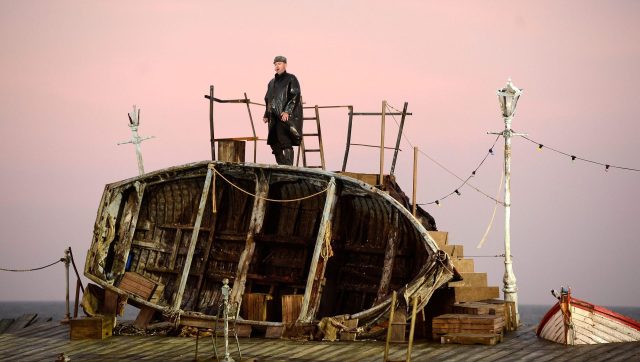
Benjamin Britten's Peter Grimes Live On The Beach in Aldeburgh 2013. (Bethany Clarke/Getty)





On a storm-lashed Suffolk coastline, a lone fisherman is persecuted by his community. So begins Peter Grimes, one of the cornerstones of 20th-century opera. Premiered at Sadler’s Wells in 1945, Benjamin Britten’s masterpiece has now been revived at the Royal Opera House, with shows running until later this month. About time: in its portrait of a rundown village plagued by paranoia, Peter Grimes is Britain’s ideal national opera — even as it gives us a chance to finally embrace a foundational myth for the 21st century.
“The art of music,” wrote Ralph Vaughan Williams, “above all the other arts is the expression of the soul of a nation.” Giuseppe Verdi knew this better than most. His opera about the Babylonian King Nebuchadnezzar’s conquering of Jerusalem, Nabucco, propelled the destitute composer to the epicenter of Italy’s artistic ecosystem: and also its politics.
Before unification in 1861, the Italian peninsula was a patchwork of separate states, with Habsburg Austria controlling much of the north. Risorgimento, the socio-political movement calling for Italian unification, called for the end of Austrian rule. Nabucco was the ideal candidate to become a symbol of the nationalist cause: in the plight of the Hebrew slaves, lamenting for their lost homeland, Italian audiences saw their own political struggle mirrored.
Smetana and Sibelius offered something similar for the Czechs and Finns in Dalibor and Finlandia. But the most ardent proponent of operatic nationalism is also its most infamous. Wagner intended his Der Ring des Nibelungen to be a foundational myth for a nation still in search of its soul. Like Verdi’s Italy, Wagner’s Germany was not a unified state, but rather a jumble of rival kingdoms, principalities, and free cities, loosely connected by a shared heritage.
Wagner was a passionate advocate for unification, writing often of his devotion to the “fatherland”. His involvement in the failed revolutionary uprisings of 1848 led to exile in Switzerland, where he conceived of and wrote most of The Ring Cycle, drawing on the Nibelungenlied and other medieval epics to craft a mythical vision of his homeland.
But why didn’t Britain produce its own Ring Cycle? The talent was there, but the need was not so great. Victorian Britain, at the height of its empire, had little use for art as a vehicle of national self-definition. Industrial prosperity and moral confidence sat comfortably alongside colonial exploitation. A nation that ruled a quarter of the world had no cause to go searching for its soul. Unlike the fragmented nations of continental Europe, still reeling from the shadow of Napoleonic conquest and Habsburg dominance, Britain knew, with considerable satisfaction, exactly what it was.
Indeed, Britain’s self-consciousness was already so distinct that it can use its identity as the basis of satire. Through Gilbert and Sullivan’s light operas we sense a culture so at ease with itself that it can afford to mock its own grandeur. HMS Pinafore lampoons Royal Navy hierarchies; Iolanthe pokes fun at Parliament; Ruddigore mocks the aristocracy.
It was not until Britain was reeling from the Second World War that a strong contender for a national opera emerged. Britten, fleeing war-torn Europe for America, stumbled across E.M. Forster’s essay on poet George Crabbe, whose poem “The Borough” was a proto-Dickensian narrative poem set on the Suffolk coast. It stirred in the expatriate composer, himself a Suffolk native, an overwhelming longing for home. Britten returned to Britain in 1942 and, collaborating with the librettist Montagu Slater, loosely adapted Crabbe’s work into what would become Peter Grimes.
After the mysterious but ultimately accidental deaths of his young apprentices, Grimes is ostracized by his village. Soon, the grim underbelly of the community is sliced open: blood, guts, and paranoia spill out. Grimes splinters into hysteria as the villagers become a murderous mob baying for blood.
Critics immediately recognized the opera’s power when it premiered at Sadler’s Wells, newly reopened after six years of wartime closure. New productions sprung up across Europe, ushering in a new age for British classical music.
As a gay man and a conscientious objector, Britten undoubtedly mapped his own sense of isolation onto Grimes’s exile. But the opera’s potency has grown beyond Grimes’s personal psychodrama. Despite being nominal victors in 1945, Britain had been left exhausted and bankrupt. On the international stage, its status as a global superpower was vanishing, and nationalist movements were gathering pace across its colonies.
With the empire’s days numbered, British identity faced an inflection point, and Peter Grimes has come to mirror this dynamic. The economic dereliction of the Suffolk fishing village bleeds into the psyche of its inhabitants. Boiling indignation fills in the hole in their hearts. Their hopelessness latches onto anyone who is perceived to threaten its fragile order, translating into violence.
Deborah Warner’s 2022 production, now back at the Royal Opera House, amplified questions about Britain’s post-Brexit identity crisis, updating the setting from Crabbe’s early 19th century to something more contemporary. A pugnacious chorus clad in football shirts wield Union Jacks as they call for Grimes’s expulsion, magnifying the moral panic and intoxicating power of the herd. When it premiered, the juxtaposition echoed the still-raw memory of the Euro 2020 final, where nationalism curdled from pride into persecution, and where some fans aimed racist abuse at black players.
Four years on from the original production, Warner’s blend of community decline, paranoia and nationalism has only become more searing. Like in 1945, after all, Britain must again search for its identity in a brave new world ravaged by disorder. We witness this identity crisis play out in public. A hard-Right resurgence proffers an ethnically exclusive vision of Britain. The Union Jack is brandished, like in Warner’s production, as a weapon of division rather than a unifying symbol of pride.
Political upheaval, if nothing else, gives us great art to wrestle with. Perhaps the national uncertainty we face today will inspire a new generation of artists to create new works that can mold a new identity for a new Britain. And as we continue to search for solid ground, post-empire, post-Brexit, post-certainty, we might do well to return to the Suffolk coast where the questions Britten embedded in Peter Grimes have not been answered — but have at least become clearer.