







 Prefer us on Google

April 27 2026 - 10:00am
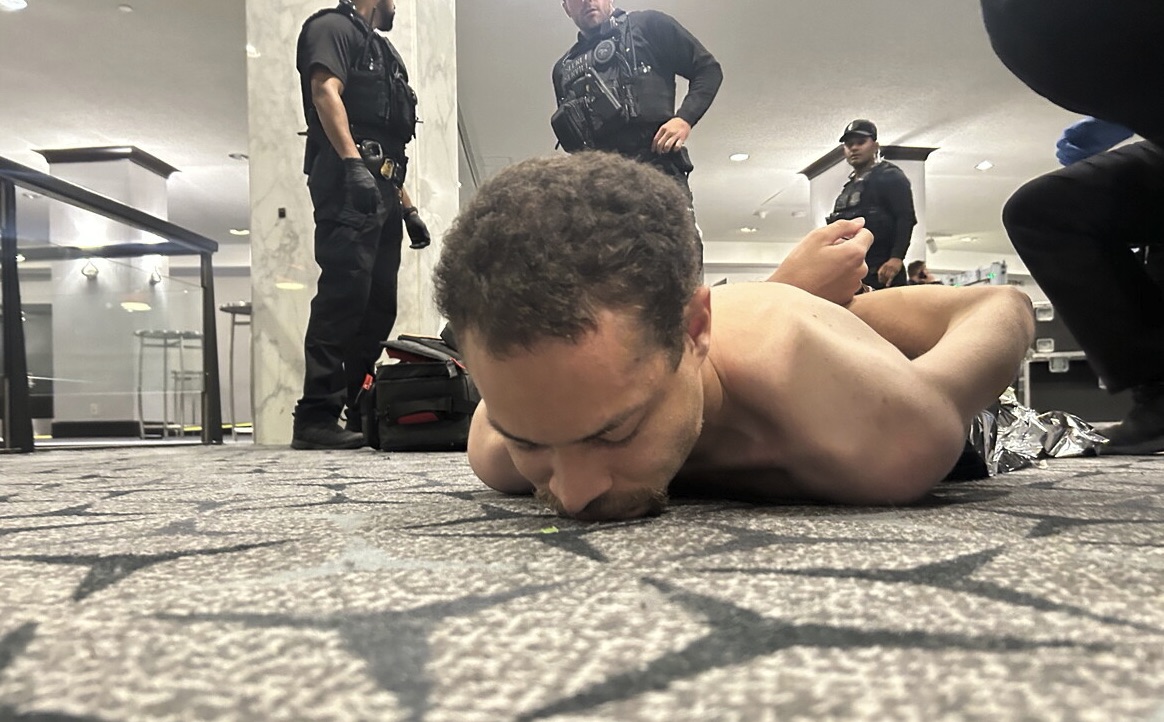
The Washington Hilton has all the luck, one must admit. In 1981 John Hinckley shot Ronald Reagan as the then-President entered his limousine outside. At the White House Correspondents’ Dinner on Saturday night, Cole Allen charged a Secret Service checkpoint inside the same hotel with a shotgun, handgun and several knives, minutes after emailing his family a manifesto in which he named himself the “Friendly Federal Assassin”. A Secret Service agent was hit but survived because of his body armor. Donald Trump and his cabinet were rushed out of the ballroom while several hundred journalists in evening dress dived under tables. The President later called Allen a “whack job” and a “lone wolf”.
The “lone wolf” framing has become reflexive, but Allen is not John Hinckley. Hinckley was a directionless lunatic trying to impress Jodie Foster. Allen, meanwhile, earned a mechanical engineering degree from the California Institute of Technology in 2017 and a master’s in computer science from California State, Dominguez Hills last year. He had interned at Nasa and won a Caltech robotics competition in 2016. His sister told the FBI he had attended a “No Kings” protest and been involved with the “Wide Awakes”, a social-justice activist group named after the 1860s abolitionist youth movement.
There are some interesting comparisons to be made with Luigi Mangione, the University of Pennsylvania graduate who, at the age of 26, shot UnitedHealthcare chief executive Brian Thompson outside a Manhattan hotel in December 2024. Mangione held two engineering degrees and was the founder of a campus video game development club. The Caltech robotics champion and the Penn engineering graduate are not the kind of men most would expect to see in perp-walk videos.
Earlier American assassins of consequence were also often men exposed to some theory. Leon Czolgosz read Emma Goldman and the European anarchists before he fatally shot William McKinley in 1901. Charles Guiteau, who killed James Garfield in 1881, was a Stalwart Republican obsessive who wrote his own book of theology. Lee Harvey Oswald left school at 16 but taught himself Marxism and Russian and defected to the Soviet Union before returning to shoot John F. Kennedy. The Hinckley type assassins are always with us while the half-organized, half-educated assassin shaped by an ideology is rarer. His appearance tends to mark inflection points in history.
Peter Turchin has a name for what produces these inflection points: elite overproduction. His somewhat controversial thesis, building on Jack Goldstone’s structural-demographic theory, is that when a society produces more credentialed aspirants than it has positions to absorb them, the surplus turns against the system. For example, France in 1789 had more trained lawyers than the Bourbon judiciary could employ, and they ended up staffing the revolution. The United States today produces engineers, lawyers, computer scientists and PhDs at a rate the labor market will not absorb, against a backdrop of stagnant wages, skyrocketing tuition fees and a housing market that prices out younger people.
Allen and Mangione certainly fit the “overproduced” profile. Mangione worked at TrueCar; Allen tutored high schoolers at a test-prep firm. Their attacks were planned with target lists, premeditation, and written justifications. Mangione carved messages into his shell casings, and Allen ranked his targets by seniority while explicitly excluding law enforcement.
Of course, shootings like these will keep happening for structural reasons that are getting worse. White-collar AI disruption is no longer hypothetical: entry-level coding, paralegal, copywriting and analyst work are all being automated at scale. Blue-collar wages will be pressed down further by a reserve army of unemployed citizens willing to take whatever work remains. The pool of frustrated graduates with technical training and no matching position keeps growing.
The nearest historical analog is Italy’s Years of Lead, the period from 1969 to the late Eighties when Red Brigades militants and neo-fascist cells produced parallel campaigns of bombings, kidnappings and assassinations. Many in the Red Brigades emerged from the Sociology Department at the University of Trento. The neo-fascists had their own intellectuals. In 1979 alone, Italy logged 2,514 acts of terrorism — more than six a day.
The United States has roughly five times the population today that Italy had back then. There are also 300 to 500 million small firearms in circulation, depending on how you count them, and a credential factory running well past saturation. Allen and Mangione are early names on a list that will surely get longer.
Oliver Bateman is a historian and journalist based in Pittsburgh. He blogs, vlogs, and podcasts at his Substack, Oliver Bateman Does the Work
 MoustacheClubUS