




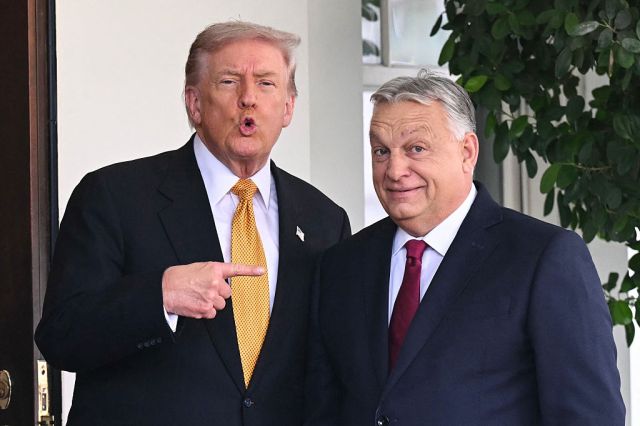
'What might be going away is the short-lived dream of an America-led solution.' (Saul Loeb/AFP/Getty)





Is this the end of the road for national populism? Viktor Orbán, Hungarian Prime Minister and bête noire of europrogressives since his election in 2010, is out of office, defeated in a landslide vote. At a symbolic level, this feels like the closing of a political chapter: one that roared into public awareness in 2016 with the twin “earthquake” of Brexit and Trump, and seemed, for a while, to have an almost geological inevitability.
In the wake of Brexit/Trump a wave of influencers (including me) theorized the end of liberalism, a retrenchment of globalization, and an insurgent, resurgent Right. With populist parties on the rise and rise across Europe and in the USA, and Orbán seemingly unstoppable in Hungary alongside (at that point) Poland’s conservative PiS government, all the cultural energy was bubbling up from this corner. It felt as though the pendulum had swung as far Left as it could, and was beginning its inexorable “RETVRN”.
Now, though, Orbán is out. Trump, meanwhile, has abandoned his campaign promise to end US interventionism in the Middle East. Forever wars are back; Hungary is “normalizing” relations with the EU. Is it over, then? Are we back in the End of History? Where does this leave the movement in which Orbán and Trump seemed such symbolic keystones? And where, in turn, does this leave Britain’s own would-be national populist insurgency?
The end of Orbán’s reign suggests there’s nothing inevitable about the ideological Right as it was envisaged by both proponents and opponents after Trump 1.0. But while Hillary Clinton is already gloating, this may be premature. I don’t think it follows from Orbán’s defeat that it’s just progressivism all the way now. Rather, the Hungarian turn against Orbán underlines the fact that structural factors driving so-called “national populism” have not gone away. And it underlines the fact that anyone who pledges to address those grievances, and fails to do so, will in time face the same anger. These things remain unchanged; what has altered, though, is something that should not elicit any gloating from the likes of Hillary. It does indicate a shift in for European populist movements: but less away from the Right, than away from America.
The picture was very different within the New Right that emerged following 2016. There, Orbánism served as a Rorschach test. His program rested on rejecting mass migration and LGBT activism in the teeth of pressure from Brussels and the international NGO class, all while seeking to incentivize pro-Christian Hungarian culture and family formation. The efficacy of the program itself was a mixed bag, but merely by pursuing it for 16 years Hungary came to occupy a dual role: both as a real place, with its own history, language, and local politics, and also an imaginary “place” in (heavily America-inflected) online political discourse.
Viewed in meme terms, Orbánist Hungary symbolized, among Anglophone progressives and their Eurocrat friends, the threat of authoritarian nationalist backsliding. For their opponents, it was as a pocket of resistance to woke totalitarianism, like the Right-wing equivalent of Asterix’s village holding out against the Romans. In practical terms, Orbán cultivated the latter image as a source of soft power, often in English, via a network of publications, think-tanks and other institutions funded by the Fidesz party, that enabled Hungary to punch some way above its weight in New Right intellectual circles.
The vision on offer was of a kind of nationalist Internationale, envisaged as a mutually respectful world of center-right sovereign nations, with strong borders and greater space for ideological pluralism: a “Europe of nations” as fellow national populist Marine Le Pen put it. In tandem, the geographic Budapest became, especially during the Biden years, a kind of Casablanca for disaffected Right-wing intellectuals. This Anglophone community of conservative expats comprised, in a sense, the real-world manifestation of the Right-wing meme Hungary, superimposed on and only lightly embedded in Magyar-speaking Budapest and its domestic politics.
The first sign that the memes might not be realized with the force of historical inevitability came in 2023, with the electoral downfall of the “based” Visegrad regime in Poland, at the hands of a coalition led by Teflon Eurocrat Donald Tusk. But then came the re-election of Trump to the White House in 2024, celebrated at an inauguration attended by numerous international Right-wing leaders including Giorgia Meloni, Marion Maréchal, and Javier Milei.
JD Vance castigated European states at Munich last February, for too much immigration and not enough defense spending: in other words, not being nationally sovereign enough. In November, a new American National Security Strategy (NSS) stated that Trump’s USA would support a vision of Europe as “a group of aligned sovereign nations”: the very vision promoted by Europopulists such as France’s Rassemblement National and Germany’s AfD. Had the hour of the nationalist Internationale come, at last?
Well. If Trump’s friends overseas hoped for a less globalizing America, and a US foreign policy keen to foster a Europe of nations, what they got was the monkey’s paw curling. Trump 2.0 has, to date, comprised such disorienting moves as punitive tariffs aimed — he says — at improving America’s relative position, but imposed every which way including upon putative allies. It’s included demands to annex Greenland from fellow Nato member Denmark, accompanied by some startlingly abrasive rhetoric. Latterly it’s included bombing Iran, in a joint operation with Israel, a move that has spiked energy costs in Europe, and been condemned by numerous European states, not to mention the Vatican.
Taken together, the impression is definitely of a less multilateralist USA. But if it’s increased European enthusiasm for more defense spending and sovereignty, it’s also scuppered the cozy vision of a nationalist Internationale — especially one led by a Trumpist USA. Indeed, Trump’s actions to date have rendered him so wildly unpopular across Europe that the surest way for the USA to lend support to a European populist party now would probably be encouraging King Don to say rude things about them on Truth Social.
These parties seem, themselves, to have recognized this, and are taking steps to disavow any electorally toxic association with Trump. RN and AfD have both spoken out recently against him. Even Nigel Farage, grinningly photographed in 2016 in the gilded Trump Tower elevator, has begun to distance himself, as have other supporters of Brexit.
But none of this tells us anything about the structural issues that drove those populist movements in the first place: immigration, living standards, and energy policy. This trifecta of wicked problems is so intertwined that it can appear as though solving any one of them will make another one worse. Some variant or other of this three-legged stool of populist disaffection can be seen across Europe, and none of these challenges have gone away just because Viktor Orbán became too firmly linked in Hungarian voters’ minds with crony capitalism and a pedophile cover-up.
Indeed Orbán’s successor, Péter Magyar, is hardly a squashy progressive. Himself a former Fidesz member, his campaign promises on immigration were even more restrictionist than Orbán’s. Meanwhile, Europe overall may be coming round to a more Hungarian stance on borders: recently it transpired that Brussels is exploring “Rwanda-style” offshore processing for asylum claims. So it may turn out, in the end, that Orbánism wasn’t so much defeated by the EU as assimilated into its program.
What is perhaps changing, though, is the perception among European Right-wingers of America’s role in these dramas. There’s long been a tradition on the European hard Right of hostility to the USA. For example, The American Malady, the “Nouvelle Droite” theorist Alain de Benoist paints America not as the savior of European civilization, as the NSS would have it, but rather as the force threatening it with extinction. Back in the heady days of Trump 1.0, arguments such as de Benoist’s seemed mad. Now, though, the transatlantic relationship is — if not exactly hostile — certainly warier. Shortly before the election in Hungary, Vance traveled to Budapest to address a rally there, in support of Orbán’s re-election. But it’s far from clear whether, at this point, an American endorsement would have been any kind of help.
What, if anything, can Britain’s insurgent Right-wingers learn from these developments? Well, first of all that the nationalist Internationale was perhaps always a contradiction in terms. Trump’s erratic second term has comprehensively and (I suspect) permanently shattered what remained of international faith in American global leadership. This includes the Hillary/USAID version, yes, but it also extends to the New Right version that imagined the USA “preserving the freedom and security of Europe, while restoring Europe’s civilizational self-confidence and Western identity to foster aligned conservative regimes internationally”.
My sense is that this is what Péter Magyar is responding to, in Hungary: a cold assessment that Hungary, historically a small state trapped between competing empires, needs to adjust its alignment. Whether or not it’s what he ends up delivering, what he offered voters was broadly the same conservative program as Orbán, but with less cronyism. And, importantly, more deliberate distance from a USA that appears to have set aside any aspiration to serve as moral exemplar, and is now, like China, simply a superpower pursuing its own interests.
Any national-populist government coming to power in Britain will need to make a similar assessment: taking cold-eyed stock of our country’s actual clout, and interests, and re-learning the art of statecraft based on these factors, rather than on sentiment or ideology. But any government offering solutions will also need to be frank about the trade-offs. Anyone who promises everything but fails to deliver, or just delivers more of the same plus some dank memes, will eventually face the kind of electoral anger that eventually turned on Orbán, and may turn on Trump.
As it stands, the hour for us is late. Britain hovers increasingly uncomfortably between the EU, the USA, and the Commonwealth, all of which now ask competing things of us. Our renewable energy aspirations, meanwhile, are unnervingly dependent on China. Our energy prices are some of the highest in the developed world. The cost of living is soaring yet again, thanks to Trump’s Iran war. Our welfare spending is unsustainable, our military is laughable, and despite all this Labour is putting asylum housing contracts out to tender that reach into the 2030s.
Sorry, Hillary: populism isn’t going away, because the problems causing it aren’t going away. What might be going away, though, is the short-lived dream of an America-led solution.
