




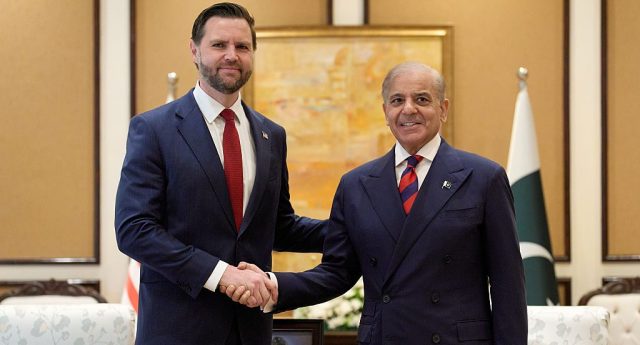
JD Vance with Pakistan's Prime Minister Shehbaz Sharif. Credit: Jacquelyn Martin/Pool/Getty Images





When a shaky eleventh-hour ceasefire between Iran and the United States was announced last week, Pakistan scored its biggest diplomatic victory in years. A meeting between the Americans and their Iranian counterparts in the Pakistani capital of Islamabad over the weekend — which represented the highest-level talks between the two countries since the 1979 Islamic Revolution — ended in failure. Yet despite the disappointment, the hard-won ceasefire has placed Pakistan at the center of world events. Not since the country served as the backchannel interlocutor between Beijing and Washington ahead of Nixon’s 1972 visit to China has Pakistan played such a critical role in diplomacy between the United States and one of its major adversaries.
Pakistan has not been alone in its recent diplomatic exertion: Turkey and Egypt also helped bridge positions behind the scenes, while China reportedly weighed in at a critical juncture. Pakistan’s prime minister Shehbaz Sharif also thanked Saudi Arabia for providing “invaluable support” to the entire process. The diplomatic efforts have been so extensive that some say that recent weeks have laid the tentative foundations for a post-war regional order, one in which countries that have taken the initiative to secure a ceasefire could play a leading role. A quartet sometimes referred to as STEP — an acronym for Saudi Arabia, Turkey, Egypt, and Pakistan — is being touted as a possible vehicle for maintaining peaceful coexistence with Iran while acting as a check on Israel. The development builds on existing trends. That the war’s mediation was enacted entirely by non-Western countries reflects the continued emergence of a more assertive Global South, along with its concomitant: a diminished United States and a curiously absent Europe.
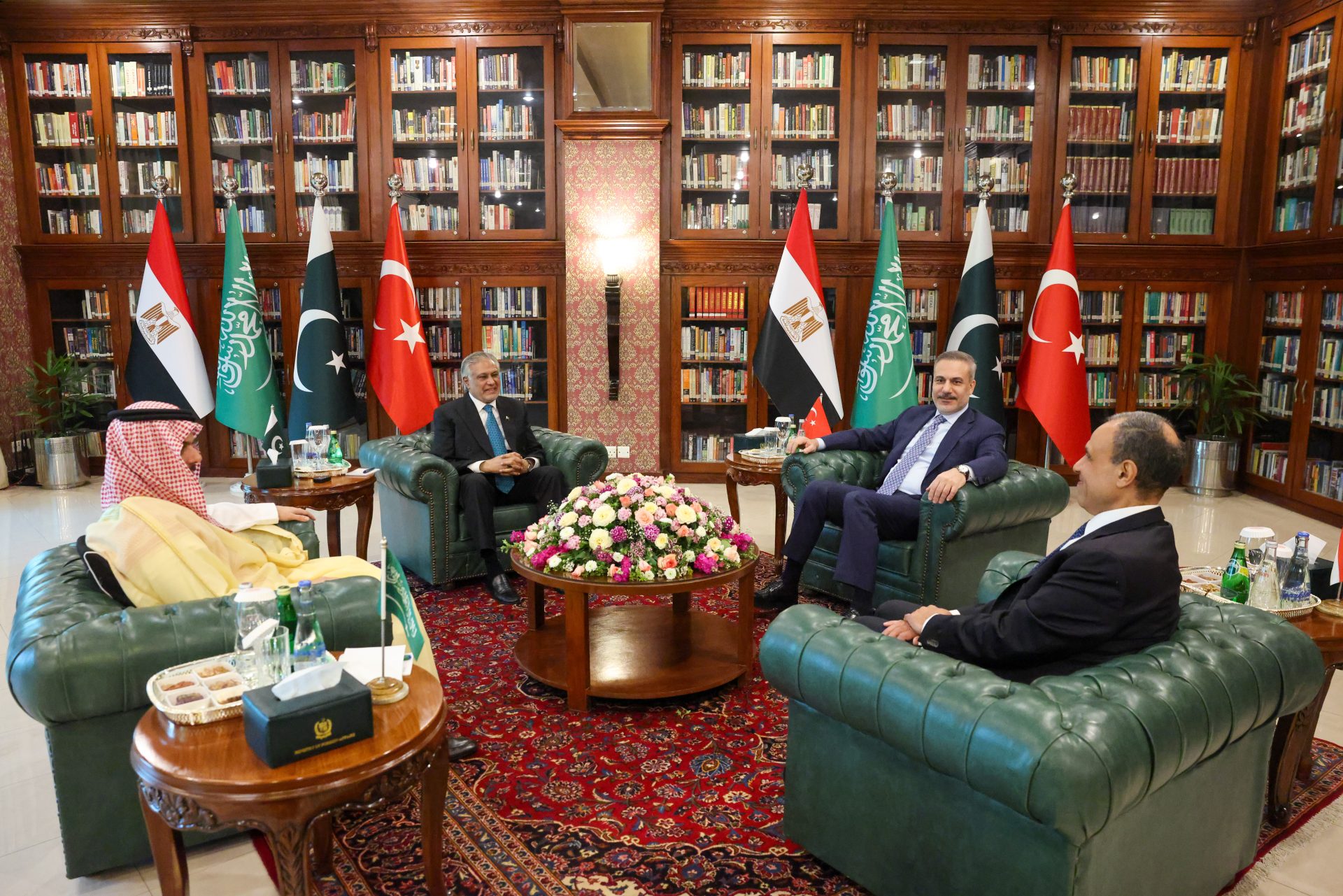
The foreign ministers of Pakistan, Turkey, Saudi Arabia and Egypt met twice last month, first on the sidelines of a summit of Islamic countries in Riyadh, and later in Islamabad for the first multilateral diplomatic meeting of its kind since the war began. That Pakistan would play host made sense: the country nurses good relations with Iran, the US, and China. The premier aim of the second meeting was orchestrating a ceasefire, but it may have contained the seeds of something more. If there is adequate diplomatic will, the coming together of these countries could translate into a reduction in regional dependency on the United States for everything from arms procurement to vanishing security guarantees. In all likelihood, regional powers will have to step in to fill the vacuum left by a weakened United States. According to the New York Times, “many” of the 13 military bases in the region used by American troops have been described as “all but uninhabitable”. “This is the physical architecture of American primacy, and Iran has essentially rendered it useless in the span of a month,” Marc Lynch, director of the Project on Middle East Political Science at George Washington University, said last Thursday. The new reality will likely demand a concerted response. As former US ambassador to Saudi Arabia Chas Freeman tells me, “West Asia, like Europe, is now in search of new arrangements to replace the Pax Americana.”
All four countries share a common interest in securing and maintaining peace. Though Saudi Arabia opposed the war before it began, the country was repeatedly targeted by retaliatory Iranian strikes, which prompted their position to change mid-conflict. After a few weeks, the Saudis decided that if the US started the war, then the US should finish it. And yet, their participation in the quartet indicates that they have also been hedging. Meanwhile, Pakistan and Turkey have real reason to fear that state collapse in Iran could spill across their borders. “In the event of Iranian nation-state collapse, the potential for more chaos in Iran’s Sistan and Baluchistan province could be exploited by armed factions fighting the Pakistani government,” Giorgio Cafiero, CEO of Gulf State Analytics, tells me.
Similarly, Turkey shares a 534-kilometer border with Iran, and is concerned that Kurdish militant groups could pose a cross-border security threat in the event of state collapse or a US-Israeli fomented uprising. Meanwhile, in Egypt, soaring energy prices and trade route disruptions — particularly those affecting shipping through the Suez Canal and Red Sea — have placed more pressure on an already brittle economy. Pakistan’s economic situation is also delicate: the country had only just begun to recover from one of the most devastating economic crises in its history when the war began. There were other sources of worry for Pakistan as well: the country is home to the second-largest Shia Muslim population in the world after Iran; at least 26 protesters were killed in clashes with police in Pakistan after Iran’s Supreme Leader Ayatollah Ali Khamenei was killed in a US-Israeli airstrike last month. Much of Pakistan’s Shia population regarded Khamenei as their spiritual leader.
Significantly, all four countries have also been eager to secure good relations with President Donald Trump. All are founding members of his so-called “Board of Peace”. Bilateral relations have also improved during the President’s second term. Last year, Trump returned from a visit to the Gulf touting that Saudi Arabia had pledged $600 billion in investments in the United States. Turkey-US relations also appear to be on better footing, a development rooted both in the personal rapport between Trump and President Erdoğan and in revised US policy: the Trump administration lifted crippling sanctions on Syria last year, and supported the integration of the Kurdish-led Syrian Democratic Forces (SDF) with the Syrian army, two of Turkey’s key demands for post-Assad Syria. The government of Pakistan announced last year that it was nominating Trump for the 2026 Nobel Peace Prize, while in the White House, Pakistan’s army chief and de facto ruler, Field Marshal Asim Munir, is known as “Trump’s favourite field marshal”. And when Trump announced last year’s supposed ceasefire in Gaza, he did so in the seaside resort of Sharm el-Sheikh in Egypt — against a backdrop emblazoned with the words “peace in the Middle East”.
Despite all this Trumpian backscratching, the Israeli-US war on Iran has inevitably forced some nations to revise their thinking. For many, the Americans have discredited themselves, both as reliable negotiators and guarantors of security. “The envoys fielded by the Trump administration are persona non grata with Iran due to their repeated participation in deceptions to facilitate surprise attacks and their perceived amateurish incompetence,” Freeman says. Further, he suggests that the Israeli-American assault on Iran demonstrated indifference towards many allies in the region. “It has become apparent that the United States cannot defend them against Iran and that it assigns military priority not to them but to Israel,” he says. It’s now clear that they need “a new security architecture in their region to coexist with Iran and to deal with the direct and indirect threat from Israel as well as unconditional American support for Israeli aggression”.
Recent events are likely to lead to greater regional cooperation — a process that was already well underway before the latest war on Iran began. After Israel’s attack on Qatar was met with only the faintest of rebukes from Washington last year, Pakistan and Saudi Arabia signed a Strategic Mutual Defense Agreement; like Nato’s Article 5, the agreement stipulates that “any aggression against either country shall be considered an aggression against both”. The move was widely interpreted as a sign the Saudis were no longer relying on the United States for their defense. In January, it was reported that Nato member Turkey was also thinking about joining the Saudi-Pakistani defense pact. This generated talk of a so-called “Muslim Nato”, a development that is probably still far off, if it’s even possible at all. But more piecemeal defense pacts are very possible. Experts have noted that these countries complement one another: Turkey has a large defense industrial base, while Pakistan has nuclear weapons. And Saudi finance would be a welcome balm on both countries’ ailing economies.
Meanwhile, Europe is nowhere to be found. The EU’s influence in the region and the world is at its lowest ebb in recent memory. With its singular preoccupation with Ukraine, Europe has effectively become a single-issue continent. Indeed, there was no European involvement in the Iran War mediation efforts at all. When British prime minister Keir Starmer announced he was travelling to the Gulf to demonstrate his support for the ceasefire last Wednesday, he was roundly mocked on social media as the face of British impotence and irrelevance. European Commission president Ursula von der Leyen faced similar opprobrium for Europe’s passivity when she announced her own support for the ceasefire and gratitude for Pakistani mediation. Nato Secretary General Mark Rutte flew to the United States last Wednesday in a slapdash effort to convince Trump not to follow through with threats to pull the US out of Nato. In a servile interview on CNN, Rutte said that the world was a safer place “thanks to Trump’s leadership”. With the exception of Spain and some vague gestures at independent thought from Austria and France, most European leaders have appeared largely content to play the role of pliant vassals.
European acquiescence contrasts with Turkish assertiveness, with Ankara appearing especially intent on shaping the emergent order to its liking. Before leaving for a meeting of the quartet in Islamabad on 28 March, Turkey’s foreign minister Hakan Fidan spoke to an audience in Istanbul about the need for the region to take responsibility for its own problems. “Our region should not be vulnerable to external intervention anymore,” he said. “We need to break this vicious cycle with a common vision and joint endeavor, and we are going to achieve it through regional ownership.” The concept of “regional ownership” is something the Turkish government has promoted extensively in recent years. It “implies that major developments in the region directly affect Turkey, and therefore Turkey has an obligation to be involved in order to shape their course”, Mustafa Caner, assistant professor at the Middle East Institute of Sakarya University, tells me. “If extra-regional great powers act recklessly and irresponsibly, regional countries must assume responsibility themselves.” Other members of the quartet concur. As one Pakistani official told me, “together, [the four countries] represent a form of cooperative, action-oriented diplomacy from the region that has been absent for too long”.
But last Wednesday, the Financial Times alleged that Pakistan’s mediation hadn’t been so self-directed after all. According to the report, Trump had ordered Pakistan to secure a truce, since the US purportedly believed that Iran would be more likely to accept the offer “if it was delivered by a Muslim-majority neighbor state”. A blunder made by Pakistani prime minister Shehbaz Sharif fueled speculation that Pakistan was doing Trump’s bidding: when the premier posted the ceasefire proposal on X, he mistakenly included a subject line that read “draft — Pakistan’s PM message on X”. Some interpreted this as evidence that Sharif’s team had posted a statement written by the Trump administration. But a Pakistani official, who spoke to me on condition of anonymity, pushed back against suggestions that Pakistan was merely acting on Trump’s behalf. “For any successful role of a facilitator, you need to have the trust of both sides and their common belief that their interests are better served by coming to the table,” the official said. “Therefore, the question of one party pushing Pakistan to play a certain role doesn’t arise.”
The other three STEP countries also share a desire to present themselves to the world as peacemakers. At the opening ceremony of the Grand Egyptian Museum in Giza last November, Egyptian warplanes flew a banner that read “Welcome to the land of peace”. The country has been eager to depict itself “as a beacon of peace and civilization in a volatile region”. In recent years, Turkey has hosted multiple rounds of peace talks between Ukraine and Russia, leveraging its “in-between” geography to promote itself as a reliable alternative to Western mediation. And at the beginning of Trump’s second term, Saudi Arabia rolled out the red carpet for high-level negotiations between the United States and Russia. Cynics may be tempted to view the “peacemaker” nation-branding as a kind of “peace-washing” — an attempt by strongmen to distract from mounting domestic woes and put on a humanitarian face for the world. And yet even the most virulent of critics probably prefer that these peace initiatives exist rather than not.
It remains to be seen whether the quartet’s diplomacy contains the seeds of something more lasting. As JD Vance left the failed talks in Islamabad on Sunday morning, he hinted that a peace agreement may still be reached soon. Successful mediation in the current conflict might give the quartet the confidence and momentum necessary for a more durable bloc to take root. Either way, there is no going back to the previous state of affairs. While Iran is unlikely to succeed in forcing the full withdrawal of the US military from the Middle East, the American role will almost certainly be reduced. For those with the political will and diplomatic imagination, this should set the stage for a new order to emerge.