




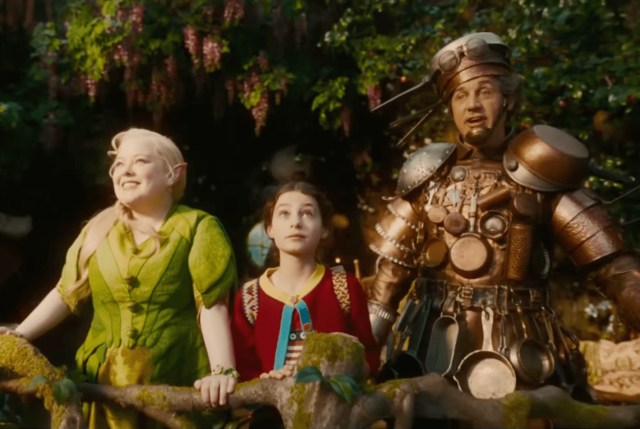
’Blyton's stories are fantastically, nostalgically fun.‘





When I was little, some time after Mr. Men and before Just William, my mother used to read to me and my brother from Enid Blyton’s The Magic Faraway Tree. Every night we would slip away into the Enchanted Wood, climb the Faraway Tree, and explore whichever strange, magical land was then stationed on the clouds above. Often the chapters ended on cliffhangers — would they make it back to the tree in time, or would they be trapped in the land forever? — so the days went by in strained anticipation. Now there is a film adaptation, written by Simon Farnaby, of Horrible Histories fame (another childhood favorite). It attempts to tap into the nostalgia about Blyton’s world which afflicts me and countless others.
It did not occur to me, when I was young, that our bedtime reading was also my mother’s first encounter with the Faraway Tree series; only later did I learn that her parents had strictly banned Blyton from their house. They were not alone: children’s libraries and the BBC banned Blyton too. Blyton, it was thought, was the quintessential parochial conservative, to whom the pliable minds of children ought not to be entrusted. While never mean-spirited, as Roald Dahl was known to be, Blyton’s stories tend to reward children first and foremost for their obedience (usually, in the Faraway Tree series, with some kind of magical sweet, like “pop cakes” or “google buns”). My doctor grandmother was probably unhappy with the gender roles at play. Even among the three children in The Magic Faraway Tree, Joe is the intrepid adventurer, while his sisters Beth and Frannie are more interested in fairies and flowers. At least The Famous Five had the tomboy George.
In 1973, her fellow children’s author Aidan Chambers inveighed against Blyton’s “triviality, linguistically impoverished style, anaemia in plot and characterisation, and clichéd, stereotyped ideas”. Writing in the Eighties, Fred Inglis, a high-minded critic, accused her of “representing the crude moral diagrams and garish fantasies of her readership”, her readership presumably comprising bigots like six-year-old me. Another author said that her books were “for children who are not very old, or not very clever, or not very well” — children who needed the comfort of monosyllables, and repetitive, formulaic narrative. My unwell, dimwitted, younger self would have been reduced by all this to tears.
Little wonder Blyton’s books have been tampered with for years, well before the advent of sensitivity readers. I grew up with Joe, Beth, and Frannie, and only learned later that, for whatever reason, they were originally Jo, Bessie, and Fanny. Dame Snap, the strict schoolmistress to whom the naughtiest pixies are sent, was “not at all a nice person”. Before the abolition of corporal punishment, she was even less nice: her name back then was Dame Slap (there is a good gag about this in the film).
As early as 1960, Macmillan declined to publish The Mystery that Never Was on account of Blyton’s “faint but unattractive touch of old-fashioned xenophobia”. Some of that xenophobia appears in the Faraway Tree series: people who are unlike ourselves are things to be gawked at. The film gets around this with a suitably diverse cast. The golliwogs in Noddy surely didn’t help Blyton’s reputation either, even if their presence in the stories was likely well-intended. The attacks on Blyton culminated — of course they did — around 2020, when English Heritage caveated her Blue Plaque with a “reappraisal”, to “better reflect today’s values”, and the Royal Mint canceled plans to give her a commemorative coin. It is probably for the best that The Magic Faraway Tree was adapted to film after those passions had begun to cool down.
More than her perceived racism, sexism, and xenophobia, what unsettled people most about Blyton was always her popularity. What did it say about British children that they so adored her books? Were they — were we — narrow-minded oiks, too? Blyton was for British children as, say, Agatha Christie was for their parents: a fine spinner of yarns, but inescapably “middlebrow”. And all this still leaves another question. How to bring Blyton’s “crude moral diagrams and garish fantasies” to contemporary audiences? How to bring Blyton’s England — the England of dandelion and burdock, where children say things like “do let’s”, “good gracious”, and “pooh!” — to an England where children are more excited by the numbers “6, 7”?
When thinking of adapting his source material, Farnaby was faced by more specific problems too. One is that the Blyton’s stories have no overarching plot fit for a feature film: they would lend themselves better to a TV cartoon of 22-minute episodes apiece, each with its self-contained adventure. Another is that the children in the books are extraordinarily insipid. The film, set in the present, solves the problem by making them angsty and screen-addled. They are not happy about leaving the city for the country. They grumble and scowl on the train to their new home; they are terrified (correctly, it turns out) that there won’t be any WiFi. The children in Blyton’s books are happy-clappy from the start; there is no arc for them to go on. “I shall pick as many flowers as I want to”, says Book Beth. Film Beth, a 2014 Tumblr feminist with Goth characteristics, seems to hate flowers: her arc is completed when she puts one in her hair. The film updates the story for the present by giving it a familiar moral: kids should put down their damn phones and play outside.
To make that moral work requires an even bigger change: the parents must be put center-stage. In the books, they are scarcely mentioned — except, of course, when the mother packs sandwiches for the children. The parents give the film a chance to flip Blyton’s traditional gender roles; we have a stay-at-home dad (Andrew Garfield) and a girlboss mom who’s nifty with a spanner (Claire Foy). Their role in the story is to drive the moral home: they were right, after all, that their kids would be happier with some country air. Perhaps children today don’t understand the kind of freedom on display in the books; or perhaps their anxious parents don’t want them to.
Farnaby has had tremendous success with Paddington 2 (2017) and Wonka (2023). Thematically and tonally, The Magic Faraway Tree is something different. Paddington and Wonka are both about the hubbub and excitement of the Big City. They are about children (Paddington and Wonka are essentially children) finding their way in an intimidating, adult world. In Blyton’s simple, rustic universe, adults and the adult world might as well not exist: the children inhabit a world of their own. It is no accident that Blyton’s peak coincided with the Second World War; though this is never explicitly stated, The Magic Faraway Tree is basically an evacuation caper, about city kids enjoying the freedom of the open air with their parents nowhere in sight. It is a paean to the countryside as a stage for the imagination, a staple of children’s literature from The Wind in the Willows to Watership Down.
Blyton’s books convey a certain image of Englishness. Her England is rural, inward-looking, and, of course, white; it is the familiar stuff of mid-century nostalgia, of “suet pudding and red pillar boxes”, and “maids hiking to Holy Communion through the mists of the autumn morning”. The more fantastical elements bear traces of English folklore: angry pixies, trickster gnomes, benevolent wood nymphs. The books play around with classic English fairytales; some of the more memorable set-pieces involve “Goldilocks and the Three Bears” and “Jack and the Beanstalk”.
Such an image of Englishness still has political teeth. Blyton’s books, it was claimed in Prospect in 2017, “set the stage for Brexit fantasies”. This is an exaggeration, but there might be a kernel of truth. After all, The Magic Faraway Tree plays on a dichotomy between town and country, with the latter representing “real Britain”. The film version updates this for the present, by contrasting the city, with its TikTok and smart fridges, to the vigor and magic of the countryside. The Paddington franchise, of course, takes the opposite view. In Paddington, London — or, at least, the colorful terraces of Notting Hill — is the real Britain, the shining template for the rest of the country to follow.
Paddington, with its Big City themes, could thus be made to fit neatly into the official ideology of modern, urban, multicultural Britain. It is nostalgic, too, but its nostalgia looks back to a particular moment of postwar affluence, rather than to Blyton’s pre-industrial idyll. For his part, the bear has been transformed into the patron saint of 21st-century Britain. He accompanies the Queen to heaven as a marmalade-guzzling psychopomp. In sentencing, judges solemnly pronounce to criminals that “your actions were the antithesis of everything Paddington stands for”. A London mural much adored by Stella Creasy MP shows Paddington doffing his cap, with the caption: “Mrs Brown says that in London everyone is different, and that means anyone can fit in.” The polite, assimilated immigrant — the fact that he is an immigrant is tirelessly pointed out — has become the mascot of “British values”. Paddington has something to say, however mawkish and obnoxious, to Britain as we find it.
Blyton, provincial and backward-looking even in her own time, has far less to say to us — which is why Farnaby had to make something up about screens. But perhaps her “simplicity”, much scorned in her own life and since, was always to her advantage. She has nothing much to say to us, and therefore nothing mawkish and obnoxious. And, as her young readers are continually finding out, that’s never got in the way of her stories being fantastically, nostalgically fun.
