




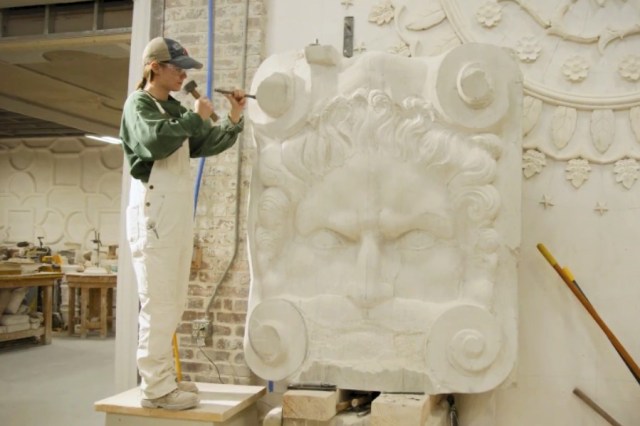
'The college has emerged as an early model for a more human-centered craft education.' (Credit: American College of the Building Arts)





Each weekday morning, just before the city wakes, a handful of fresh-faced students make their way down Meeting Street toward the last remaining trolley barn in Charleston, South Carolina. Dressed in Carhartt hoodies, carpenter pants, and beat-up leather workboots, they disappear into studios and workshops where they transform raw materials — cedar, limestone, and clay — into stunning architectural features. The nearly 130-year-old brick building, which once sat empty and crumbling, is now home to the American College of the Building Arts (ACBA) — the only accredited four-year college in the United States that combines a liberal arts curriculum with hands-on training in the traditional building trades.
In recent years, as the rapid development of artificial intelligence has given rise to anxieties about the future of work, the college has emerged as an early model for a more human-centered craft education. It offers a holistic alternative to the traditional university-to-white-collar route, one that focuses on training both the body and the mind. The idea is to prepare students for the coming era of technological disruption by helping them develop a deeper understanding of those qualities that have traditionally shaped the built environment: empathy, patience, humor, and an appreciation of beauty. These are not easily replaced by machines, precisely because they’re rooted in humanity.
The renovated warehouse is a fitting setting. Charleston — with its unique blend of Georgian, Federal, and Greek Revival architecture — boasts one of the largest historic districts in the United States. ACBA was founded in part to help maintain that built legacy.
When Hurricane Hugo tore through Charleston in 1989, damaging 80% of the city’s homes and businesses, local leaders discovered that there were not enough traditional artisans in the nation, let alone the state, to make necessary repairs to historic properties. Industrialization, combined with a cultural shift toward white-collar work, had almost entirely erased the craft of building. As a result, efforts to reconstruct the city were delayed. Desperate homeowners commissioned tradesmen from outside the United States or otherwise relied on contractors who used modern construction methods that undermined the historic integrity of the buildings.
Alarmed by this shortage of skilled artisans, preservation groups began laying the groundwork for an institution that could bridge the gap. What began as a skilled trades summer program for high school students then evolved into a series of community workshops called the School of the Building Arts (SoBa). In 2004, SoBa formalized its curriculum and began offering four-year degrees. It also adopted a new name: the American College of the Building Arts (ACBA).
In the years since, the school has developed a reputation for training meticulous craftsmen capable of safeguarding millennia-old building traditions. In addition to assisting with major projects in and around the city of Charleston, students have supported work at the White House, the U.S. Capitol, Monticello, Mount Vernon, England’s Lincoln Cathedral, and Germany’s Hundisburg Castle. In an environment that favors speed over quality, the college is concerned with making objects of enduring physical beauty. In fact, that’s at the heart of its mission.
Though the school allows and even encourages the use of digital tools, it requires its students to learn to do things by hand first. In one classroom, first-year students pore over digital images of Venetian facades, and then put pencil to paper in an architectural drafting exercise. When I approach her desk, Omarion McKinnon, a petite young woman with a warm expression and a searching gaze, points out to me the architectural wonders of the Doge’s Palace.
Yet when I ask her what brought her to the school, her mind turns toward home to Beaufort, South Carolina. It’s the second oldest city in the state after Charleston. On her phone, she searches for photographs of places she knows more intimately — town centers and white churches, some with tabby walls. Her interest in design was informed, in part, by her deep familial connection to the place. A couple of times, she mentions Saint Helena Island, home to a rich architectural legacy shaped by the Gullah Geechee — an African American community that has preserved African cultural traditions for generations and helped make the Sea Islands a center of creative flourishing. “I do think it would be pretty cool,” McKinnon says, “if I could play some part in helping to preserve places like these.”
That idea — architecture as an expression of cultural identity — is part of the school’s broader philosophy. Through its liberal arts curriculum, it teaches students about the history of craft, but it also teaches them to grapple with difficult histories manifested in the material world, including Charleston’s history of racial oppression. “It’s really important to us that the educated artisans we’re producing understand that they’re part of a long continuum,” Christina Butler tells me. “We want them to be thinking through these difficult questions, regardless of what the answers might be”
Butler, who serves as Provost and General Chair of Education, goes on to warn that “some of these trades that have been passed down generationally almost completely disappeared in the 20th century”. “And they will disappear if there’s not a way to pass them forward,” she says.
The college’s curriculum is specifically designed to support students as future professionals in the building trades, including through courses in literature and philosophy, business leadership and construction management, communications and composition, and mathematics and the material sciences.
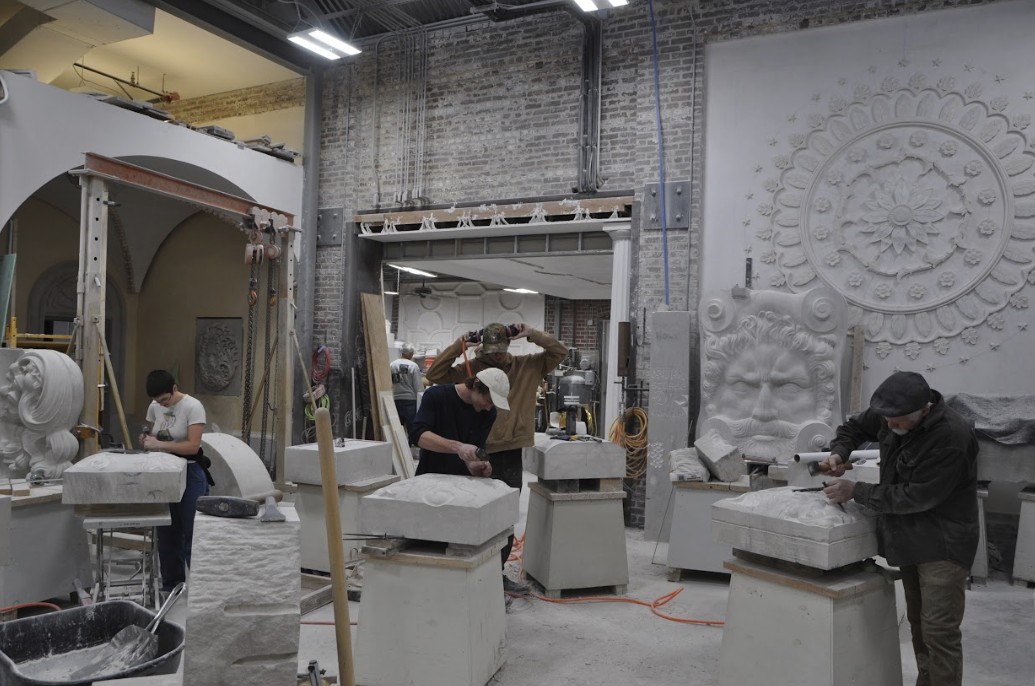
In addition to their academic studies, they spend at least 10 to 15 hours each week in trade-specific workshops where they refine their skills in one of six specializations: architectural carpentry, blacksmithing, classical architecture and design, plaster, stone carving, and timber framing. Inspired by France’s Compagnons du Devoir, a prestigious 10-year apprenticeship program that originated during the High Middle Ages, the school adopted a similar (albeit condensed) model that emphasizes observation and practice, technical development, and demonstration of mastery.
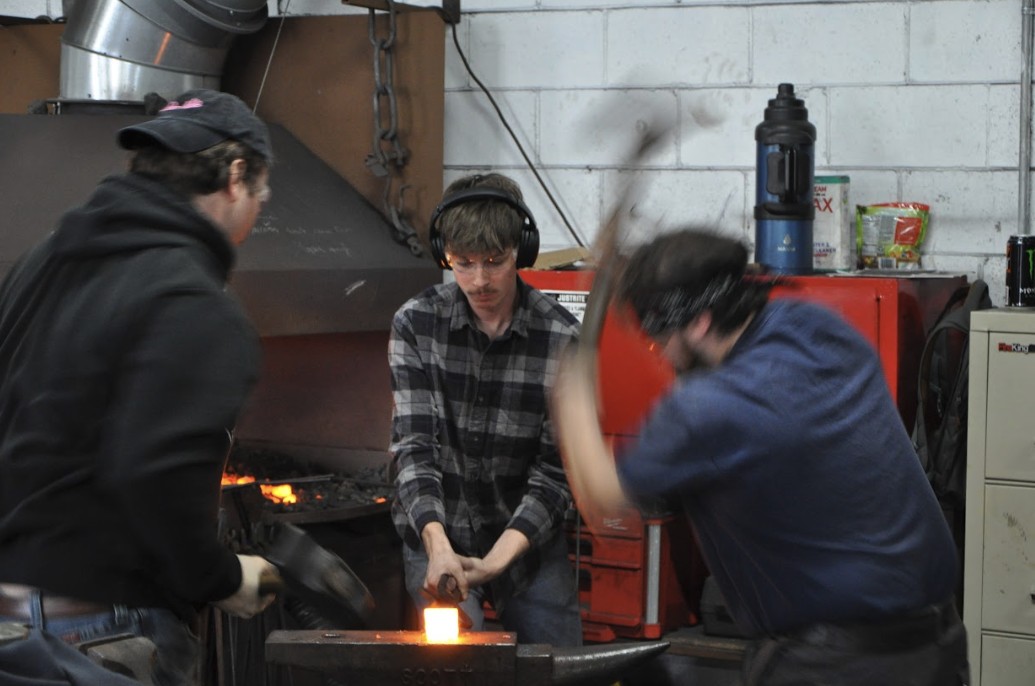
Mentorship is at the core of practice, and it’s not uncommon for graduates to return to the college as instructors. Casey Hebel is a 2025 graduate who now serves as an adjunct professor. A Northern Californian who came to ACBA from the Marine Corps, he takes satisfaction in difficult tasks. When he left the military, he had a buddy who was already training to become a blacksmith. He was enticed by the idea of using brute force to bend and shape metal. “You’ve already done something hard and laborious,” he tells me, rocking back and forth from his heels to his toes as he talks, “so it’s exactly the sort of thing you’re drawn to”
Now, Hebel is concerned not only with the practice of blacksmithing, but with the trade’s future. In 2012, NPR estimated that just 500 to 1,000 professional blacksmiths remained in the United States. Today, that number is likely even lower. “We are trying to remind people that it’s for the common good that these kinds of crafts continue to exist,” Hebel explains. “As soon as that knowledge goes away, then people stop building these kinds of things into their designs.”
Even before Hurricane Hugo, there were warnings that the traditional building trades were disappearing in the United States. Following the 1966 passage of the National Historic Preservation Act, comprehensive legislation designed to protect historic places amidst a wave of urban renewal, the National Trust for Historic Preservation (NTHP) released the 1968 Whitehill Report detailing major gaps in the preservation workforce. It warned that new building methods, inspired by new materials, were erasing the skills necessary to repair and maintain old buildings. There would be no easy fix, the report said. Instead, preservationists would have to come up with “a new solution”. It advised that these young men and women should not only engage in conservation work, but in making “contemporary works of beauty” as well.
It’s a recommendation that ACBA takes seriously. Seniors are required to design and execute a masterwork that demonstrates both technical skill and conceptual understanding. In the wood shop, Brendan Cerling is constructing a portative organ, its pipes carefully sized and shaped to produce melodic hymns. Nearby, Lee Brooks is building a desk with delicate features, “mostly as an excuse to do the tiny, particular, decorative stuff”
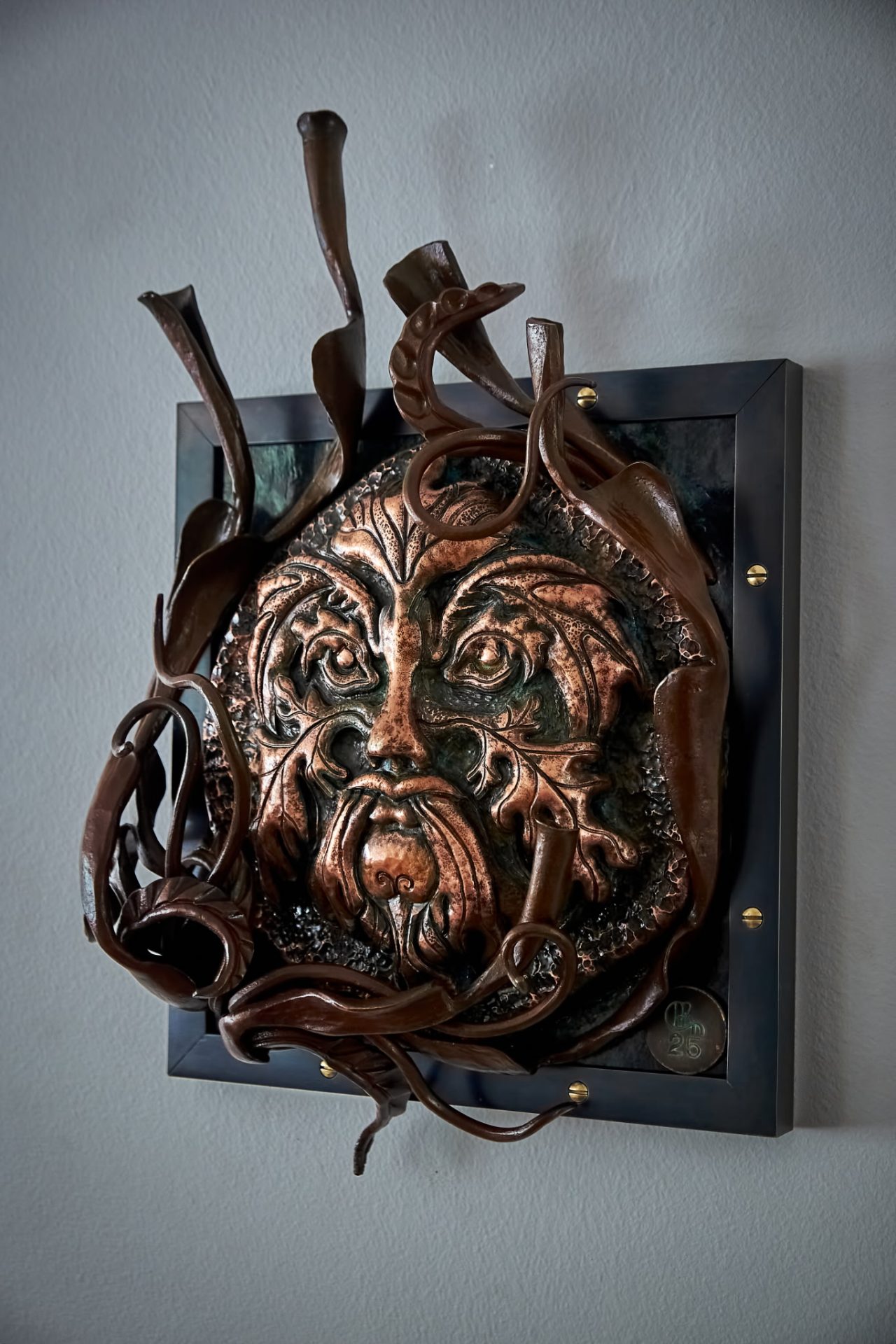
In the blacksmithing shop, Riley White is at work on his own capstone project, which is also a commission for a local client. “Do you want to see?” he asks. He steps away for a moment, and when he comes back, he’s carrying a portfolio. He opens it to reveal sketches of an Art Nouveau lantern bracket that spans eleven feet from end to end. “You know how good it is, right?” I ask. “I wasn’t that confident when I started,” he says through a grin, “but I’ve had to sell it to so many people at this point, it feels like it has to be good.” As a final touch, he plans to restore a copper lantern that has been in the client’s family for generations. “It’s amazing,” he says. “I get to leave a mark on a city that I love.”
The physical, tangible nature of the work is part of what draws students and — increasingly — parents to ACBA. As the entry-level white-collar job market begins to evaporate, and as debates rage about the value of the four-year degree, there’s been a renewed interest in heritage crafts and in the trades as a whole. “What we’re finding,” Christina Butler says, “is that the stigma about the trades is fading away. There are high schools all over the country trying to reintegrate programs that were eliminated in these last decades. Everybody recognizes that there’s work that’s well paid now, and it’s work that we need.” When it comes to the traditional building trades, she says, there will always be people who want things that have been touched by human hands.
Even in this brave new world, where automation and instant gratification proliferate, ACBA students and graduates are finding work in new construction. That includes the new Courier Square project just north of the city. Students are contributing architectural elements — iron lanterns, gates, stone columns, sculpted terracotta panels, and hand-carved keystones representing each of the four seasons — to a large multi-family building that’s been dubbed the Laurel. Christian Sottile, one of the architects behind the development, said that working with ACBA has helped to humanize the project. He believes that the idea that traditional building arts are only for historic upkeep is outdated. “The frontier is new buildings,” he told me in an email. “The world needs artists. It needs a built environment that we can fall in love with again.”
Bri Meyer, a blacksmithing student with a keen eye for detail, puts it another way: “Why not make something that inspires joy?” she asks. Meyer has watched people walking through Chicago, her hometown, with their heads tucked into their chests and their eyes cast down on the pavement. “When there’s nothing worth looking up at,” she says, “then people just don’t look up anymore. The world becomes tragic.” Like looking into a black box. She shows me some of the things that she’s made, a candle stick with dripping wax and flowers so delicate that they don’t seem made of metal. “You know you can get blind to beauty,” she says. She talks about the small ways she’s finding to fight against that. “A little wisp of flower here and there. If you change from iron to copper, you get a beautiful glow. Might as well, you know? Might as well.”
The city settles in for the evening, and I linger for a while in the stone shop. The elegant white sculptures at the perimeter of the room make the space feel sacred. Resting on overhead shelves are dozens of medallions hand-carved for the Courier Square project. “Each one of those is distinct,” Professor Joseph Kincannon tells me. “If you really look at them, they’re almost like fingerprints. When everything is the same,” he continues, “we get bored and look away. But when we recognize even subtle differences, we can’t look away. And that’s really my hope — that we never stop looking.”