




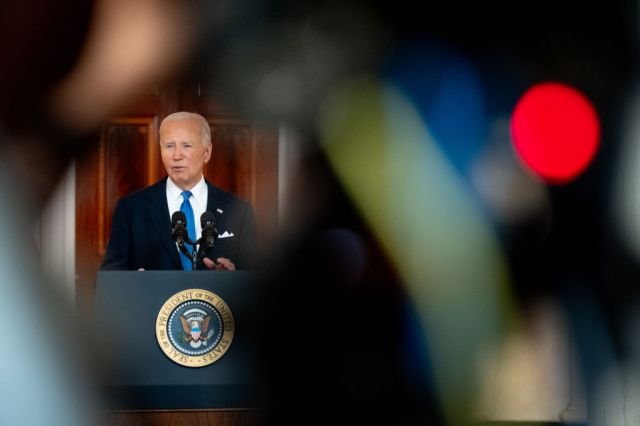
Biden's presidency marked a high water mark for the information state. (Andrew Harnik/Getty Images)





In Joe Biden’s presidency, two great forces pushed the information state to the limits of its power. The first came from the administration’s response to the Covid-19 pandemic. The second came from its decision to use the arsenal of counterinsurgency against American citizens accused of domestic extremism. Both relied on the vast public-private apparatus of censorship and surveillance, originally built to combat foreign disinformation, to wage political battles at home.
The pandemic dumped jet fuel into the growing counter-disinformation machine while extending its controls into the physical world. That brought the information state into people’s everyday lives. This was something different from the drama of false allegations about Donald Trump’s collusion with Russia that plagued the Trump presidency. Though Russiagate dominated the news cycle, it was essentially a political crime against abstractions like the “rule of law” and the “democratic process.” Normal people who did not devote their time to scrolling newsfeeds could mostly choose to ignore the sordid Trump-Russia drama. Covid lockdowns and vaccine mandates removed the “normie” exemption.
The senseless cruelty of preventing people from attending outdoor weddings and visiting sick relatives in their final moments. The images of authorities in New York City placing locks on children’s playgrounds. Authorities in Venice, California, using bulldozers to shovel thirty-seven tons of sand into the city’s iconic skatepark to prevent kids from playing outdoors. Prolonged school closures that isolated children and caused generational learning losses, hurting poor and disadvantaged kids worst of all. The brazen flouting of these restrictions by the upper classes and political elites. At Barack Obama’s 60th birthday party, for instance, where the former president and his hundreds of celebrity guests on Martha’s Vineyard danced with their faces exposed while the army of workers hired for the event were forced to wear masks. The fact that the technique of lockdowns was imported into the United States from the authoritarian surveillance state of China, where the virus originated. The even more galling fact that mere discussion of the virus’ origins was labeled a racist conspiracy by the most venerated institutions of science and journalism.
By imposing excessive and arbitrary policies while attempting to conceal vital information about the pandemic, the state provoked a public backlash. In turn, government officials treated the backlash not as legitimate democratic dissent, but as proof that unregulated misinformation was fueling domestic extremism. They responded by doubling down on the same policies, tightening their information controls, and imposing new methods of digital cancellation like “debanking” that cut off people’s access to their own financial accounts. Official repression and popular revolt fed off each other in a cycle that radicalized both sides and laid bare the realities of mass manipulation and digital dependency in the information state.
***
On February 15, 2020, as people were just learning about Covid, the World Health Organization head Tedros Adhanom Ghebreyesus announced, “We’re not just fighting an epidemic; we’re fighting an infodemic. Fake news spreads faster and more easily than this virus, and is just as dangerous.” His statement came almost a month before the World Health Organization (WHO) officially declared a pandemic. The “infodemic” not only preceded the physical pandemic, it was, in the words of the world’s foremost health authority, “just as dangerous.”
The following month, all the major tech platforms — Facebook, Google, LinkedIn, Microsoft, Reddit, Twitter, and YouTube — released a joint statement pledging that they would be “jointly combating fraud and misinformation about the virus” while also “elevating authoritative content”.
“The containment of the coronavirus pandemic will necessitate a global surveillance network capable of identifying new outbreaks as soon as they arise,” wrote Klaus Schwab, head of the Davos-based World Economic Forum (WEF), in a book published at the start of the pandemic that announced its aims in the title, COVID-19: The Great Reset. The global surveillance network Schwab described had a second purpose. Beyond detecting the spread of new viruses, it could monitor the information environment and shape the public’s response to new policies. Yet the category of “authoritative information”, which would supposedly prevent future “infodemics”, was less reliable than its name suggested.
Members of the public who had eyes to see could not help but notice that whatever the experts vehemently declared about Covid could be reversed a day later. Health authorities like the WHO and US Centers for Disease Control and Prevention were often acting on incomplete information to rush out policies heavily influenced by political considerations in the name of “science”. Susan Wojcicki, the CEO of Google subsidiary YouTube, said her platform’s publishing policy called for “removing information that is problematic”. Examples of problematic information she named included people advocating vitamin C and turmeric as cures for the coronavirus and “anything that would go against World Health Organization recommendations”. Meanwhile, the WHO frequently changed its recommendations, which meant the meaning of misinformation changed from day to day.
By following its own rule, Google would have been forced, at various times during the pandemic, to ban posts that advocated wearing masks, that characterized the virus as highly contagious, or that suggested that it might have come from a laboratory, since all those went against official stances taken by the WHO. The CDC was similarly inconsistent, changing its policy on masking at least three times in the span of two years. The agency originally discouraged their use before endorsing it, then finally acknowledging that the cloth masks most Americans used could not stop the fine aerosols that spread Covid — a fact that Anthony Fauci had privately acknowledged at the outset of the pandemic in a February 2020 email.
Despite the inconsistencies of the public health authorities, experts from the disinformation field proved flexible enough to enforce every new pronouncement as if they were both moral imperatives and matters of settled science. When Arkansas Senator Tom Cotton suggested that Covid-19 could have escaped from the Chinese virology laboratory in Wuhan at the epicenter of the outbreak, he was swiftly attacked by journalists who all seemed to use strikingly similar language. The Washington Post labeled the idea of a possible lab leak a “conspiracy theory that was already debunked”. A reporter who was then at Politico accused Cotton of “spreading rumors… that were easily debunked within minutes”, while The New York Times chided Cotton for spreading what it called a “conspiracy theory.” Given the apparent consensus, Facebook banned users from discussing the lab leak theory under its misinformation policy. That May, The Washington Post’s top fact-checker, Glenn Kessler, wrote that it was “virtually impossible” for the virus to have come from a lab. A year later, Kessler published a new article explaining “How the Wuhan Lab-Leak Theory Suddenly Became Credible.” And a short time after that, Facebook quietly reversed its policy, posting a notice that read, “In consultation with public health experts, we will no longer remove the claim that COVID-19 is man-made or manufactured from our apps.”
In June 2020, the US government’s Cybersecurity and Infrastructure Security Agency, known as CISA, sponsored the creation of a nominally independent organization called the Election Integrity Partnership whose mission was to monitor and remove election-related misinformation online in the lead-up to the November election. A consortium of four groups (two universities, a private defense contractor, and a Washington think tank), the EIP’s mandate, according to one of its founders, a former chief security officer for Facebook, Alex Stamos, was to “try to fill the gap of the things that the government could not do themselves”. With more than 100 employees scouring social media sites for speech that they deemed misinformation and flagged for suppression or removal by the tech companies, the EIP did the kind of work, according to Stamos, that the government “lacked both kinda the funding and the legal authorizations” to do on its own.
Immediately after the election, one of the four groups that made up the EIP, the Stanford Internet Observatory, spun off into a new information-monitoring initiative called the Virality Project. In a seamless transition from elections to public health, the project collaborated with the surgeon general’s office and the CDC while policing social media for what it labeled vaccine and pandemic-related misinformation. One email sent by a Virality Project staffer to multiple social media companies recommended that the platforms take action even against posts that described “stories of true vaccine side effects”, specifically “true posts which could fuel hesitancy”.
Back in 2017, two academics affiliated with Harvard had created a novel category to describe speech that was factually true, but undermined official interests. They called it malinformation and defined it as speech “based on reality, used to inflict harm on a person, organization or country”. Could constitutionally protected criticism of the US government be classified as malinformation? Only the information regulators could say for sure since all power rested in the authority to define the terms. The government seized the opportunity. In the very first month of the Biden administration, CISA rewrote its mission from focusing on foreign disinformation “to focus on general MDM”, an acronym for misinformation, disinformation, and malinformation — a three-part classification developed by the 2017 Harvard paper that coined “malinformation”. The machinery of the information state had completed its inward turn. Rather than defensively protecting critical infrastructure from outside attack, the agency would now “be responsive to current events” inside the US.
Without any public deliberation or legislative debate, without any formal amendments to the Constitution, the authority to censor that which was true but deemed harmful had become the law… not quite of the land, but of the society online that was ruled by code. The more arbitrary the health policies became, the better they propped up the authority of the information regulators.
***
At 77, Joe Biden was the oldest major-party candidate to ever run for president, and it showed. Heading into the November 2020 election against Trump, he looked unsteady, even feeble, in his limited and carefully stage-managed public engagements. Biden’s voice would trail off mid-sentence. He would forget what he was talking about or refer to someone who had died as if they were still alive.
Given his frequent verbal gaffes, blank stares, and ghost-white pallor, there were concerns about his health and mental fitness for office. But the powerful fact-checking bureaus in the press dismissed these concerns as Right-wing conspiracy mongering, misinformation, and ageist discrimination. One Homeland Security bulletin leaked to the media detailed an alleged Kremlin plot to manipulate American voters by spreading “unsubstantiated allegations” about Biden’s declining mental health.
With the election only a few months away, Biden’s campaign announced that he would not hold any public campaign rallies due to Covid-19. Biden added, in an offhand comment to reporters, “This is the most unusual campaign I think in modern history.” Not long after that, Biden won a most unusual election.
After losing the election, Trump spent two months challenging the results and stoking the fury of his supporters with a manic “Stop the Steal” campaign that mixed reasonable questions of electoral interference with absurd and wildly irresponsible claims that prodded at the fragile basis of civic peace. The effort culminated on January 6, 2021, when a large pro-Trump demonstration that had assembled in Washington, DC, to challenge the election results splintered off into a riot at the US Capitol building. Ugly scenes of Trump supporters rampaging around the Capitol and fighting with police officers blanketed the news.
In a symbolic register, the images of protesters dressed like Vikings marauding inside the Capitol building were uniquely threatening to American democracy. But, despite the symbolism, the riots were disorganized and ineffectual. Moreover, January 6 fit into a larger pattern of political violence that had played out over the previous year. The nationwide Black Lives Matter protests, which had taken place six months earlier, were orders of magnitude larger and more destructive than the pro-Trump riot. Nineteen people were killed in violence connected to the BLM protests, which spread to more than a hundred cities across the US and caused over $1 billion in damages.
And yet the elite establishment overwhelmingly supported the BLM movement and sympathetically pandered to its demands such as defunding the police. Nancy Pelosi, the powerful Speaker of the House, posed for a photo op kneeling in a brightly colored African kente cloth to show solidarity with the protesters. Public figures who for months had vilified public gatherings as deadly superspreader events suddenly celebrated the sight of tens of thousands of demonstrators crowding in the streets for BLM marches. One petition signed by more than 1,200 health officials declared it incumbent on members of the medical profession to offer “unwavering support” to the protesters. The ruling tech platforms, like Google, Facebook, and Twitter, all vocally endorsed and amplified the BLM movement.
In contrast, the response to January 6 was as swift and decisive as any political fallout in recent history. One day after the Capitol melee, Facebook banned the sitting president from posting on its platform. Then Twitter banned Trump permanently, citing “the risk of further incitement of violence”. PayPal and its subsidiary Venmo blocked the accounts of individuals and groups involved in organizing the pro-Trump demonstrations, as well as a Christian crowdfunding site raising money for the protesters. GoFundMe announced that it would remove fundraisers promoting conspiracy theories and “misinformation” about the election.
To be sure, one could reasonably argue that the threat posed by rioters storming the Capitol and threatening to overturn the election justified the response. That was a political judgment. But the coordinated campaign of digital disconnection reflected a profound transformation in the American system of government. It exposed the outline of a new power structure that operated outside of the formal government by controlling the strategic heights of the information space. A cartel of Silicon Valley tech companies had accomplished in days what Congress failed to do over four years: it shut Trump up and silenced his movement. For a while, at least.
Biden’s inauguration a week later came as a mere formality. The first Trump presidency ended the moment he lost his means of speaking directly to the public, which social media had initially provided, propelling him into the White House, and then unilaterally revoked. The invisible hand of the information regime, once it decided to reveal itself, simply hit mute on the most powerful man in the world. In doing so it revealed an essential rule of power in the digital age: sovereign are they who control the information.
This is an edited extract from The Information State: Politics in the Age of Total Control, by Jacob Siegel (Henry Holt & Company).
