




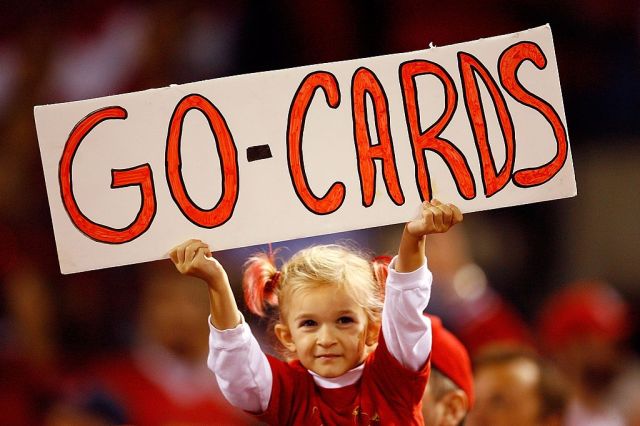
'Opening Day is a city-wide family reunion.' (Jamie Squire/Getty)





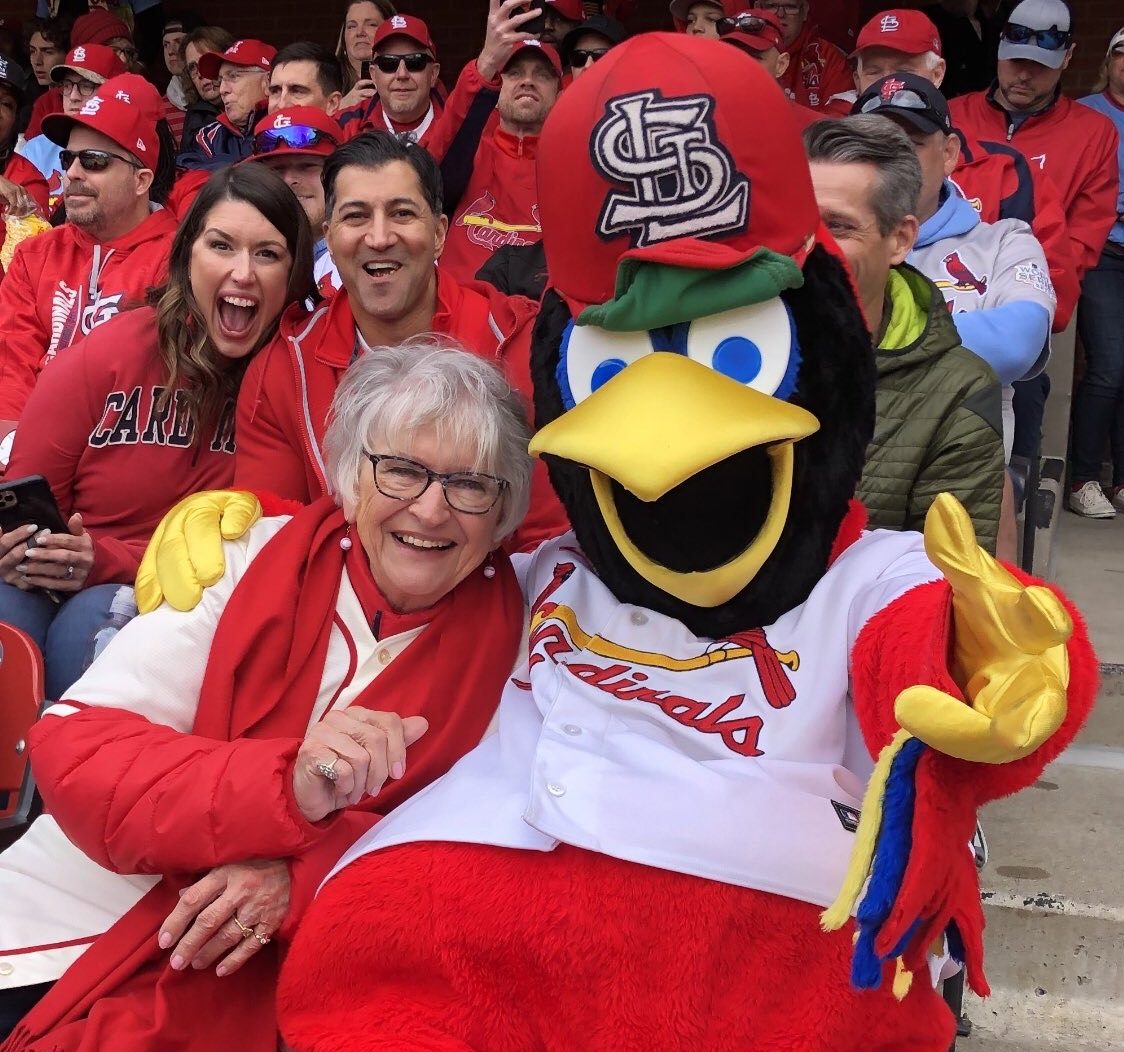
In St. Louis, baseball has always been serious. But for Jan Daniels, it’s practically divine. “Opening Day,” says the 88 year old, her eyes beaming, “Is a Holy Day of Obligation. You don’t miss it!” Beginning in 1958, “Super Fan Jan” has attended 69 consecutive St. Louis Cardinals home openers. The first 60 were with Dan, her late husband. Today, she makes the pilgrimage with Stephen, her son, and he’s as devout as his mother. As the middle-aged cancer survivor explains, the Cardinals, alongside a splash of Jan’s holy water, may even have saved his life. “I always think,” he says of his time in the bleachers, “that it could have been one of the reasons I made it.”
Not everyone here sees the game as literally miraculous. But it’s hard not to feel that Opening Day in St. Louis is life-giving, the crack of batted ball the moment spring’s green shoots defeat the prairie chill. This year, over 100,000 are here to party. And why not? The St. Louis Cardinals are the bishops of baseball, with a near-mystical relationship with their fans. “You’re going back to the late 1800s, handed down to generations of fans,” explains Tom Ackerman, program director at KMOX, a local radio super-station that’s broadcast Cardinals games for a century. “If you grow up in a Cardinal’s family that’s what you know. The loyalty goes back through the generations, the history, the success of the franchise.”
And what success: with 11 World Series, the Cardinals are historically one of elite franchises across American sport. Technically, too, the team is impressive. Embracing what’s known as the “Cardinal Way” — a robust training style involving crisp defense, speed on the basepaths, and putting savvy play over big payrolls — the team is equally famed for its sportsmanship. As Jan Daniels says, former players returning in different jerseys will always get applauded if they play well. “Whenever there’s a good play from the other team that deserves a hand, we do that. That’s what the St. Louis fans do, we just like good ball playing.”
Yet if fans love vibes and a winner, the Cardinals are ultimately so beloved thanks to KMOX: a 50,000-watt mega-station that broadcasts games to over a dozen states. Because of St. Louis’s prime location in America’s heartland, some 700 miles from the sea, it gathers in supporters from right across the south and Midwest. For 71 years to 2021, a series of radio icons called the Cardinals’ games. Sure, on TV, the graphics and images tell the story. But on radio, the announcers can paint a picture in prose. Phrases like Jack Buck’s iconic “That’s a Winner!” now serve as city-wide maxims. For three quarters of a century, these greats were the sound of the summer. They were more than broadcasters; the intimacy of radio made them friends; their warmth and talent made them family.
To that extent, then, Opening Day is a city-wide family reunion. “They’re our glue, the glue of the city,” says Al Crenshaw. 34 years old with a broad smile, he’s hanging out with some pals, tailgating as it’s known in America, standing by a grill of smoking meat and holding a can of Budweiser, St. Louis’s hometown beer. “They are our glue, the glue to the city,” Crenshaw adds of his team. “You can’t think of St. Louis without thinking of the Cardinals first.”
Fair enough. Yet amid the joys of Opening Day, you don’t really get the sense that St. Louis’s communal spirit survives the rest of the year. “That’s part of our problem as a region,” says Tony Messenger, a veteran local journalist. “We aren’t literally invested in the success of downtown St. Louis. And if we were, Opening Day would be more meaningful.” Separated by city and county, middle-class suburbanites adore the St. Louis Cardinals. But their tax dollars do not pay for the streets abutting the team’s stadium, nor for derelict city schools. United on Opening Day, St. Louis is divided on most others.
Around the turn of the century, some 60% of St. Louis residents were immigrants or their children. Many found work in the city’s famous breweries — both Budweiser and Anheuser-Busch, the latter giving the Cardinal’s stadium its name. Home also to the nation’s eighth-largest African-American urban population, St. Louis soon became a hodgepodge of ethnic enclaves. The Hill, a neighborhood famed for its migrants from the Lombard plains, was typical. Amid this diversity, the Cardinals were the city’s social glue. For an immigrant kid whose parents spoke with an accent, donning a red hat meant near-instant assimilation. The baseball diamond is where two Hall of Fame baseballers, the Hill’s Yogi Berra and Joe Garagiola, shed their ethnic origins and became plain-spoken Middle Americans.
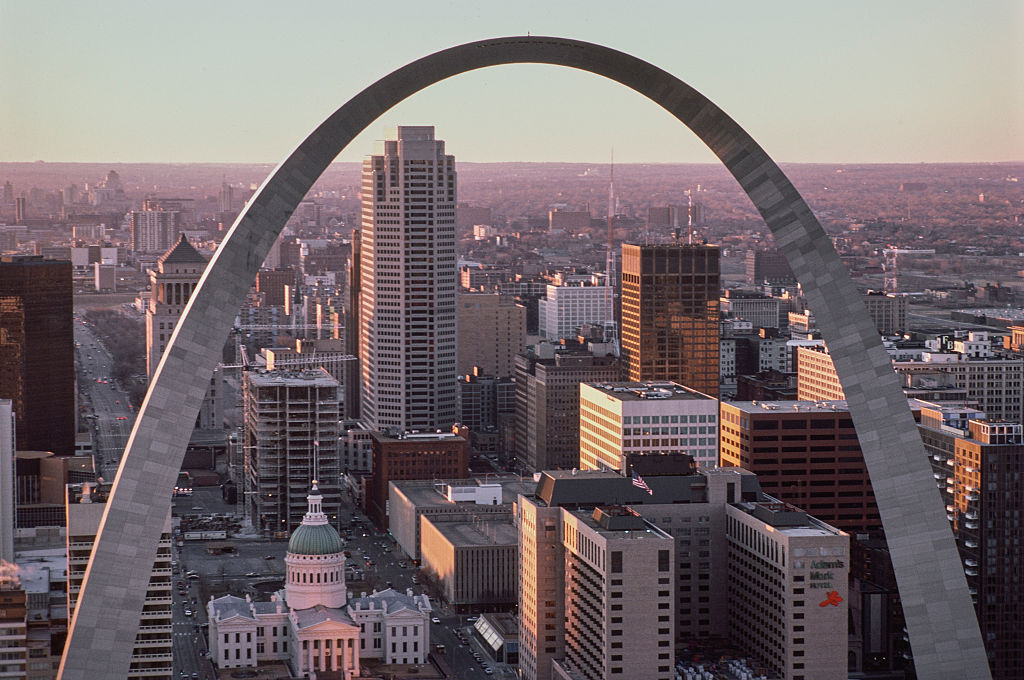
All the while, the city boomed. As late as 1975, St. Louis hosted eight Fortune 500 corporate firms. Aerospace, cars, biotechnology, food — all these, alongside beer, fueled the local economy. Corporate execs enjoyed cushy expense accounts; organized labor gave workers security. Even now, this wealth can be seen on the city’s streets. Think, here, of the “painted ladies” of Lafayette Square — their iron balconies and double-sloped mansard roofs evoking the city’s 18th-century French founding — or else the Siamese-Byzantine beauty of the Fabulous Fox Theatre. Then, of course, there’s the Gateway Arch, 630 feet high and a symbol of the city since 1965.
Yet as so often in Middle America, the good times wouldn’t last. From the Sixties, residents started fleeing the urban core for the suburbs. Crime, urban riots, and integrated schools drove them out; cars and interstates made the exodus easy. That was bad news for the institutions that drove St. Louis’s economic growth: the universities, the corporate headquarters, and, indeed, the Cardinal’s downtown stadium. Mirroring the city’s wider decline, attendance rates collapsed through the Seventies, even as the team itself stopped winning.
In some ways, things are even worse today. In 1950, roughly a million people lived in St. Louis. Now, there are barely a quarter, with white-collar workers, alongside their tax dollars, fleeing to ever-more distant exurbs. For Messenger, indeed, the city’s vast scale is part of the problem. Bestriding the mighty Mississippi and Missouri Rivers, Greater St. Louis is an 8,500-square-mile region that spans 15 counties and, in Illinois and Missouri, two states. Yet if that means the central core has long struggled with money — residents can easily commute to jobs far away — St. Louis also has to contend with the shadow of its hyper-local, polyglot history. “Where did you go to high school”, the city’s standard icebreaker, is a remnant of a past when neighborhood was a core marker of identity. But that hardly chimes with a place where whole districts are ghost towns. As Messenger puts it, St. Louis has the “bones” of a big city, but without enough people to fill it.
And if that causes a host of downstream problems — city schools are only “provisionally” accredited; the state recently assumed control over the police department — none feel as pressing as crime. Messenger says it permeates every discussion of the city, and with 139 murders a year, it’s not hard to see why. This brutal reality is impossible to separate from the question of race, itself, in a sense, the unfortunate flipside to the city’s central location. If, after all, the Cardinals boasts fans from right across the country, St. Louis also blends the post-industrial black ghettos of the Midwest with the sharper racial legacy of the South.
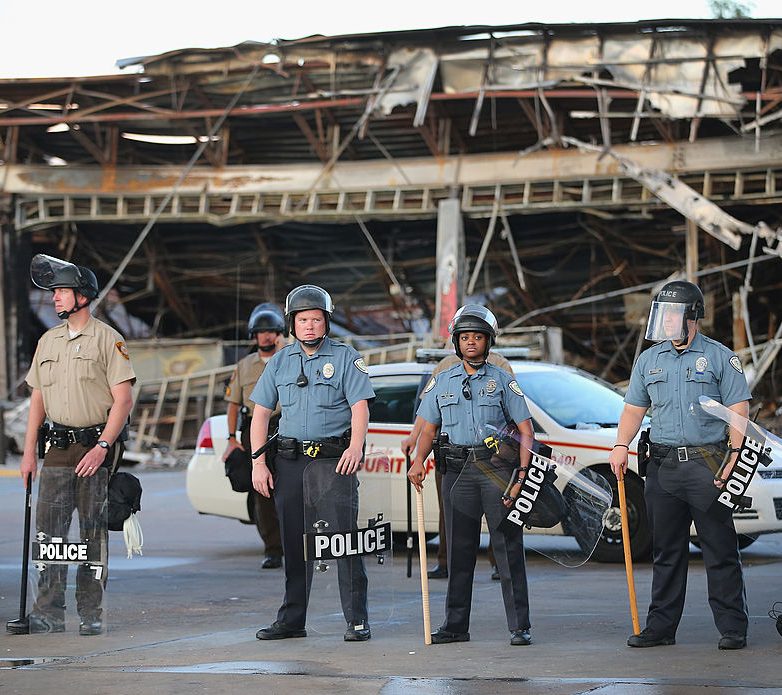
Practicing a semi-official form of Jim Crow, with schools and hospitals segregated until the Sixties, the 2014 Ferguson Riots suggest that the city’s wounds are far from healed. And if the proportion of black people murdered in Missouri is the highest in the nation, that’s shadowed by less vicious but no-less disruptive crime. During Covid, teens staged “street takeovers” where drivers performed dangerous stunts, while onlookers tossed fireworks and even mobbed police cars. Dr Mike Tsichlis, a St. Louis native who studies the city’s history, laments. If things continue, he worries, “the city itself will not be a viable sustainable place for living.” That’s a far cry from lily-white suburbs like Ladue, where donors put gold-plated nameplates on school water fountains. Meanwhile, the black kids in 30 city schools go thirsty from shut water fountains fed by lead pipes.
And though crime has now returned to pre-Covid levels, Messenger concedes that the “crime narrative” drives residents from the city — or, decades after the mafia bombings or garden-variety street robberies of the Seventies, from attending a Cardinals game. Go to any drinking hole in Greater St. Louis, the journalist guarantees, and you’ll find “an old white guy” saying “‘I gave up my ticket, so I’m not going down there.’” Such sentiments are based on headline-grabbing incidents. In 2025, for instance, a visiting kid from Tennessee lost both his legs when an unlicensed St. Louis teenager, out on bail for robbery, sped through a yield sign and caused a major crash.
Not that everything’s hopeless. The Cardinals, Messenger argues, are dealing with the city’s crime-soaked “narrative” — a narrative he thinks they can beat. Well, maybe it was Super Fan Jan leading the cheers of a sellout crowd. Or perhaps it was “Don’t Stop Believing” blaring through Downtown. It could also have been the Budweiser Clydesdales, a team of eight draft horses pulling a red, white, and gold beer wagon around the pre-game field. But, whatever the reason, on this Opening Day, St. Louis beat the narrative. Down 7-1 in the sixth inning, the Cardinals came roaring back for a 9-7 win. The St. Louis family erupted.
It’s a joy Daniels knows from her 60th and final Opening Day with her husband Dan. On that 2017 day, they were celebrated on the stadium Jumbotron. Fans roared for the couple and their six-decade streak. Leaving the stadium after the game, the 85-year-old Dan Daniels struggled to walk. He panicked. Yet at this moment of fright and anxiety, the Cardinal Way intervened. Dan, with his walker, and Jan, carrying two-dozen roses, were easy to spot. So just as a terrified Daniels shuffled his way through the crowd, his son Daniels recalls, “you hear this clapping, and then another person’s clapping, and another person. And the sea of red parted. And all the people lined up to one side and started clapping.” In the center of this parted sea were Jan and Dan, who walked back to their car past lines of cheering fans. “And as we get to the end,” Stephen recalls, “these girls came up and said, ‘thank you, you gave us something to believe in’.” They’re not alone there.
Jeff Bloodworth is a writer and professor of American political history at Gannon University
 jhueybloodworth