




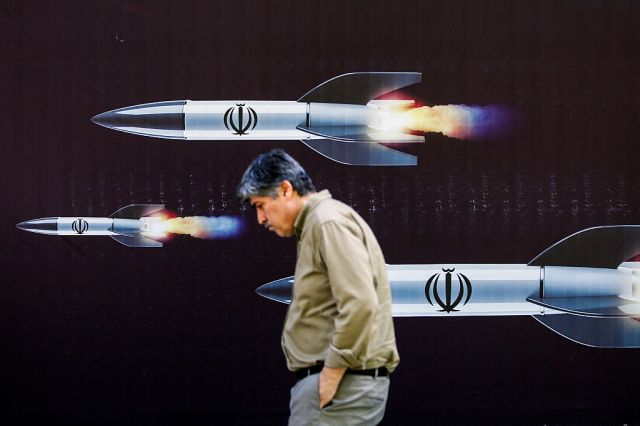
Thanks Obama. (AFP/Getty)





Since October 2023, Iran has launched more than 1,000 ballistic missiles against Israel — and many more against its Gulf Arab neighbors. It has also launched thousands of drones, sending more than 1,500 toward the United Arab Emirates alone. How did the Islamic Republic accumulate such vast inventories of expensive weapons? And expensive they are: drones would only be cheap, as the media keeps claiming, if their number were not so large, while ballistic missiles are necessarily expensive because of their size. Iranian Shahab-3 missiles weigh 16 tons, while Korramshahrs come in at 25.
Just as with any other feat of accumulation, this too is the result of disciplined persistence. In the regime’s case, that meant allocating Iran’s limited foreign-currency earnings to what really mattered: not waterworks against desertification, not gas pipelines to bring cheap gas to the cities, not desalination plants to overcome water shortages even in Tehran, but rather the production of very large numbers of long-range missiles to attack Israel and other countries.
This enormous industrial effort has been underway for years, yet it was greatly accelerated by the transfer of $1.7 billion to Iran by the Obama administration. Officially, this was merely an overdue refund for canceled military orders dating back to the time of the Shah. But the payment’s first installment — $400 million in stacked banknotes — was sent on 17 January, 2016. This just happened to coincide with the release of several Americans from Iranian captivity, and the coming into effect of Obama’s grand diplomatic achievement: the Joint Comprehensive Plan of Action.
In those early weeks of 2016, one would hear the initials “J-C-P-O-A” proudly enunciated by Obama staffers even at lowkey Washington gatherings. Why? Because, its supporters claimed, the deal would definitively end Iran’s efforts to acquire nuclear weapons. It limited Iran’s uranium-235 enrichment to just 3.67%, with dangerous levels only kicking in at 60%. Iran was also permitted a meager 300 kilos of nuclear material.
But for Robert Malley, head of Obama’s Iran team, this technical win was outweighed by a more emotionally satisfying achievement. Having grown up in a household where Algeria’s FLN nationalists were much celebrated, and where traditional Arab rulers and Israel were greatly deplored, Malley hoped the JCPOA would stop US-Iran frictions. That, in turn, would allow Obama to finally sideline both the embarrassing Saudis — with their over-the-top gold-bathtub polygamy — and the insufficiently humble but very demanding Israelis.
Given those tacit but clear preferences, one can understand why Obama disregarded all Saudi warnings about the Revolutionary Guards. This was a Shia supremacist organization, but its long-term plan was nonetheless to become the hero of all Arabs, Sunnis included, by defeating Israel and taking the Temple Mount. Mecca itself was another aim. Meanwhile, US diplomats in Saudi Arabia — who reported that Iranians arriving for the Mecca pilgrimage were seemingly eager to assert themselves by picking quarrels — were dismissed as having gone native.
Israel was worried too. It noted that the Revolutionary Guards were taking a rising proportion of Iran’s oil revenue — itself increased by the JCPOA — to build more missiles, to increase their number of U-235 separation centrifuges, and to expand both their own forces and those of auxiliaries abroad. Those warnings were too well-documented to be dismissed out of hand. Yet nothing was done, for action would have spoiled Obama’s great diplomatic success.
To be fair, Obama was not responsible for what happened next. After the JCPOA removed all export restrictions on Iran, the country’s hard-currency earnings from oil exports rose. The Revolutionary Guards swiftly demanded an even larger share of the total, even after oil prices started to dip.
Mahmoud Ahmadinejad, Iran’s president from 2005 to 2013, and who was famous for his slogan about the sofreh — the traditional tablecloths of modest households, focusing attention on the needs of Iran’s poor — seems to have complained. But Qasem Soleimani and the Revolutionary Guards were in the ascendancy with Ayatollah Khamenei. So while Ahmadinejad was set aside, the Revolutionary Guards claimed an increasing share of Iran’s oil revenues.
It was then that the Natanz complex was hugely expanded to accommodate two immense centrifuge cascades, of 25,000 centrifuges each, while an entire separate centrifuge cascade was installed deep underground at Fordow. Meanwhile, a weaponization facility was established in Isfahan, to go with one at the Parchim base near Tehran.
I have never heard a convincing explanation for these projects: far more than needed even for many bombs, let alone civilian electricity production, and especially in a country with unlimited natural gas. Corruption is hard to prove in a dictatorship with so much oil money sloshing around. But even here, graft cannot always stay hidden. When Mossad killed the chief nuclear scientist of the Revolutionary Guards in November 2020 — using a remote-controlled machine gun placed inside a parked Nissan van — he was being driven on his hour-long twice-daily commute from Tehran to Absard: a fashionable hill town where rich Iranians go to escape the capital’s pollution. Families without personal chauffeurs tend to visit Absard only on weekends, and generally settle for simple lodgings. But this nuclear scientist seems to have been unusually wealthy by Iranian standards.
At the same time, the Revolutionary Guards also spent immense sums on ballistic missile fuel and other components — including the multiple “cluster” warheads now causing much damage in Israel. The sheer scale of Iran’s missile production is itself amazing too, with 3,000 the low estimate for the longer-range types targeting Tel Aviv and other Israeli cities.
All the same, neither Israel nor any other country has been as harmed by the Revolutionary Guards as Iran itself. Because the Islamic Republic has overspent its oil export earnings — not at all huge for a country of 90 million — it has neglected to make investments elsewhere. Especially urgent is water supply, needed for major cities including Tehran, whose 13 million inhabitants now face the possibility of desertification-driven evacuation. Mashhad, with three million inhabitants and Iran’s second-largest city, is in the same predicament. Located near the Afghan border, its problems are aggravated by Taliban dam building, as are many smaller cities, including ancient Yazd with its Zoroastrian eternal flame.
What all these places desperately need is a new supply of desalinated seawater, pumped all the way from the Persian Gulf. With three times as much natural gas as the US, Iran could produce all the water it needs, just as Israel is doing — but that would have required vast investments starting decades ago. Iran’s grossly insufficient electrical supply is another victim of Revolutionary Guard overspending, with frequent power cuts whenever temperatures fall and more heating is needed.
We keep being told that Iran’s population cannot liberate itself for the simple reason Trotsky long ago identified: popular insurgency could conquer the Bastille in 1789, but by the Twenties Trotsky’s Red Army had Maxim machine guns that could mow down any number of demonstrators. Iran’s Basij and Revolutionary Guards have done just that, and can do so again.
That being true, the US-Israeli war still has a purpose: to destroy Iran’s missile and drone factories and inventories. For as long as they exist, they will permanently threaten the Gulf states, just as they have already closed the world’s largest airport in Dubai, and which continue to menace water-desalination plants in Qatar and oil-separation facilities in Saudi Arabia.
Whatever their leaders say in public, nobody of consequence on the western side of the Gulf wants Trump or the Israelis to stop undoing the damage that began with Obama’s once-celebrated JCPOA. That deal, it is now clear to see, did not stop nuclear enrichment towards the bomb — and indeed accelerated every other danger emanating from the Islamic Republic.
Professor Edward Luttwak is a strategist and historian known for his works on grand strategy, geoeconomics, military history, and international relations.
 ELuttwak