




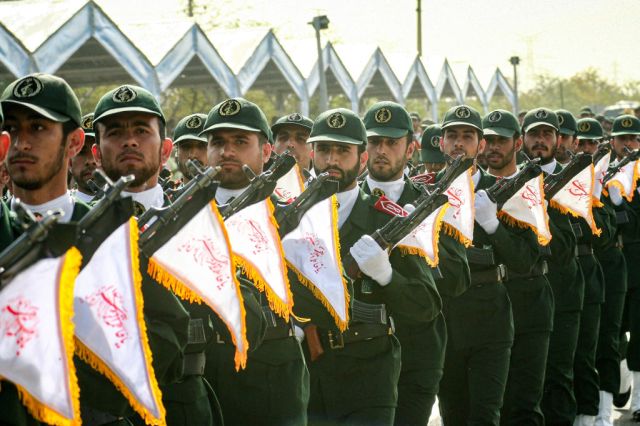
Iran's Revolutionary Guards are one component of a formidable military. Credit: Getty





Ten days into President Trump’s Iran war, what was supposed to have been a swift, Venezuela-style operation has widened into a massive air campaign that the Pentagon reportedly believes could last into September. And as the mission’s ill-defined objectives continue to bloat — from regime change and denuclearization to “unconditional surrender” — there is growing talk of a ground invasion. Trump himself has refused to rule out dispatching a ground force, with White House press secretary Karoline Leavitt going so far as to suggest that the administration might re-institute the draft.
It’s not hard to see why. Military history teaches us that airpower alone is insufficient to achieve the kinds of aims the Trumpians have set for themselves. Unless the administration accomplishes what has historically proved impossible, it must either scale back its objectives or attempt a ground invasion of Iran. As a former US Army infantryman, who fought in what used to be called the War on Terror, I know one thing: the latter option shouldn’t even be on the table.
A ground war against the Islamic Republic, on Iran’s own terrain, will send American troops into hell on earth — or about as close as we mortals can get to it.
First, the sheer size of the ground force will be staggering. Any serious American invasion of Iran would likely rival or exceed the scale of Vietnam or the 1991 Gulf War, making it the largest US military undertaking since the Second World War. Iran’s land mass and population size alone would prove a daunting hurdle. The country is nearly four times the size of Iraq, and its population is more than three times larger.
Iran’s terrain is, in a word, punishing. Its topography is dominated by mountains, which by some figures constitute half of its territory. Unlike most nations, Iran’s urban centers are located inland, nestled amid mountains, and buffeted by uninhabitable deserts to the east and the south. This combination of Iran’s built and natural environments would mean that US forces would have to advance through numerous bottlenecks to even reach Iran’s military and population centers. And while Iran is in the middle of the pack in terms of population density, its capital, Tehran, teems with more than 15 million souls; a fight to capture the city against a determined enemy would amount to the largest urban battle in American military history.
The idea of capturing and pacifying Tehran alone illustrates the near-impossibility of such an invasion. Using the troop density employed in the 2004 battle for Fallujah, Iraq, as a point of reference, suggests that it would require more than 600,000 soldiers — roughly the size of the US deployment during the Vietnam War. Hence, perhaps, Leavitt’s talk of reinstituting the draft.
Looking to the invasion of Iraq in 2003, a similar invasion of Iran, given its population size, would require as many 1.6 million troops. Those estimates appear more daunting still when compared with the actual force structure of the US military, which boasts about 2.1 million members in active service, reserves, and the National Guard. Of these, only about 20% are combat troops. Simply put, committing 1.6 million personnel would mean using roughly three-quarters of the entire US military, including combat forces America simply doesn’t have.
Such a war couldn’t be undertaken without a massive mobilization, and a fundamental reordering of American global commitments, requiring the diversion of forces from Europe, Asia, and elsewhere. An invasion of Iran would therefore impel the United States to confront something it has long sought to avoid: hard choices about the limits of its global military footprint. Summing up the scale of the prospect, the columnist Max Boot, not exactly known for his pacifism, described an invasion of Iran as “the mother of all quagmires.”
Then comes the next obvious problem: fighting the war. While Iran’s military would likely lack air superiority and remains less technologically advanced than that of the United States, the Islamic Republic shouldn’t be taken lightly. Before the outbreak of the current war, the country’s regular armed forces were estimated at roughly 420,000 personnel. Iran’s more ideologically committed Islamic Revolutionary Guard Corps numbered around 190,000, backed by a militia force, known as the Basij, of more than 600,000.
How much of this force could ultimately resist an invasion is speculative: some may defect, and others removed from the battlefield before they can fight. But what is clear is that Iran would likely adhere to its long-standing doctrine of defense in depth. Drawing on lessons from the Iran-Iraq War, Iranian planners have adopted what they call a “mosaic strategy”: decentralized command structures combined with a willingness to trade territory to wear down an invading force through attrition.
Supporting this strategy would be Iran’s still-significant arsenal of rockets and drones. These have already surprised US military officials in recent engagements, and could prove even more dangerous on Iranian soil, where shorter flight times would give the Americans far less warning. Iranian militias in the region, too, are battle-hardened, versed in irregular warfare, and, in many cases, acquainted with American tactics.
US forces would likely find themselves fighting a determined asymmetric opponent armed with effective weapons and operating on difficult terrain. For a military that has not attempted a major invasion in more than two decades, and that remains only partially tested against modern drone warfare, such a fight would be far from easy. In short, Iranian commanders would aim to draw the United States into a long and bloody war of attrition, and they would have the terrain and urban density do it.
Some will argue that the past is not prologue — that the Iranian regime is unpopular and therefore unlikely to inspire serious resistance. It’s telling, however, that American bombing has yet to create fissures in the regime. Nor has the American air campaign inspired the Iranian people to revolt. On the contrary, all available evidence points to regime consolidation, and the closing of the gap between public sentiment and elite opinion.
Then, too, critics underestimate the power of nationalism, particularly in the Iranian case. The “rally around the flag” effect — the well-documented tendency of citizens to unite behind their government in wartime — was most clearly demonstrated in Iran after Saddam Hussein invaded the country in 1980, a move that ultimately consolidated the very regime the Iraqi dictator had hoped to topple.
Even under the most ideal circumstances of state collapse — like those seen in the early days of George W. Bush’s Iraq War — a post-invasion insurgency in Iran would be all but certain. Between the most fervent supporters of the IRGC, and with the potential backing of Shiite militias across the region, it would not take many committed fighters to prolong the conflict. As Washington learned in both Iraq and Afghanistan, even a relatively small but determined insurgent force can sustain a war for years. That force could draw from an estimated “fit-to-service population” in Iran of 41 million, plus the larger Shiite sphere, including warriors from Iraq, Bahrain, Lebanon, and Pakistan, among others. Much like Iraq and Afghanistan, the defeat of the Iranian army would be a fleeting victory assuredly followed by a bloody and open-ended slog with an insurgency.
Finally, an American escalation into a conventional ground invasion would deepen the already daunting regional crisis. Deploying ground troops in Iran would provide an ample opportunity for America’s great-power rivals, Russia and China, to drain Uncle Sam of blood and treasure. So far, the pair have yet to expand their assistance to Tehran beyond diplomatic and intelligence support. But the presence of American forces on Iranian soil would provide Moscow and Beijing with a tempting pressure point against a superpower that is already overextended, indebted, and domestically fractured. Iran, then, could become a bloody site of great-power competition.
Given the totality of Iran’s geography, demographics, military capability, and geopolitical connections, the prospect of an American invasion of the country should be unthinkable. Yet Trump’s ill-considered decision to launch the war, coupled with his vague-but-ambitious goals, has made this impossible scenario a military possibility. Given the horrific costs such an invasion would entail, however, Trump should choose a different path: declare “victory” and de-escalate. Washington must stop throwing good American money after bad — and preserve the lives of the brave men and women who daily underwrite our national security with their blood.