




(Leon Neal / Getty)





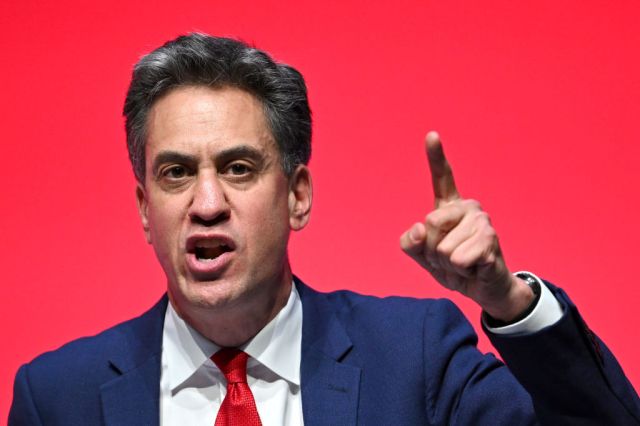
During his unsuccessful tenure as Labour leader, it was said that Ed Miliband wanted “to govern a country that doesn’t exist”. In his idealistic, academic progressivism, formed in blissful detachment from the concerns of ordinary voters, his critics complained he spent his time indulging in “intellectual conceit” more suited to the seminar rooms of Harvard or the dinner tables of Hampstead than to Britain in the 2010s. The charge was given more weight by the result of the 2015 election, the increased seat tally for the Cameroons belying Labour’s faith in a Leftward turn.
And yet, according to reports leaked from Labour’s National Security Council (NSC) this week, Miliband was crucial in preventing Keir Starmer from deeper embroilment in Trump’s Iran war. Far from appealing to an idealized, imagined Britain, one full of Ottolenghi-loving Fabian podcasters and policy wonks, that position leaves him closer to the public than most of the British Right. Both Reform and the Tories have either sycophantically embraced MAGA militarism, as an American client faction attached to the body politic, or else indulged in forlorn nostalgia for a prelapsarian imperial age.
Conservative commentators and politicians bemoan our inability to project power and state capacities on the world stage, demanding a reassertion of military prowess even as industry, services and the social fabric continues its inexorable decline at home. They live in a parallel dream world; the idea that there exists any latent jingoistic desire among Britons to sacrifice limited butter for inconsequential guns is as delusional as any ivory tower Left-liberalism.
Apparently Miliband’s cabinet interventions on Iran were “petulant, pacifist, legalistic and very political” — strongly reminiscent of his attitude in 2013, when he urged parliament to block UK military action against then Syrian President, Bashar al Assad. To which the only rational response can be: thank God. The Americans may not be happy (“This is not Winston Churchill we’re dealing with,” an irritated Trump told the White House press corps). But, thanks to the insistence of Red Ed, history may yet absolve the prime minister in what proves to be his finest hour, particularly in the not-unlikely scenarios that the Islamic Republic endures, re-radicalizes, or else descends into anarchy — with all the stagflationary pressures and refugee flows that implies.
To be sure, Starmer’s characteristically stiff reaction to the violence seems perfectly calibrated to alienate all sides. His sclerotic legalism has put off advocates of intervention who decry the Government’s initial hesitance in allowing US use of British bases, while opponents baulk at the subsequent U-turn giving the green light for operations to defend Gulf states from Iranian missiles. But the outcome of the NSC meeting shows where the Labour leader is politically: in his post-McSweeney and post-Gorton era, with the pivot-to-Reform strategy roundly discredited, he is a puppet of the party’s resurgent progressive forces.
There’s little doubt that Miliband is enjoying an extended second wind in his political life. Milibandism 1.0 was an amorphous thing, bound by the residues of New Labour and the orthodoxies of the period. Post-financial crisis populism was still in its infancy, the Overton window was narrower, and any antagonism towards the post-Thatcherite settlement had to be couched in conciliatory language. A Labour figure once remarked that the Corbynite 2017 manifesto was “basically the programme Miliband would have loved to have presented” to the country — with all its paeans to nationalization, regional investment banks and the recreation of postwar social democracy updated for the 21st century.
In the end, though, Miliband was bound by Brownite instincts and the curse of his insiderism, unable to see the appeal of promises of totalizing, systemic change. Perhaps that’s why he was always something proto-Starmerite in his awkward adoption of the rhetoric of faith, family, flag. In the wake of Emily Thornberry’s St George’s Cross furore, the Labour leader told us he felt “respect” when he saw a white van. The problem wasn’t so much the odd phrasing or sentiment, but rather the dissonance between Miliband’s words and his party’s palpable disdain for overt displays of plebeian nationalism in the provinces. The issue typified his and his party’s estrangement from what might have once been their natural base of lower-paid, non-university-educated voters.
Yet Miliband’s stint as leader of the opposition also included heavy flirtations with Blue Labour: it was Miliband who ennobled Maurice Glasman, and appointed another of its thinkers, Jon Cruddas, as policy co-ordinator; it was Ed again who earned the ire of the activistocracy by stamping “controls on immigration” onto a campaign mug.
For all its faults, then, Milibandism 1.0 at least attempted to shore up the marriage between the Hampstead intellectuals and the working class that constituted the unsteady coalition of the post-Blair Labour party. It’s only in its later guise that Milibandism has become so unabashedly associated with Labour’s soft Left — the woolly, liminal space between the ultra-Atlanticist and pro-American Blairite Right, and the niche “anti-imperialist” causes and foreign guerrilla fetishism of the Corbynites. But as the cabinet doyen of that loose band, Miliband may this week have acted as the country’s foremost Left sovereigntist, a “Britain First” Left patriot, as uninterested in dissolving the country’s capabilities into the arsenal of a mercurial Washington hegemon as he was back in 2013.
Of course, it is his departmental role, rather than his non-interventionist foreign policy, that has defined Milibandism 2.0, with a more self-confident, assured performer emerging from his 2015 election loss. His name has become synonymous with the Government’s mission to decarbonize the energy grid by 2030, and as a result Miliband himself has become the whipping boy for a Right which has broken with the once-tight net zero consensus. Preventing new drilling and exploration on British territory, even as we continue to depend on volatile imports from abroad, is pure magical thinking, sacrificing pragmatism in the interests of His Majesty’s Treasury and the British balance of payments for the kind of idealistic virtue signaling so familiar to Milibandism’s core milieu.
But, he would respond, in pushing the transition to renewables so mercilessly, Miliband is in fact attempting to assert “energy independence” with “home grown” clean energy — reducing our reliance on unreliable and expensive imported sources. This isn’t a position shared by many energy economists, and it does little to assuage fears that our green transition is coinciding with the decimation of heavy industry and a rise in industrial energy costs, while new grid technology and infrastructure are sourced largely from China and Denmark. Yet whatever the problems of actually-existing Milibandism, he at least remains one of the cabinet’s few doers: his project may be incongruent with our new age of Great Power resource competition, but it is being pursued consistently, and with more alacrity than any other of the Government’s scattergun agendas.
So even if they disagree with him — whether on Iran or North Sea oil — the Right would do well to take Miliband seriously. After all, there is surely space in British politics for a sovereigntist, anti-globalist conservatism. Post-Brexit, in a deglobalizing world, that would entail the pursuit of an independent foreign policy, and a relentless focus on domestic British interests, transforming our cumbersome state into an agile, interventionist market-shaper, rebuilding industry and state capacity towards creating a more cohesive, resilient and national economy. An appetite for foreign adventurism would give way to the hard-headed realism necessitated by our status as a middle power with limited resources. The desperate maintenance of an illusory “special relationship” would give way to genuine self-reliance, and a fluid engagement with a changing world in our own interests. High welfare and high migration would be eschewed for high investment and renewed national infrastructure.
It appeared, for a moment, that this kind of Anglo-Gaullism might be the future of Reform, with its nods towards industrial policy and a renaissance of manufacturing capital. But, instead, the kneejerk Americanization of Right politics continues apace, sticking to a capricious White House like a limpet. Today, it is the Right that wishes to govern a country that doesn’t exist. And, in this context, it will be for flawed but ascendant Milibandism to reassert some shaky version of national sovereignty.
Jonny Ball is a Contributing Editor at UnHerd. He formerly wrote under the name Despotic Inroad.
 DespoticInroad