




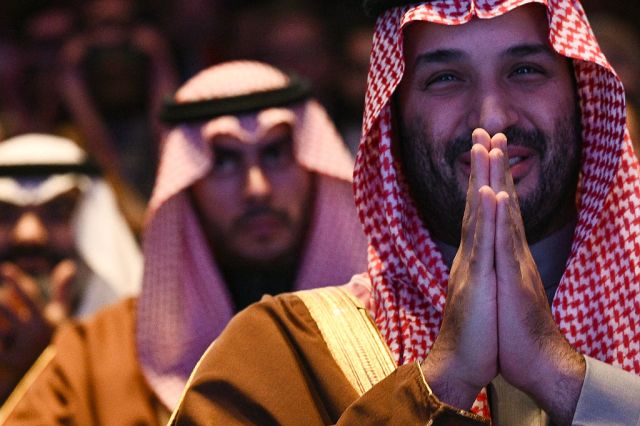
Bin Salman is negotiating a delicate balance of power in the Middle East. (Win McNamee/Getty Images)





Amid the growing chaos in Western Asia following the Israeli-American attacks on Iran, many questions remain unanswered. The country’s Supreme Leader, Ayatollah Ali Khamenei, has been killed, along with members of his family and leading commanders of the Islamic Republic in Tehran. But why the sudden urgency to strike, when there are ongoing negotiations in Geneva aimed at reducing Iran’s nuclear program? Were these discussions — overseen by President Trump’s special envoy Steve Witkoff and his son-in-law Jared Kushner — conducted by the United States in bad faith?
And why did the two powers strike in broad daylight on Saturday 28 February? Was it because Mossad, the Israeli intelligence agency, or the CIA tipped them off that Khamenei and his entourage would be above ground in their compound rather than in their night-time bunkers? Did the Israelis in effect “bounce” the Americans into attacking Iran on that day?
Historians will no doubt debate these questions if, as seems likely, Benjamin Netanyahu and Donald Trump fail to unseat the authoritative institutions of the Islamic Republic. Given the lack of a coherent opposition in Iran, there is a real possibility that forces loyal to the regime — the Revolutionary Guards and Basij militias — will simply unite under a new Supreme Leader and maintain the momentum that saw thousands slaughtered after the street protests in January, meanwhile unleashing the kind of bloody “forever war” that Trump has pledged to avoid.
But the uncertainties raised by this war also lead to a more immediate question. Given the chaos triggered by the attack — canceled flights through three of the world’s largest airport hubs; thousands of tourists stranded in Dubai; the closing of the Hormuz Straits; punishing hikes in oil and gas prices — what can the Gulf states have been thinking?
Before the February attack, the conventional wisdom held that the petrodollar monarchies — including Saudi Arabia — were urging restraint on Washington and (more distantly) Tel Aviv. What they feared were precisely the consequences that have now come to pass: Iran — the wounded animal — launching missile and drone attacks against targets across the Gulf that host US forces. Strikes or attempted strikes have hit the United Arab Emirates (including the Al Dhafra air base and sites in Dubai), Bahrain (near the US Fifth Fleet headquarters in Manama), Kuwait (Ali Al-Salem air base and Shuaiba port), Qatar (areas around Doha and US facilities), and Saudi Arabia (notably the Ras Tanura oil hub). Civilian infrastructure has also been affected, including Dubai airport, hotels, and port facilities, largely as a result of missile impacts or debris from interceptions.
The pattern suggests that Iran’s strategy is to target US military infrastructure and energy nodes across the Gulf while signaling that the region’s economic lifelines are exposed in the event of escalation. The Gulf energy infrastructure remains vulnerable — as was dramatically demonstrated in September 2019, when drones and cruise missiles struck the Abqaiq processing facility and the Khurais oil field in Saudi Arabia. The attack temporarily knocked out roughly 5.7 million barrels per day of production — about half of Saudi output and nearly 5% of global supply — making it the largest sudden disruption in oil market history. Although Iran’s allies, the Yemeni Houthis, claimed responsibility, Western intelligence agencies concluded that the weapons and planning bore the Islamic Republic’s hallmarks. Production was restored within weeks, but the strike exposed the extraordinary fragility of Gulf energy infrastructure and the global economy’s continuing dependence on it.
Given the damage predicted — and already inflicted — on Gulf oil production, not to mention the tourism industry, the voices urging caution sounded eminently reasonable. It was therefore surprising to learn from the Washington Post and other sources that Saudi Crown Prince Mohammed bin Salman (MBS) played a behind-the-scenes role in encouraging Trump to attack Iran.
According to several officials familiar with the discussions, the crown prince held multiple private phone conversations with Trump in the weeks preceding the US-Israeli strikes. In these calls, he reportedly urged Washington to act quickly, warning that Iran would become “stronger and more dangerous” if decisive action were delayed. There may have been other links as well. As I reported in my book Unholy Kingdom, MBS formed a personal bond with Trump’s son-in-law Jared Kushner, an Orthodox Jew with close links to the Netanyahu family. During Trump’s first term, when the scandal over the murder of Jamal Khashoggi was in the headlines, MBS and Kushner were reported to have been in contact via WhatsApp, with Kushner acting as the crown prince’s most important defender in the White House. As the late Martin Indyk, the former US ambassador to Israel and a leading Middle East expert, told The New York Times at the time; “the relationship between Jared Kushner and Mohammed bin Salman constitutes the foundation of the Trump policy not just toward Saudi Arabia but toward the region”. There has been no suggestion since Trump’s return to power that the “WhatsApp bromance” has been fractured.
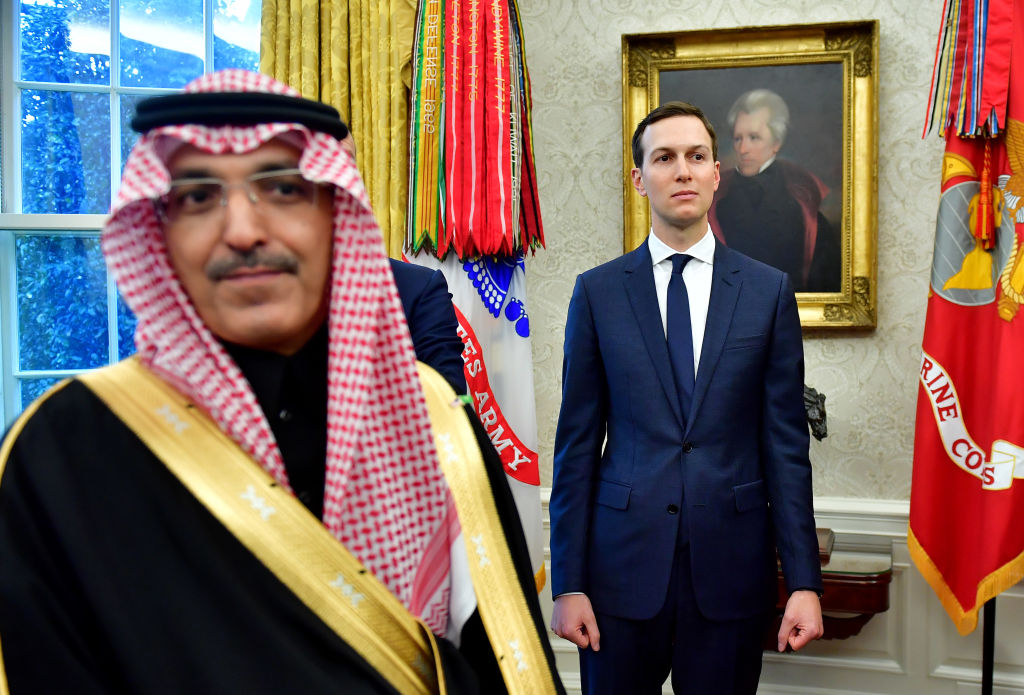
The Post reported that MBS’s behind-the-scenes lobbying contrasts sharply with Saudi Arabia’s public emphasis on dialog with Tehran. Saudi officials have repeatedly stated that they do not want a regional war and would not allow Saudi territory or airspace to be used for an attack. Privately, however, the crown prince and other Saudi officials, including his brother, the defense minister Khaled bin Salman, reportedly argued that the moment was strategically favorable for confronting Iran and degrading its missile and military infrastructure.
These communications occurred amid a broader effort by regional allies to influence Washington’s decision. Kushner’s friend, Benjamin Netanyahu, has long advocated US strikes on Iran, with Israeli officials also pressing the White House to act. The Post reported that the combined pressure from Israel and Saudi Arabia helped shape Trump’s final decision to authorize large-scale attacks despite US intelligence assessments that Iran did not pose an imminent direct threat to them.
One of the most destabilizing developments in contemporary Middle Eastern politics has been the sectarianization of geopolitical rivalry; this is what happens when strategic competition between states becomes reframed as a religious confrontation between communities. The current war risks accelerating that process dramatically. What began as a campaign to neutralize a nuclear program could easily be interpreted across the Muslim world as a coalition of Israel, the United States, and Sunni monarchies against a Shi’a sovereign state. If that perception spreads, the conflict may mobilize actors far beyond Iran’s borders: militias, religious movements, and sectarian networks whose motivations extend beyond conventional state interests. Once political conflicts acquire sacred meaning, they become far harder to resolve.
Supporters of the strike argue that decisive action will destabilize Iran’s regime and perhaps open the way for a more pragmatic leadership. Intelligence analysts have reportedly even considered scenarios in which factions within the Revolutionary Guard might assume power and pursue accommodation with the West.
History suggests caution. Regimes built around revolutionary ideologies rarely moderate under external pressure. Stalin’s regime, for example, was strengthened by Hitler’s attack on the Soviet Union; its collapse in 1990–91 came only after a prolonged period of declining Cold War tensions. More often than not, external conflict — especially aerial bombardment — serves to radicalize. If this conflict becomes widely interpreted as a struggle between rival religious visions of history, it could ignite precisely the kind of sectarian confrontation that has repeatedly destabilized the region over the past two decades, when Sunni leaders such as Jordan’s King Abdullah saw themselves facing a “Shi’a crescent” following the fall of the Sunni dictator Saddam Hussein. At that point the arc of Shi’a influence stretching from Iran via revitalized Shi’as in Iraq and Alawite-dominated Syria to the Mediterranean.
The departure of the Assad regime from Damascus, the weakening of Hezbollah in Lebanon, and now, the attacks on Iran, might suggest to Sunni rulers that Shi’ism is on the retreat globally. However, revolutionary activism inspired by Khamenei’s “martyrdom” among Shi’a populations in Bahrain or the oil-bearing province of Saudi Arabia may present a more menacing challenge. The Saudi kingdom’s clerical establishment are quiescent but not “defanged” as MBS pursues his program of social modernization and they could remobilize if a Shi’ite revolutionary menace was perceived as emerging from within the confines of the state. Then, short of the kind of quick, decisive strike that Trump might have envisaged after his actions in Venezuela, we are into something far more intractable: a contest of sacred narratives among the three great Abrahamic traditions.
When a conflict becomes framed through religious narratives of martyrdom and sacrifice, defeats can easily be transformed into moral victories. Geopolitical calculations and theological narratives have converged. Netanyahu’s need for political triumph, Saudi Arabia’s strategic rivalry with Iran, American evangelical support for Israel, and Iranian revolutionary theology have all contributed to the atmosphere in which war has broken out. When strategic rivalry between states becomes entangled with domestic political incentives, ideological movements and religious expectations, volatility increases.
The centrality of martyrdom to Shi’a political theology only exacerbates that risk. The death of Imam Husayn at Karbala in 680AD has long provided the Islamic Republic with a powerful symbolic language through which suffering can be transformed into moral vindication. The assassination of Iran’s supreme leader risks reinforcing precisely this narrative, helping the regime to present itself as the victim of unjust aggression, with the anti-government protesters dismissed as treacherous agents inspired by Mossad and victims of Western manipulation.
At the same time, Israeli politics has been undergoing a profound ideological shift. The coalition sustaining Netanyahu’s government includes figures such as Bezalel Smotrich and Itamar Ben-Gvir. Their outlook is shaped by currents of religious Zionism that see the modern state of Israel as part of a redemptive historical process. Within this worldview, the restoration of Jewish sovereignty over the biblical lands is not simply a political development but a step in the unfolding of sacred history. Conflict with Israel’s enemies therefore acquires a metaphysical significance.
America itself appears to be increasingly under the sway of extreme religious ideology, with a parallel narrative existing between American evangelical Christianity and Jewish messianism. (The denouements of these end-times scenarios may differ radically, with Jews expecting redemption while their evangelical supporters expecting Jewish conversions to Christianity, but this doesn’t affect contemporary theo-political forces). Millions of evangelical voters interpret Middle Eastern politics through a dispensationalist reading of biblical prophecy in which the modern state of Israel plays a central role in an unfolding divine plan. The US ambassador to Israel Mike Huckabee frames Israel’s conflicts not merely as geopolitical struggles but as episodes within a larger biblical drama. Within the MAGA political coalition, this constituency carries enormous influence, reinforcing support for Israel not only through strategic calculations but also through theological conviction.
It bears repeating: when wars acquire eschatological meaning, they rarely end quickly — or predictably.
There is, however, another possible perspective. One geopolitical objective of Washington’s confrontation with Iran may be to weaken a state that has become an important partner for both Russia and China. Yet the Chinese leadership has previously demonstrated that diplomacy in the region need not follow the logic of confrontation. In 2023, President Xi Jinping’s government brokered the unexpected rapprochement between Saudi Arabia and Iran, reopening diplomatic relations after years of hostility.
That episode suggests that even in a region long defined by rivalry and proxy conflict, political imagination can sometimes achieve what military force cannot. Whether the current crisis will leave room for such diplomacy remains the unanswered question.