




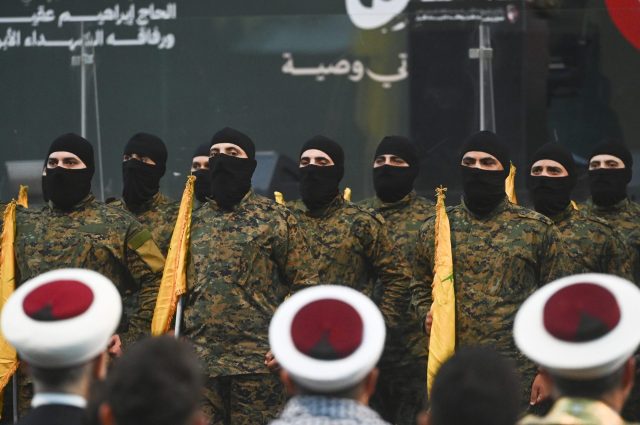
Hezbollah troops in Beirut, Lebanon (NurPhoto/ Getty)





Seven. That’s how many times Israel has invaded Lebanon since 1978, yet this latest incursion could prove the most momentous of all. Unlike previous assaults, changes inside Lebanon itself mean the IDF could finally achieve a long-cherished goal: the crushing of Hezbollah and a political realignment in Beirut that removes future threats to Israel’s security. That, in turn, could shift the balance of power right across the Levant, extending Israel’s influence, and Benjamin Netanyahu’s political legacy, yet further. Still, as always in the Middle East, what happens when the dust settles is a very different question, as is its impact on the lives of innocent civilians — especially when the Lebanese are unlikely to accept Israeli domination for long.
At first glance, Hezbollah’s actions over the last week seem baffling. Despite having been bruised militarily by Israel — and politically marginalized by pro-American politicians in Beirut — the group fired several rockets and drones against a military facility near Haifa. Bolder still, if reporting from Cyprus is correct, Hezbollah also launched a drone against the RAF base at Akrotiri, marking a previously unthinkable expansion of its offensive operations. The way to understand these attacks, of course, is precisely as a mark of weakness. With the Ayatollah dead, the Revolutionary Guards scrambling, and Israeli warplanes operating essentially at will, Hezbollah’s strikes were a last-ditch attempt to remain relevant, an appeal to heaven to retain whatever remained of its “resistance” credentials.
The contrast with Israel couldn’t be clearer, with the IDF relentlessly hammering Lebanon’s south, the Bekaa Valley, and Beirut’s suburbs. Then there’s Israel’s renewed ground incursion, leading to dozens of deaths so far. Just yesterday, meanwhile Israel warned all civilians south of the Litani River in southern Lebanon to evacuate, suggesting at best preparations for a wide-scale ground assault — but possibly also a broader occupation. Yet if all that’s grimly familiar to students of the region (Israel last invaded Lebanon less than two years ago), things today feel different. Unlike nearly all Israel’s previous campaigns, this one was triggered not by imminent, large-scale threats to its national security, but instead by pre-emptive opportunism.
Right after the October 7 attacks, Hezbollah began sporadic bombardments of Israel’s north, leading to the mass evacuation of Israeli civilians and, the following October, an IDF advance towards Beirut. This time, the militant group’s attack wasn’t even in the same ballpark; indeed with only around 20% of its original arsenal remaining, Hezbollah was hardly ready for another war against Israel. But having developed plans for the group’s final destruction months ago, Netanyahu saw his chance and decided to take it.
While Israel has all but neutered Hezbollah over the last few years — not least via Mossad’s pager-bomb annihilation of its senior leadership — this new campaign is yet another expression of Netanyahu’s maximalist logic. Buoyed by Trump, Israel and its prime minister are clearly willing to eliminate even potential threats to their interests, whatever the human cost.
Yet more than Israel, what really matters here are political developments inside Lebanon. Channeling the rage of a people drawn into yet another war, Prime Minister Nawaf Salam has declared all Hezbollah’s military activity illegal, ordering that the group finally give up its substantial stock of weapons. Against the odds, Salam’s move is already having real-world consequences. This week, the Lebanese Armed Forces (LAF) has reportedly arrested a dozen Hezbollah members, something unthinkable even a year ago.
The appointment of Salam as prime minister — and Joseph Aoun, an anti-Hezbollah Maronite general, to the presidency — dramatically altered the political landscape in Beirut. At the behest of the Americans, and taking advantage of Hezbollah’s new weakness, Lebanon’s civilian politicians could finally begin to make progress toward replacing the group’s hegemony in southern Lebanon. In the first place, that meant bringing in the LAF, with the Lebanese government announcing in January that it had completed the first phase of a weapons control plan.
Forced to reckon with this challenging new reality, Hezbollah played along with Lebanon’s government where it had to, while holding jealously to what remained to its political power and military arsenal. Indeed, despite the Lebanese state’s piecemeal efforts at disarming Hezbollah, the group may well have enjoyed a slow and gradual post-conflict decline — had it chosen not to martyr itself alongside the Islamic Republic.
Now, though, not only has Hezbollah given Israel an excuse to finish it off entirely, it has also alienated its most ardent allies among Lebanon’s Shi’a electorate. The Amal Movement, another Shi’a party that had long provided Hezbollah with cover within Lebanon’s explicitly sectarian politics, have abandoned the militants. Just this week, two Amal ministers voted in favor of a cabinet resolution banning Hezbollah’s military activity. Given the broader context, that’s unsurprising. Shi’a-majority regions of Lebanon suffered more than anywhere else during the 2024 conflict. Lacking both funding and political stability, swathes of the country remain in ruins, even as a new war threatens to bring yet more misery. No wonder even Shi’a strongholds like the Bekaa are expressing open frustration with Hezbollah — perhaps the first time this has happened since the end of the Lebanese Civil War in 1990.
Taken together, Nabih Berri, Amal’s leader and the veteran speaker of parliament, has clearly decided that Hezbollah now threatens his own political survival. Paradoxically, this means that only by meeting Israel’s demands, and allowing Hezbollah to be disarmed, can Berri give his constituents the space and support they need to rebuild their homes and lives. Over the longer term, this may also allow him to lead Amal into the political vacuum once Hezbollah leaves the stage.
Of course, Hezbollah won’t vanish overnight. The group still commands fierce respect among its diehard base, especially among Shi’a in the south. But if the Islamic Republic truly does collapse in Iran, whatever funds Hezbollah may have still been receiving from Tehran will quickly dry up, leading to an eventual collapse of not only its military procurement capabilities, but also its state-within-a-state network of clinics, food banks, and other social services. And with the central government in Beirut for the first time trying to confiscate its weapons, Hezbollah will be lucky if it emerges from Israel’s onslaught with even its electoral future intact.
Yet as so often these days, Israel remains a wildcard. Despite proclaiming victory over the militants in 2024, Netanyahu and his war cabinet have always wanted more. Indeed, given American and Israeli pressure on Lebanon over the last year, their new campaign isn’t just about smashing Hezbollah, but also about forcing Beirut to normalize relations with Israel for the first time since 1948. Whatever Lebanon’s eagerness for going after the militants, this would be a hard pill to swallow. Regardless of the pro-US, anti-Hezbollah posture of the current Lebanese government, even they understand that they cannot afford to alienate a populace that nonetheless remains deeply opposed to Israel. Though they have signaled an openness to negotiations with Tel Aviv — itself a major step — a full-blown peace treaty, and all the Israeli demands that’ll accompany it, may be a bridge too far. That tension, it goes without saying, would set the stage for yet another destabilizing confrontation between Israel and Lebanon: and all at the worst possible geopolitical moment.
Given Israel’s current confidence, meanwhile, there’s no reason to think it wouldn’t push its luck and demand a degree of security enforcement over Lebanon’s south as a corollary to its peace treaty, and perhaps even seek to manage Beirut’s military affairs too. While a new occupation is certainly possible, you’d hope that Netanyahu would have learned enough from decades of Israeli errors in Lebanon to know that such a move would only catalyze the rise of Hezbollah’s successor.
While Hezbollah’s downfall may be imminent, in short, it won’t happen smoothly — and when it does, new challenges will inevitably emerge. The future behavior of Lebanon’s Shi’a will be decisive here, as will the ability of the country’s newly assertive government to quash sectarian rivalries. Violence between the state and Hezbollah, once off the table, is now a very real possibility, but so is the sort of backroom maneuvering that is a hallmark of Lebanon’s bureaucratic politics. While Israeli power is very directly and violently on the minds of Lebanese today, a sectarian civil war could yet loom tomorrow.
One thing, however, is abundantly clear — despite Trump and Netanyahu’s desire to carve out a new American-Israeli order in the Middle East, one where Iran is nowhere and they alone call the shots, Lebanon will hardly be a pliable vassal. With or without the Party of God, this country’s long-suffering people have long memories, and the wounds of the last two years won’t soon be forgotten.
 Michal_Kranz