









When the professional breaking point came for public middle-school teacher Benjamin Coleman, it wasn’t about lousy pay, meddling helicopter parents, or even the insidiously distracting smartphones. It was a school-mandated computer program that had hijacked his classroom — and ultimately drove him toward early retirement.
For 10 years, Coleman loved his job teaching math and technology in Fall River, Mass. He lived for the “teachable moments” when young minds lit up and grasped concepts during lively, spontaneous tangents from lesson plans. Then his district mandated that he use i-Ready, an online platform that delivers canned tests and “personalized learning” on internet-connected devices. Coleman wasn’t wild about it. His students began complaining bitterly. Many disengaged entirely or learned to game the system.
Then a directive came down that usage of the system would increase. “The day that the principal told us that we needed to do i-Ready three times a week, that’s when I was done,” he tells me. “It was three hours a week for each class, when we only had five hours a week. So 60% of the teaching was going to be done by this computer that the kids absolutely hate. That’s not what I went to college for.”
Coleman’s story isn’t unusual. Across the United States, veteran teachers in public and private schools alike describe a quiet exodus from a profession radically transformed by i-Ready and other educational-technology, or “ed-tech,” platforms.
Of course, American education has had a rough few decades; student achievement continues to fall ever further behind other developed nations. Partisan tribalists may blame their favorite villains — lazy union teachers and woke-ness for the Right, structural racism and poverty for the Left. But both political parties have been equally guilty of legislating more and more standardized testing over the past 25 years, creating an ideal environment for Big Tech to hawk “data-based” panaceas like i-Ready.
Marketed as a high-tech solution to lagging scores on government-mandated tests, i-Ready is used across 30-plus US states and a staggering 70% of the top-100 school districts, covering nearly half of elementary- and middle-school children. This, even though i-Ready has never been proved to successfully teach, immerses already-screen-addled kids in yet more screens, and in all likelihood is making America’s children quantifiably dumber.
But storm clouds are gathering. Teachers are whispering their outrage. Parents are organizing to demand that their children be allowed to opt out. And last year, i-Ready publisher Curriculum Associates was hit with a federal class-action lawsuit that insists the platform is less about e-learning than it is a data-extraction racket exploiting minors without parental consent.
Curriculum Associates did not respond to multiple requests for comment for this essay
In the $94 billion North American ed-tech market of 2026, Curriculum Associates stands as a dominant pillar. Founded in 1969, the firm operated for decades as a sleepy, also-ran textbook publisher before pivoting to the nascent e-learning market in the late aughts. Today, the company is a private-equity-backed juggernaut with more than 2,700 employees and $750 million in annual revenue — derived overwhelmingly from America’s taxpayer-funded public schools.
Curriculum Associates’ flagship product is i-Ready. First launched in 2011, it has evolved into two tightly intertwined screen-based products. i-Ready Inform is the diagnostic half: standardized “adaptive” tests given three times per subject annually. The other half is i-Ready Learning, which translates each student’s i-Ready Inform scores into algorithmically generated lessons called “My Path.” This takes the form of gamified multiple-choice math and English questions delivered by infantile cartoon characters with names like “Yoop Yooply” and “Snargg.”
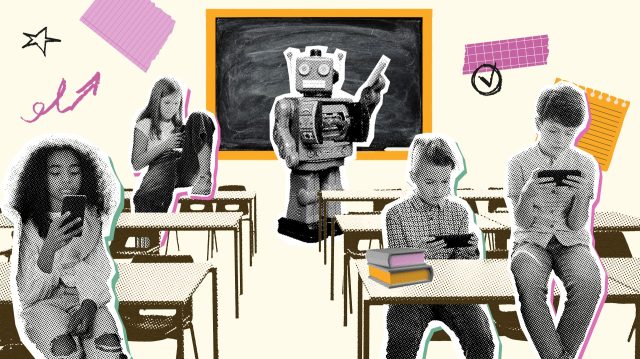
The sales pitch is that kids benefit from a kind of one-on-one “personalized instruction” that today’s teachers are simply stretched too thin to deliver. In practice, it usually means that in any one classroom, 25 headphones-wearing students are silently absorbing 25 unrelated e-lessons on a grid of glowing screens, rather than interacting in shared learning moments.
In traditional, analog education, human teachers can apply infinite adaptations to assist struggling students, answering questions and reading facial expressions and classroom energy. But when kids answer i-Ready questions incorrectly, the system merely swaps in new numbers or texts and instantly regurgitates them through the same characters and scripts. For millions of children, this quickly becomes excruciatingly repetitive.
A private math coach in Alaska describes kids’ frustration to me in stark terms. “I’ve been tutoring for 25-plus years. In my experience, universally, without a doubt, every single kid hates i-Ready. Even my most diligent, self-taught kids loathe it.”
When children are mandated to spend hours each week using a tool they actively detest, it trains them to equate schoolwork with coercion and monotony. The danger is not merely that kids dislike i-Ready; it’s that the software risks poisoning their attitudes toward learning as such.
Across the internet, students howl visceral invective against i-Ready: thousands of one-star ratings dominate on Apple’s App Store, excoriating i-Ready as “mentally exhausting,” “THE WORST,” and “a nightmare.” On websites like Sitejabber, which aggregates consumer reviews, thousands more one-star ratings accompany statements like: “It makes students want to kill themselves.” A recent YouTube video titled “i-Ready GARBAGE” racked up 350,000 views in one week; its creator calls i-Ready a “medieval torture method.”
Given this extraordinary geyser of acid bile from i-Ready’s own captive user base, it’s unsurprising that on both its official YouTube channels, Curriculum Associates disables all commenting.
As for educators, many view i-Ready as a vocational and philosophical threat: a substitution of analytics and algorithms for human insight, one that erodes teachers’ role as decision-makers and is a Trojan Horse for the total machine takeover of education. Teachers resoundingly give i-Ready a failing grade at Common Sense Media and take to private Facebook groups and Reddit in droves to vent that it is “useless” and “toxic.”
The most common educator complaint is that i-Ready replaces finite, invaluable teaching time with gratuitous additional testing. “Ms. A,” a director of math curricula at a California public charter school, who requested anonymity in order to speak freely, explains that “we lose between three and six weeks of actual instruction time every year taking the i-Ready assessments, and our teachers don’t find it useful at all.”
That problem is compounded in districts that also mandate i-Ready Learning. Although Curriculum Associates nominally recommends limiting usage to 45 minutes per subject per week, institutional pressure to demonstrate Stretch Growth® — CA’s convoluted internal metric that conveniently interprets failure and success as grounds for more i-Ready use — often bloats into hours of student screen time every day.
Teachers resent that i-Ready strips them of the authority to design lessons based on years of experience, effectively demoting them to a demeaning hybrid role: part test proctor, part IT support, part teaching assistant to their digital stand-in. Worse, educators are expected to treat i-Ready’s algorithmic assessments as definitive, even when the results contradict their firsthand knowledge of students’ abilities.
Coleman, the Massachusetts teacher, recalls the program reporting that his class couldn’t solve basic geometry problems he knew they had already mastered. The software “was telling me my kids were completely ignorant,” he said. “But I knew for a fact they could take apart a right-angle triangle and figure out the other angles.” In his experience, many students gamed or rushed through the diagnostics, generating incorrect scores that then locked them into weeks of needlessly remedial lessons.
However heartfelt or valid their objections to i-Ready, many teachers dare not protest once a school or district implements the system. As Coleman explains, educators “will not stick their necks out, they don’t want to get fired … teachers are terrified.” This anxiety is exacerbated because the program itself also becomes a vector of almost Orwellian surveillance. Last year, “Mr. J,” a West Virginia teacher, received a reprimand after local officials noticed his students weren’t clocking the minimum i-Ready minutes per week. “A district administrator came to my class and sat me down and told me that I had to do what I’m told,” he explained. “Teachers at my school are worried…. There’s absolute fear.”
You might assume that i-Ready must meet rigorous standards to lead district leaders to insist on its use, over and against the complaints of teachers and students. But you’d assume wrong. The Every Student Succeeds Act (ESSA), the 2015 federal K-12 education law that replaced No Child Left Behind, requires schools to use evidence-based programs. Yet those standards are far looser than the public imagines. Genuine proof of the effectiveness of a program requires multiyear, independently run, randomized trials — which are slow and expensive.
To date, no such gold-standard studies support i-Ready’s effectiveness. A 2016 Johns Hopkins Institute for Education Policy Brief warned “there is no evidence that [i-Ready] provides information that teachers can use to help students learn,” and chided Curriculum Associates for claiming “their assessments have the ability to increase learning,” when “none of the studies we found were peer-reviewed or independent.”
Instead, Curriculum Associates routinely turns to its own employees and paid contractors to produce non-randomized quasi-experimental studies that meet only the very lowest threshold of ESSA evidence — enabling the firm to legally market i-Ready as “evidence-based” without substantiating the claim in a manner rigorous enough to pass muster with independent scientists.
Public LinkedIn profiles reveal that Curriculum Associates staffs a research-and-analytics department with more than 50 full-time data and psychometrics scientists, whose names appear as authors on a steady stream of positive white-paper self-evaluations — all housed in the company’s own painstakingly search-optimized Research Library.
Critics point to this as fitting the textbook definition of science-washing: credentialed employees using scientific language and internal data to overwhelm would-be doubters with well-packaged supportive documentation — a convincing facsimile of true scientific rigor.
Lisa LeVasseur of Internet Safety Labs, which evaluates ed-tech software, says the strategy carries ominous echoes of Big Tobacco’s heyday: “Curriculum Associates funding their own research sounds like part of what I call the ‘Product Safety Resistance Playbook,’ which the tobacco industry pioneered back in 1953. It’s a whole set of social-engineering strategies to attack unfavorable research and fund bullshit research that showed positive things about cigarettes. And now we’re seeing that playbook again.”
Curriculum Associates, to be sure, also commissions evaluations from prestigious academic brands like the Johns Hopkins Center for Research & Reform in Education, or CRRE, which has produced at least seven CA-sponsored studies supporting i-Ready’s efficacy. Each study stresses that the underlying data is provided by school districts by way of touting its independence. Yet this sidesteps the reality that even district-supplied data are born of the firm’s closed i-Ready algorithm, which researchers can’t audit. That i-Ready generates the in-house black-box data upon which its supporting studies depend means that CA effectively operates a closed-loop evidence system, highlighting these affirmations in its Research Library as proof that i-Ready works.
Asked to clarify Johns Hopkins’ policy on whether its clients are permitted to review or edit their fee-for-service studies, CRRE Executive Director Steven Ross replied via email that “we don’t have a written policy,” adding that “they may offer caveats or suggestions for editing.”
University research departments, moreover, routinely post their output to online government databases, including the Education Resources Information Center. ERIC is a mere digital archive which does not evaluate the legitimacy of any studies stored therein. But when i-Ready’s self-funded studies appear atop Google search results on the US Department of Education’s ED.GOV web domain, replete with federal ID numbers, it signals a government-vetted imprimatur that the research doesn’t actually have. The end result is credibility laundering: Curriculum Associates’ marketing studies wear federal government badges they didn’t earn — a distinction few district administrators or school board members are capable of making before deciding whether to implement i-Ready.
Perhaps more troubling is that on rare occasions when truly independent research into i-Ready has been conducted, Curriculum Associates has materially distorted mixed or negative findings. For example, CA’s research library summarizes a 2018 WestEd/Gates Foundation evaluation as evidence that i-Ready students “demonstrated a significant improvement in their scores” on the Smarter Balanced Assessment and “tended to score 24 points higher.”
But to the vanishingly few who slog through the 52-page report, the opposite picture emerges. WestEd cautioned that “causal conclusions about the impact of i-Ready cannot be made.” Students described lessons as “repetitive” and said they were “not learning new material,” while teachers reported that the diagnostic results “did not match their own perceptions of students’ readiness.” In other words: Curriculum Associates took a study festooned with red flags and repackaged it as a blue ribbon.
So how is a product so unloved and so untested now compulsory for a generation of American K-8 students? Like other companies whose target market is government bureaucracy, Curriculum Associates employs lobbyists across the county. A filed lobbying disclosure by the firm declares an intention to “promote education technology within federal compliance standards,” and job postings for senior government-relations positions seek candidates “to drive policy wins with state leaders that grow student learning and expand CA’s business.”
One tactic to drive policy wins is Curriculum Associates’ “Diamond Level” sponsorship of conferences for the Council of the Great City Schools, or CGCS, an organization that engages in federal- and state-level lobbying on behalf of America’s 81 largest school districts. CGCS brochures indicate its Diamond Level sponsors enjoy VIP access to top district leaders and are “entitled to share gifts and/or materials with attendees.”
In 2019, an unprecedented joint initiative by CGCS and Los Angeles Unified School District selected Curriculum Associates as one of just three (out of 100) ed-tech publishers to develop “high-quality instruction materials.” A news release encouraged districts nationwide to piggyback on a no-haggle contract, assuring them “15 major city school systems have already expressed interest,” and CGCS’ Urban Educator newsletter praised the effort to “harness the joint purchasing power of the nation’s major city school systems.” The criteria for selecting Curriculum Associates over 97 other publishers were never released, despite the choice creating a de-facto whitelist of national vendors.
While there is no public accounting of exactly how many urban districts ultimately contracted with Curriculum Associates because of the CGCS consortium, news releases indicate that its classroom penetration surged 75% in the four years following, jumping to 14 million by 2023.
i-Ready didn’t achieve its stranglehold on US classrooms because school boards are foolish or malicious, however. It’s because i-Ready is exquisitely designed to prey on education leaders’ accountability anxiety. Today, poor scores on federally mandated assessments can trigger state intervention plans, tank school ratings, animate angry parents, and place proverbial heads on chopping blocks.
So when i-Ready promises “actionable data” and a “path to proficiency” packaged in color-coded dashboards exuding scientific precision, it’s catnip for superintendents desperate to inoculate themselves from sanctions, lousy headlines, and charges of ineptitude. i-Ready enables district brass to say “we’re on this” by subjecting students as young as kindergarten to the stress and tedium of six additional standardized tests per year.
Once implemented, the black-box system is perniciously self-perpetuating. Low i-Ready scores serve as proof that students will benefit from more i-Ready lessons. Over time, districts embrace the circular logic and begin optimizing not for actual learning, but for improved metrics within the i-Ready ecosystem.
There’s also alarming evidence that i-Ready plans to colonize more of the school experience. In late 2023, Curriculum Associates acquired Ireland’s Soapbox Labs, which specializes in AI recognition of children’s voices. A spring 2025 news release indicates that i-Ready is actively integrating SoapBox’s voice engine, which “will allow children to read aloud while the technology listens, analyzes, and provides timely feedback.”
Curriculum Associates CEO Kelly Sia praised the plan, declaring that it would soon be “giving teachers back precious instructional time” — when, in fact, it is designed to supplant teacher interaction with students. By automating the act of listening to a child read and responding in real time, the software supplants one of the most intimate instructional roles a teacher performs and turns the teacher into a mere supervisor.
In July 2025, Curriculum Associates also acquired Stile Education, an Australian ed-tech company that produces middle-school online science curricula. “Expanding into science is the next obvious strategic priority for us,” Sia explained in a news release. This means i-Ready’s core portfolio could soon balloon beyond its math and English to absorb science classes, boosting kids’ screen time even more.
Another concern is privacy. i-Ready, just like social-media apps, is built for internet-connected mass data extraction — tracking and recording users’ every click, scroll, keystroke, and pause. According to its own Data Handling & Privacy Statement, i-Ready combines such “usage metrics” with personally identifiable information, including the names, birthdays, and racial backgrounds of its 14 million student users. And because it is a cloud-based system, i-Ready’s data extraction continues unabated whether children are in a classroom or in the privacy of their own bedrooms doing i-Ready homework on school-issued devices.
The rub here is that minors can’t legally consent to surrendering their privacy for industrial-scale harvesting. In fact, American children are supposed to be protected by strict privacy laws. Federal laws like the Children’s Online Privacy Protection Act and the Family Education Rights and Privacy Acts are meant to shield children from predatory digital exploitation. But both contain loopholes big enough for Curriculum Associates to exploit.
In December 2025, a group of parent activists filed suit in a federal court in Massachusetts, accusing i-Ready of amounting to a compulsory child-surveillance system. The complaint alleges that CA sells “highly intimate academic and psychographic profiles of children” to advertising, marketing, and consumer-data-profiling companies. It further asserts that the company evades child-privacy laws by forcing families to surrender basic privacy rights in exchange for a public education. The suit seeks more than $5 million in damages under wiretap, privacy, and consumer-protection laws.
In 2026, a mere 15 years after launching, i-Ready isn’t some upstart tech disruptor — it’s the status quo. With roughly 14 million students jacked into the platform, and usage guidelines requiring roughly 54 hours per child annually, that’s a conservatively estimated 750 million hours (or 86,000 years) of childhood consumed by i-Ready screen time annually — a breathtaking displacement of young American lives into one company’s experimental ecosystem.
Which raises the fundamental question: has i-Ready delivered results? The big picture suggests not. Because i-Ready’s core selling point has always been improved performance on government-mandated assessments, those same standardized tests offer a common-sense measure of the product’s effectiveness. Unfortunately, results indicate that i-Ready’s screen-based learning paradigm has been a bust.
The National Assessment of Educational Progress, or NAEP, was established by Congress in 1969 as the benchmark of American academic performance. While NAEP showed broad student-achievement gains in the early 2000s, during the 2010s, when smartphones and ed-tech took over, achievement flattened. On NAEP’s 2025 Nation’s Report Card, America’s reading scores continue to fall, math gains are minimal, and achievement gaps between low-income students and their affluent peers are widening. NAEP may not explicitly point to i-Ready as causing the decline, but it undercuts any claim that the platform’s massive market share is reversing it.
As for hope that i-Ready districts buck that trend, even Curriculum Associates’ own State of Student Learning 2025 report — based on diagnostic data from all 14 million current i-Ready students — acknowledges that “academic recovery has stalled nationwide,” with “little change or small declines” across nearly all grades, subjects, and income levels in the previous year. The report reveals that i-Ready users’ proficiency has regressed so deeply that in Grade 8 Math, 60% of students fail to reach grade level — a failure rate that has increased since 2019. Worse, nearly 30% of fifth graders are two or more years behind, proving that the i-Ready algorithm is not a recovery engine, but a stagnation trap.
And so the rise of i-Ready has mirrored a collapse of US academic achievement. This demands we finally ask: if i-Ready simply doesn’t work, at what point does America’s education establishment cut its losses and declare it digital snake oil — a boondoggle of historic proportions?
If and when we do, Benjamin Coleman won’t miss it. He still yearns for a return to the personal, empathetic classroom dynamics he watched Curriculum Associates steadily erode. “There is no teachable moment with i-Ready, man,” he says. “It’s all kids sitting in silence staring at the freaking screen. It takes the humanity out of education. It’s very sad.”