




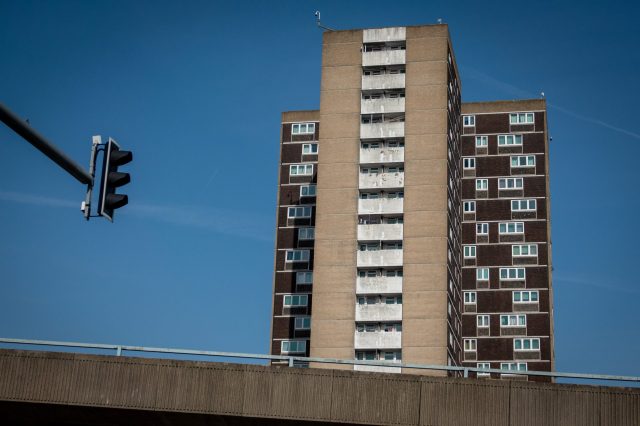
We need to promote an entirely different vision of urbanism.(Anna Barclay/Getty)





“This is Portsmouth, people went to war from this city.” For a place associated with some of the greatest writers in the English language — Dickens was born here, Conan Doyle and Kipling both lived in Southsea — it’s apt that its finest description came courtesy of Alan Ball. More famous as a World Cup winner than as a wordsmith, the former Portsmouth FC manager nonetheless captured how Pompey sees itself: hard, unpretty and as unyielding as the Palmerston forts standing guard off its shore.
That attitude extends to Southsea, once a fashionable Victorian resort and absorbed into the city in 1904. “Southsea — it’s still Portsmouth,” reads one print by a local artist. Beneath the slogan is Clarence Pier, a Sixties carbuncle that replaced a far more beautiful building bombed during the war. To complete the image, one man urinates against a kiosk while another kicks a hapless victim on the floor. Self-effacing to its core, the picture reflects another pillar of modern Portsmouth identity: don’t get ideas above your station.
Yet dig a little deeper and that story — of a place purely defined by martial toughness and an aversion to airs and graces — turns out to be relatively recent. True, the home of the Royal Navy never had the concentrated wealth of Godalming or Guildford, nor the venerable spires of Chichester and Winchester, but it was, for a time at least, rather beautiful. That parts of Pompey are now ugly, almost intentionally so, is no accident: the city’s slow fraying over decades was the result of choices made by politicians. The story of how it happened is, in microcosm, the story of a nation in decline.
To grasp Portsmouth’s former splendor, just listen to Arthur Conan Doyle, who ran a medical practice in Southsea while writing the first Sherlock Holmes novels. He called it a “glorious place”, with a “great glamour” on its streets for “anyone with the historic sense”. Conan Doyle even went as far as saying that were he forced to live outside London, he would only opt for Southsea. In a cruel twist of history, Bush Villas on Elm Grove, where his practice once stood, was hit by the Luftwaffe. These days, a friend of mine refers to the road as the city’s answer to Skid Row. Earlier this year, a Co-op supermarket, near the site of where Conan Doyle lived and practiced medicine for almost a decade — itself is now a dreary block of flats — had to close because of industrial-scale shoplifting.
As that comparison implies, Conan Doyle — and indeed other Portsmouth writers, from HG Wells and Dickens to Olivia Manning — knew a very different city. A century ago, it was home to more people than now, something all the more striking given it remains Britain’s most densely populated city after London. It also had trams, rattling past rows of Georgian and Victorian buildings. Walk through the elegant streets of Chichester or Winchester, and it’s worth recalling how their larger neighbor once resembled them.
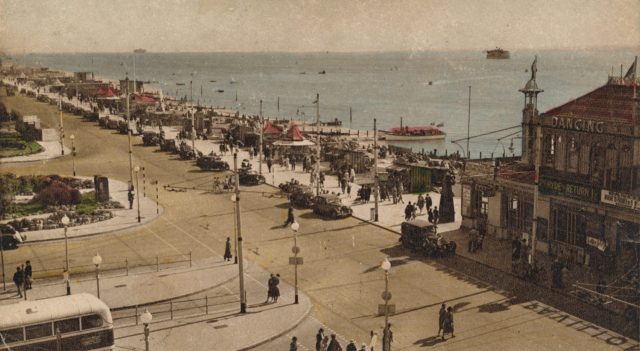
It was the 19th century that really proved to be Portsmouth’s making, as a grand civic spirit, alongside the preternatural growth of the Royal Navy, gave rise to the city’s Guildhall and Victoria Park. W.H. Smith was the patron who paid for the beautiful St Mary’s Church in Fratton, while Andrew Carnegie gifted the nearby library. The spirit of the age was clear: urban improvement, a desire for visual harmony, and a belief in personal self-improvement alongside the inevitability of broader social progress.
Visual harmony are not words you’d choose to describe Portsmouth these days — particularly given the legacy of war. From 1941, over 65 German air raids successfully targeted the city, with thousands of buildings destroyed or damaged and almost 1,000 locals killed. Among the leading architectural casualties were the Guildhall, reduced to a burnt-out shell (although thankfully restored); Clarence Pier, since replaced by that Sixties eyesore; and the Royal Garrison Church, where Charles II married Catherine of Braganza in 1662, and whose nave remains roofless to this day. Beyond these individual losses, whole districts were flattened. Take Commercial Road, then as now Portsmouth’s main thoroughfare. Photos from before the war reveal handsome brick palazzi, as proportionate and beautiful as any great European city. Today, by contrast, it’s arguably Britain’s ugliest town center.
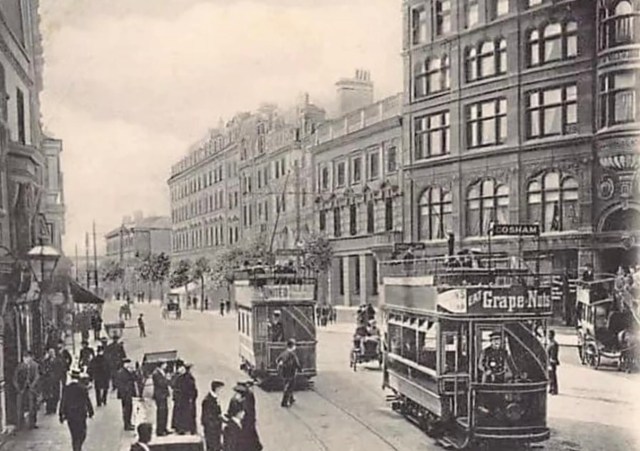
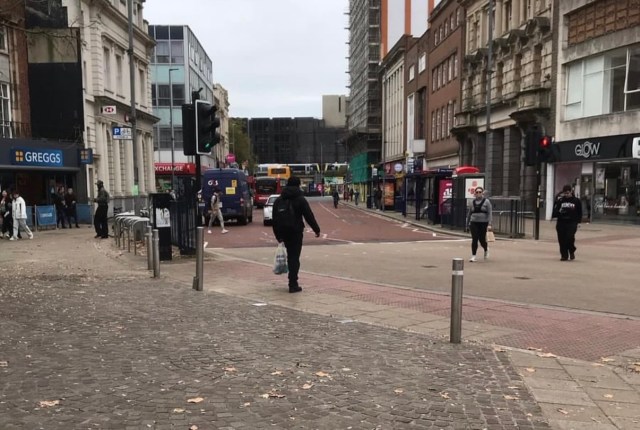
If the Blitz was one problem, failure to properly rebuild was another. Much of what drove that compulsion was an abstract desire to modernize: which, alongside a well-meaning desire to give Britain’s workers better homes, in practice often meant reshaping social life around the automobile. Indeed, the role of the car in the brutalization of our cities is often overlooked, not least because it’s comforting for conservative aesthetes to blame Left-wing planners, even if they doubtless played their own part too.
The impact of all this is obvious in Portsmouth today. Buildings like the Crystal Palace pub were demolished for minor road expansion, while the same happened to the Lady Chapel of St Agatha’s Church — though the street it was demolished for was never in fact built. In the city center, meanwhile, the impressive General Post Office was flattened in the Seventies, with a car park duly appearing in its place.
Quite remarkably, the demolitions continue even now. After a recent consultation, in which 1,500 locals were contacted and barely one in 30 replied, the Liberal Democrat cabinet approved plans to demolish a historic MoD building, built in the 1890s — and a small remnant of the stunning Victoria Barracks mentioned by Nikolas Pevsner in his guide to Hampshire. Defending the decision, councillor Hugh Mason said it could “hardly be said to be a beautiful building”, a statement made all the more remarkable once you’ve seen nearby tower blocks. No doubt Mason’s predecessors said much the same as they waved through the demolition of the old Royal Hospital, flattened for a Sainsbury’s that has itself since vanished. Rather than a single moment, anyway, it was dozens of similar decisions, over many decades, that snatched the coherence and beauty of the place Conan Doyle once loved.
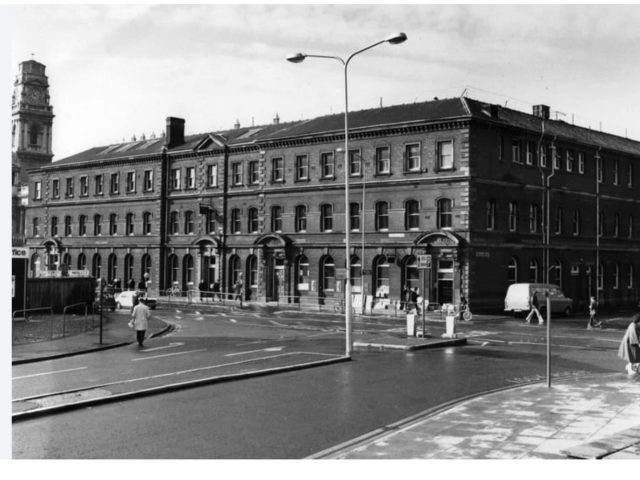
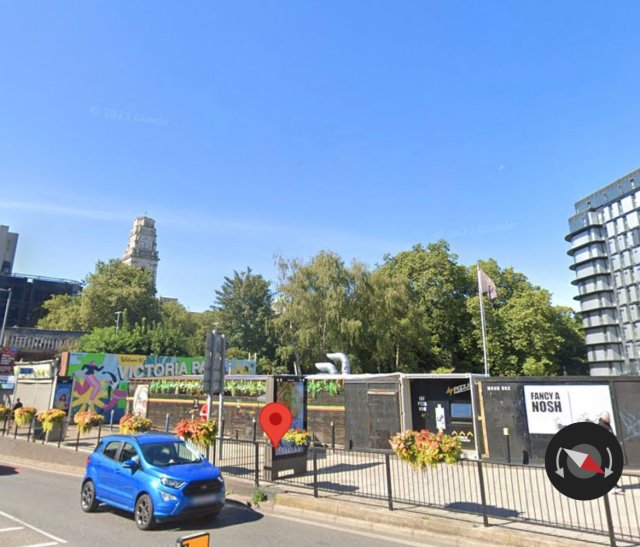
If, however, the destruction keeps coming, what has changed are the motivations behind it. Because while, half a century ago, the wrecking ball smashed in the name of ideology, an abstract wish to “modernize” in favor of four-wheeled individualism, similar outcomes unfold today because it’s simply the easiest thing to do. In the case of that MoD building, the council aren’t even particularly clear with what should replace it. There are other examples too: when the polarizing Tricorn Center was demolished in 2004, by the then recently elected Lib Dem council, they promised new shops and flats within a couple of years. More than two decades on, the site remains bare. A lack of imagination, and even less common sense, are just as serious problems for local government as a scarcity of funds.
This, then, is city planning for end-times liberalism: where, in the words of Patrick Deneen, “gratitude to the past and obligations to the future are replaced by a nearly universal pursuit of immediate gratification”. For me, this became particularly apparent after observing Portsmouth’s centenary celebrations in recent months. The flagship event of Portsmouth100, a year-long program of events, is a free trail of 45 decorated lion sculptures — the “Pride of Portsmouth” — which includes creations such as “Cubmarine” and “Together We Are Fierce”. If the 19th century essentially built Portsmouth and the 20th gave it electrification, a huge commercial port and, as recently as 20 years ago, Gunwharf Quays, then what is the reasoning behind fatuous guerrilla artworks and “placemaking”?
If local government is largely to blame here, then councillors and council officer play the leading role. Britain’s urban spaces look awful in large part because many with power outside Westminster don’t appear to know what they’re doing. And why would they? The former are poorly paid — in Portsmouth, a councillor can typically expect to earn £12,000 a year — and the role is essentially a part-time hobby, with many councillors working around 22 hours a week. Little wonder the job proves so popular among retirees, status seekers and party apparatchiks with delusions of grandeur.
There’s a growing consensus that if Britain is to thrive again, its small and medium-sized cities will have to play a greater role. Indeed, it’s no coincidence that our new prime minister, and his party’s last great hope, made his name in one of the country’s few civic success stories: Greater Manchester. But as more power flows to cities and city-regions, how do we rewire the politics of these places to value beauty once more? How can we stop the slow, dull decimation of Portsmouth and places like it?
In 2020, Emmanuel Grégoire wrote an essay titled “For a New Parisian aesthetic”. It begins with a Victor Hugo quote about how the function of a building belongs to its owner, but its beauty belongs to everyone. Fast forward six years, and Grégoire is mayor of Paris, having earlier this year won on a platform including a “right to beauty”. Since then, he has appointed Lily Munson, a designer and urban planner, as his new “delegate general for design and aesthetics”. Britain’s metro mayors, including those who’ll be elected in the years to come — including in Hampshire—, should follow Grégoire by having a regional “chief beauty officer” with a clear brief to remove eyesores. This could be paid for by abolishing pointless roles among existing local authorities, starting in Portsmouth with its (clearly failed) director of regeneration. One advantage of metro mayors, and the strategic authorities they sit atop of, is that places as far afield as Portsmouth, Eastleigh and Southampton can pool resources for more ambitious roles.
The idea of a chief beauty officer isn’t entirely alien to the UK. For instance, Richard Rogers served as Ken Livingstone’s chief adviser on architecture and urbanism, though my proposal is something more formal. So what would these blemish bashers do? First, they’d bring coherence to the public realm, drawing up a single street design guide that sets standards across a metro region for everything from bins to bus shelters, a measure which would also save money with more efficient procurement. Second, they’d oversee a “public realm improvement fund” to upgrade 100 places across their city-region each year, working alongside residents and community groups, as well as council services brought in house, to declutter a street, repair broken benches or simply tackle visual neglect.
Third, they’d work with those responsible for issues like street cleanliness and rubbish collection, scrutinizing outsourcing companies when they fall short and expanding capacity and ambition when services are placed back under public control. They’d also have a say in the planning process: pushing to restore older buildings rather than demolishing them, and ensuring new developments add to a place rather than detract from it. Conservation is often the hard option, which is precisely why local authorities avoid it.
To borrow a phrase from Andy Burnham, these figures could be “circuit-breakers” to stop the enshittification of our cities, from ugly new builds to the chaotic blight of e-scooters. In the end, though, this is about more than beefed-up metro mayors. We need to promote an entirely different vision of urbanism. We need more trained architects — who should no longer be compelled to pay student fees — and different people to enter politics. One tactic might be halving the number of councilors while doubling their pay. Here’s a more tongue-in-cheek proposal, but half-serious too: give every council in the country a subscription to Monocle and FT Weekend. They might then learn how other places do things, and almost always better.
Given the destruction of the last 85 years, anyway, we have no choice but to be visionaries — centering the idea of beauty in the public realm. Who knows? After almost a century, the 800-year-old Royal Garrison Church — exposed to the elements — might finally get its roof back.
Aaron Bastani is the co-founder of Novara Media, and the author of Fully Automated Luxury Communism.
 AaronBastani