




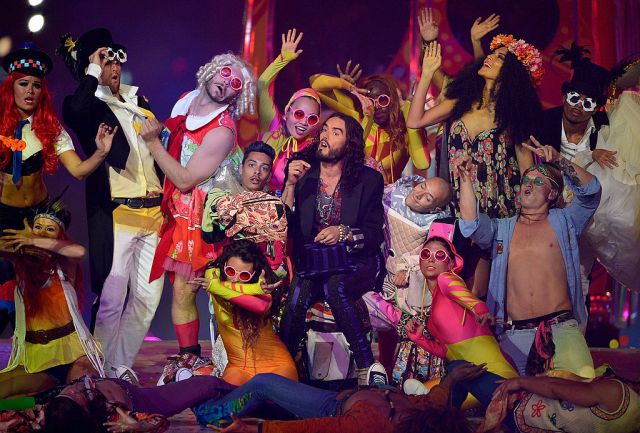
“Brand belonged to a rougher, readier era of programming.” (Jeff J Mitchell/Getty)





It’s always the ones you most expect. That, at least, has been the conclusion online after the rape conviction of Russell Brand. Rather than admit that Brand’s conspicuous, hypersexual persona was a rather effective sleight of hand — one which successfully distracted production companies and audiences from his criminal private life for two decades — social media has spent the past week telling itself it can spot a wrong’un a mile off. So it is that long-buried clips of Brand making rape jokes on Channel 4 quiz shows have popped up on our timelines: see, these posts say, this is what a rapist looks like.
It’s a reaction I can understand. Watching back clips of Brand’s big-haired heyday, it is difficult to understand why nobody raised the alarm. There’s the recording of Brand offering to send his personal assistant to Jimmy Savile, naked; “Nothing wrong with that,” warbles the elder predator. There’s the clip of him on a talk show, bragging about convincing women to “trust me” by posing as gay — before “bang! Pregnant”. There’s the one where he jokes about dragging a woman “into a cubicle” to “show her my pubicles” (a similar account cropped up in court). This was a man whose recurring gag was being vulgar, boastful, libidinous and frightening. In isolation, these snippets are shocking — but lest we forget, these qualities were once the very foundations of late-night television. The rape jokes look stark in retrospect; in their context, they were seen as naughty asides in a comedy culture which loved nothing more. Half the joke was the ambiguity of whether Brand “meant it”.
It’s impossible to imagine perviness being a joke today, so squeaky-clean is our post-#MeToo mainstream comedy culture — but the recent past is a foreign country. The Noughties, the decade that produced Brand, was positively anarchic by today’s standards. Programs like Never Mind the Buzzcocks (fronted by Simon Amstell) and Big Brother’s Big Mouth (a reality-recap spinoff fronted by Brand) were so watchable because of their sweary, offensive, unpolished banter. Guests would drink heavily, hosts would tease relentlessly and a barrage of obscenities and fights would cap off the night. These shows were combustible by design: panelists’ flimsy egos were flambéed at every opportunity in a way that would give an on-set welfare officer a coronary today. In one memorable spat on Buzzcocks, Amstell goaded the mononymous singer Preston (remember him?) to storm off by reading out the most airheaded portions of his wife Chantelle’s autobiography.
Producers today would cower from “platforming” anything quite so third-rail, or even slightly mean — which is why the BBC, ITV and Channel 4’s late-night offering is a revolving door of Rob Beckett, Romesh Ranganathan and whatever green-haired Goldsmiths graduate they can drag off the street. Late-night banter has been replaced by light-entertainment lols in Scottish castles. We are a million miles from the 2007 Brit Awards, hosted by Brand, in which he managed to crack jokes about the Queen’s “privates”, the friendly-fire death of a soldier in Iraq and the hanging of Saddam Hussein.
Brand belonged to a rougher, readier era of programming in which hosts functioned as ringmasters and made a spectacle of wrangling unpredictable stars. Something “happening” — a fracas, a sly joke, a flash of nudity — was precisely why we watched. After the watershed, moral instruction vanished. After Fiona Bruce had packed up her papers, a band of twenty-something brigands would saunter on set to deliver vulgar nightly sermons. Brand was the most vivid product of this culture — the most flamboyant bird of prey, and a breed now long extinct. Part of this week’s social-media cope is the insincere refrain that Brand was not just evil, but unentertaining — a more honest reckoning would acknowledge that his theatrical, voracious, quippy persona was in fact TV gold. His perviness was not incidental here; it was part of the act. Looking back at clips from Big Brother’s Big Mouth, audiences are delighted by the edginess of it all; they like the feeling of being shocked.
All this — gasps included — meant great ratings. In the 2000s and 2010s, British television was buoyed by a handful of charismatic but creepy men. In the years since, many of these men have been unmasked as various shades of problematic. There is David Walliams, the poor man’s Kenneth Williams, who was dropped by his publisher and lost a tie-in with Alton Towers after being accused of inappropriate behavior towards women (a claim he denies). There’s Gregg Wallace, the cheeky-chappie-in-chief of the MasterChef kitchen who producers brought on as a working-class hero — only for him to be investigated for inappropriate behavior, sexual comments and bullying (allegations he denies). The list of shamed male TV favorites seems to grow by the month: what began with Savile became respectable newsreaders like Huw Edwards and lovable children’s entertainers like Rolf Harris. Understandably, the industry has swapped its riskiest constituents — late-night livewires — for focus-grouped fun like Sky’s Saturday Night Live UK, stocked with on-message TikTok comedians. Not only has this made comedy worse — it also won’t work.
Gutting schedules of rogues is no guarantee of moral perfection. Padding out panel shows with scarf-swaddled softbois is an understandable reflex for production companies keen to avoid the mistakes of Endemol, the one-time handler of Brand. Really, though, you cannot judge a man’s propensity to rape you based on whether he wears natty little Victorian waistcoats or piles up his hair like a Whitechapel harlot. Brand may stick out as an example of where instincts should have been trusted — but so much of modern masculinity has been defanged and made to feel “safe” that real wrong’uns are incredibly difficult to discern. Think of Neil Gaiman, whose alleged sadism (which he maintains was always consensual) was packaged in the disarming guise of a sensitive sex nerd. At a time when audiences — and especially women — are suspicious of swagger, it has never been more fashionable to don sheep’s clothing. If he were starting out today, Brand would pose as a nice boy. There is no better evidence for his slipperiness than his spiritual conversion, itself a flagrant attempt to retcon his rapey years as a period in the wilderness.
In the Noughties, sexual appetite and celebrity ego were extraordinary bringers of social capital. Today public horniness is reserved for a select group of heavily media-trained women — Sabrina Carpenter and Zara Larsson, for example, who seem only ever to dry-hump their way through pop sets. Meanwhile men are more likely to cry on television and tell entertainment correspondents all about their body-consciousness than crack jokes about shagging. In comics, the transformation is perhaps the most noticeable of all — they have gone from carte-blanche provocateurs to professional personalities, ones who must withstand the same purity tests on the issues du jour as all other celebs.
None of that will stop the Brands of the future. The sanitized stars British networks choose to replace the rogues of yore could be just as odious behind closed doors. Bad behavior seems to seep out of the woodwork of celebrity with such regularity that we have to assume there is something corrupting in fame itself.
Our reckoning over Russell Brand is due. It is right that we ask ourselves how we could have ignored, even praised, such a conspicuous sleazebag. But we shouldn’t delude ourselves about what a bad guy “looks like”. The truly disturbing thing is that Brand, like Savile, was an unusual example of someone who bore his badness as a sort of double-bluff. The plethora of old gods tumbling out of favor over the 2020s represents the whole spectrum from grandfatherly to grotesque — proof of how easily some men slip under the wrong’un radar. In the wake of Brand’s undoing, it is tempting yet fruitless to trawl through old footage of this particular prancing perve to make ourselves feel better about “missing” the truth. In the ultra-horny Noughties, salaciousness was standard fare; today we live in a paranoid purity culture which prefers its famous men to look as unthreatening as possible. But the mistake is to confuse the performance of a personality with the evidence of character. Television may well have changed the men it celebrates, but that doesn’t mean we have learned how to recognize the dangerous ones.
