




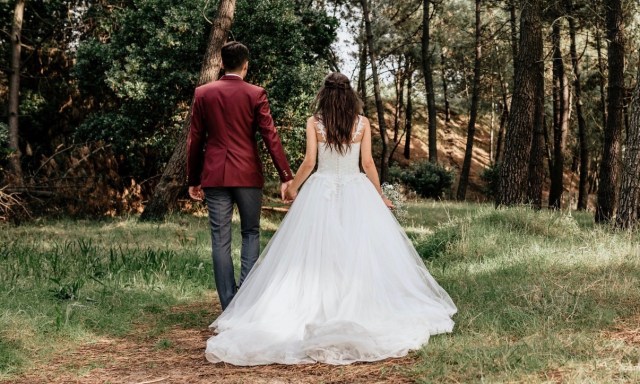
Love is especially present in the certainty of death. Credit: Getty





In a week, barring setbacks, my sister will marry a man dying of cancer, in a small church in Akron, Ohio. Elizabeth met George in person six months ago for the first time, after a courtship of six months of talking on the phone (she lives in Pennsylvania; they met online). Their first date ended up in the hospital after my sister noticed that George’s skin was jaundiced; tests revealed that he had pancreatic cancer, which has since become metastatic.
The new couple was able to spend the summer together, in relatively good spirits, road-tripping to different clinics to get second, third, and fourth opinions on George’s tumor, but George’s prognosis has not improved; they have not found a treatment that will meaningfully push back the horizon of death. They will get married with the unendurable awareness that they have only a few weeks or a few months together.
Elizabeth says that she was in denial this summer and so was George. They could let themselves think that pancreatic cancer was misdiagnosed as pancreatitis. They talked about having five kids together. They had a life in mind. They’ll be lucky to have five weeks, let alone five months.
I wanted to write about them, with their permission, because I think their kind of story is the most important in the world. The tendency of modern society is to remove death and suffering, leaving us unaware of the real stakes of living. But far from being consoling, this trick leaves us wracked with low-level anxiety, as we try to make the next day resemble the previous day and reduce minor sources of risk. Beyond that, the way we talk about each other now excludes any possibility of transcendental devotion, of opening oneself up to suffering and indeed to shame, finitude, and failures of all kinds.
Parallel to the development of my sister’s relationship with George, I developed a persistent depression that has caused me to question whether I want to be alive, and that has, in many ways, made me lose my joy in life. When George went into the hospital last month with sepsis after his stent became infected, his beautiful summer with my sister came to an end, along with their capacity for denial. My sister called home to my parents distraught, blaming herself, saying she should have pushed George to get invasive surgery earlier.
I was at home with my parents, attempting to enjoy a basketball game after a CBD gummy and a glass of wine, intentionally numb. My mom came downstairs, her voice cracked, describing the state Elizabeth was in. All I could feel was the same lassitude I’d felt for most of the past few months, and I recognized that there was something pathetic about the state I was in, even if I couldn’t force myself to change it, to change my brain. It was absurd to not be able to find joy in good health, in the prime of life.
I had to go for a walk. Once I was outside my own emotions started to inflate, but mostly I saw George. I imagined George; I imagined being George, alone in a hospital bed in Ohio, trying to watch the Sixers-Cavs game that I was trying to watch in Pennsylvania. I was sedating myself intentionally; he was sedated by doctors.
On the walk, I called the woman I love and told her I loved her and started to cry, which is not something I’ve been able to do much of, and kept walking. While this didn’t cure me of my own bad feelings, my very, very deep anxieties, regrets, griefs, I could at least see a way through. I could feel something other than depression, because I saw for a moment through George’s eyes, not my own; I was able to open my eyes and breathe, without taking sight and breath for granted.
Internalizing George and Elizabeth’s situation showed me a glimpse of what I can only call universal truth: we die; love is the only real source of hope; everything is trivial; everything you think is unendurable or frightening is not, if it is not death itself.
All fall, I’ve been reading a book called Our Thoughts Determine Our Lives: The Life and Teachings of Elder Thaddeus of Vitovnica, written by an Orthodox monk from Serbia who died in 2003. Father Thaddeus talks about rabbits playing in the grass and asks why people can’t be like that: natural, free-spirited, enjoying the sensation of being here. I think that’s a devastating idea.
“Do you have no idea how beautiful life is?” my sister texted me after George went into the hospital. “You have no idea.” My sister is closer to Father Thaddeus than I am, or than anyone I know, or you know, right now, closer to that pure awareness of the good, because she is living so close to death, in a state of mercy.
I think most of us know that something is wrong with the world, with our daily lives. We push death so far away that living at high intensity would be too painful, because it would remind us of our mortality. Yet what we want is for someone to be the guardian of our soul, the guardian of our mortality, to lie next to us, to be tender with us. We want to know our sins are forgiven. We want another rabbit to play in the grass with.
As cruel as it seems that George should be diagnosed with cancer on the day he met my sister, there’s another way of looking at it. He was already sick, and God sent my sister to George before his health broke down. Even without a medical miracle, they experienced a miracle: this radical faith and belonging together, this humble caring for each other.
There are other stories like this in the world, and tragedy is everywhere. The reason I wanted to share Elizabeth and George’s story is what it forced me to admit: I’m not so important, my suffering is not so important, what really matters is our capacity for mercy and sacrifice, operating from the trust that there is a reason for things, that, in the words of Romans 8:28, “all things work together for good to them that love God.”
Technological civilization is an illusion and living in the face of mortality, immanent or not, helps us break out of collective anhedonia and into the spirit of forgiveness; it helps us to surrender to God’s will. And we must do so, I think, before it is too late: before our lives pass by, numb, scared, and affectless. We do not have total control over nature, or over ourselves. We are still fragile, breakable, sinful, and so much modern sadness and alienation comes from human beings acting like autonomous agents that will simply be turned off like a phone that runs out of battery, rather than interdependent and mutually forgiving and graceful creatures with souls, who must accept one another, or destroy one another.
Love between individuals, face to face, really is the only thing that cuts through addiction, depression, poverty, loneliness, resignation, and regret. Love for its own sake is the last and only resort against the uncontrollability of the world and the uncontrollable cruelty of human beings when we form groups and tribes.
There is nothing that we cannot lose at any moment. George met my sister just in time to go through the most terrifying thing with someone who loves him. We who have our health might consider ourselves lucky, but no one is luckier than the man who has been brought close to God’s love.
