




(Sean Gallup/Getty)





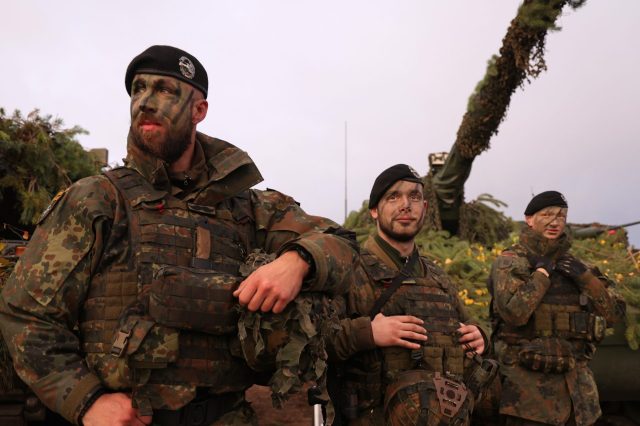
A heavy rain is falling on Rukla, a former Soviet army base an hour north of Vilnius in Lithuania. Infantry fighting vehicles race past through the mud, decked with fir branches for camouflage. “This is a great opportunity to show what we’re capable of and train with our allies,” Robin Eskeland, a Norwegian lieutenant, tells me as I take shelter in the back of his CV90 battlefield taxi. “Of course, we have our differences,” he says. “We like to be flexible; Germans want to stick to the plan. And they’re ultra-punctual. If an exercise is due to begin at 8am, they’re always there, guns at the ready, half an hour beforehand.” For all the Jeux Sans Frontières stereotypes of national quirks, Eskeland sees this deployment as the “most meaningful” of his seven-year army career so far — a chance to prepare for a war that, in this corner of Europe, no longer feels quite so unimaginable.
Since 2017, Germany has led NATO’s multinational force in Lithuania, with troops from eight other countries rotating in and out to serve alongside German forces. Russia’s full-scale invasion of Ukraine in February 2022 prompted Vilnius to seek firmer guarantees that its allies would come to its defence if the Baltic states became the Kremlin’s next target. Berlin responded by committing to permanently station an armoured brigade in Lithuania, establishing a combat-ready deterrent on NATO’s northeastern flank. The move is unprecedented for the Bundeswehr: this is its first permanent military deployment abroad since the Second World War. Latvia and Estonia sought similar commitments from Canada and the UK, respectively, but Lithuania alone secured an entire brigade.
Addressing parliament in Vilnius two years ago, Germany’s Defence Minister Boris Pistorius promised that German troops would stand shoulder to shoulder with their Lithuanian counterparts, ready to defend the country — part of a wider Alliance commitment to protect every inch of NATO territory. A year later, in May 2025, Chancellor Friedrich Merz attended the commissioning ceremony of the newly created 45th Panzer Brigade against the backdrop of a grand neoclassical basilica in Vilnius’s Cathedral Square. “The security of Lithuania is also our security”, he declared. “The protection of Vilnius is the protection of Berlin.”
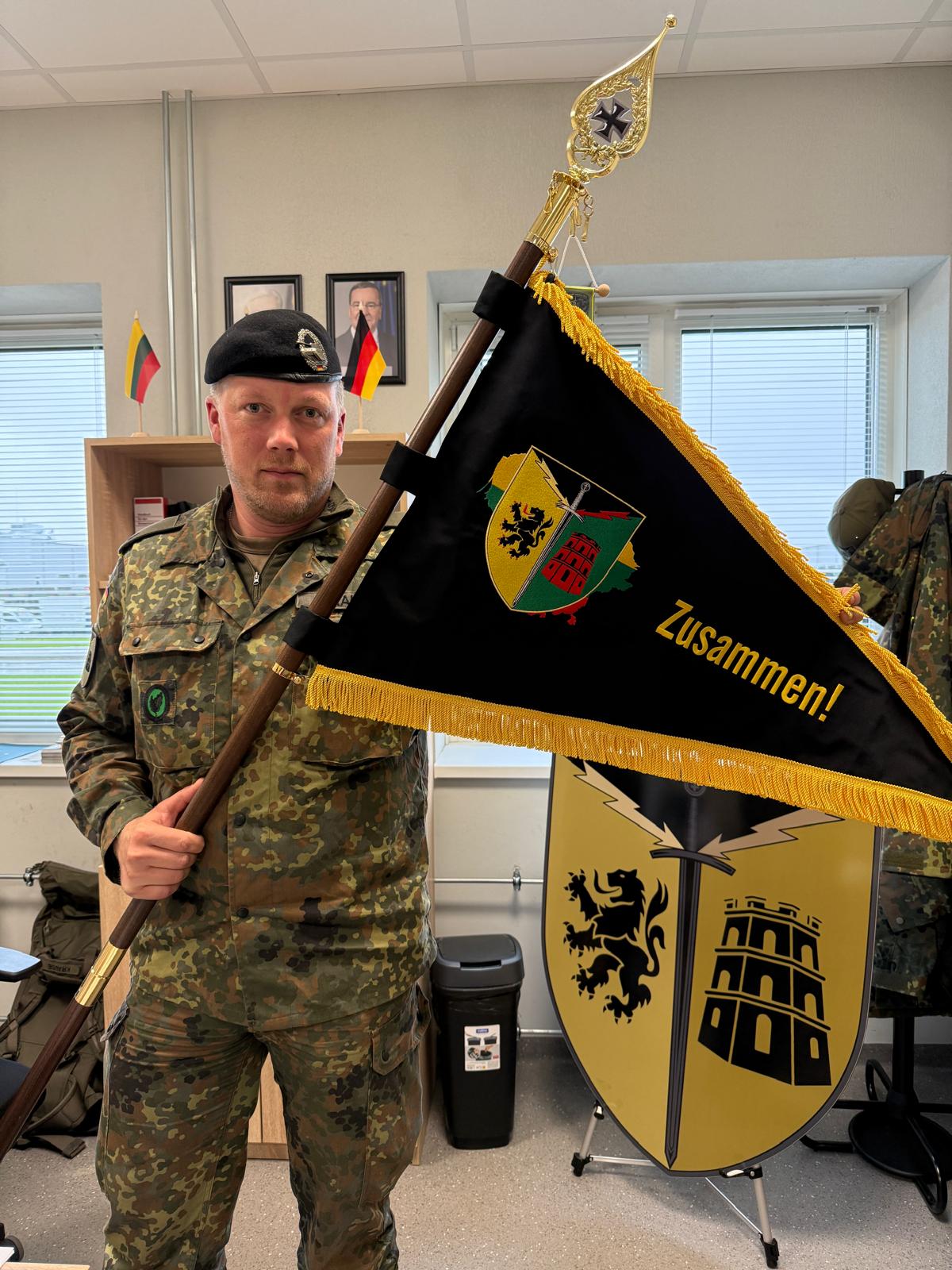
The brigade has its own coat of arms, worn on every soldier’s uniform. A black Staufer lion, the heraldic emblem of Germany’s medieval Hohenstaufen dynasty, stands next to a sword and Gediminas’s Tower, one of Vilnius’s most famous landmarks. Green, red, black and gold, the colours of the German and Lithuanian flags, tie the design together.
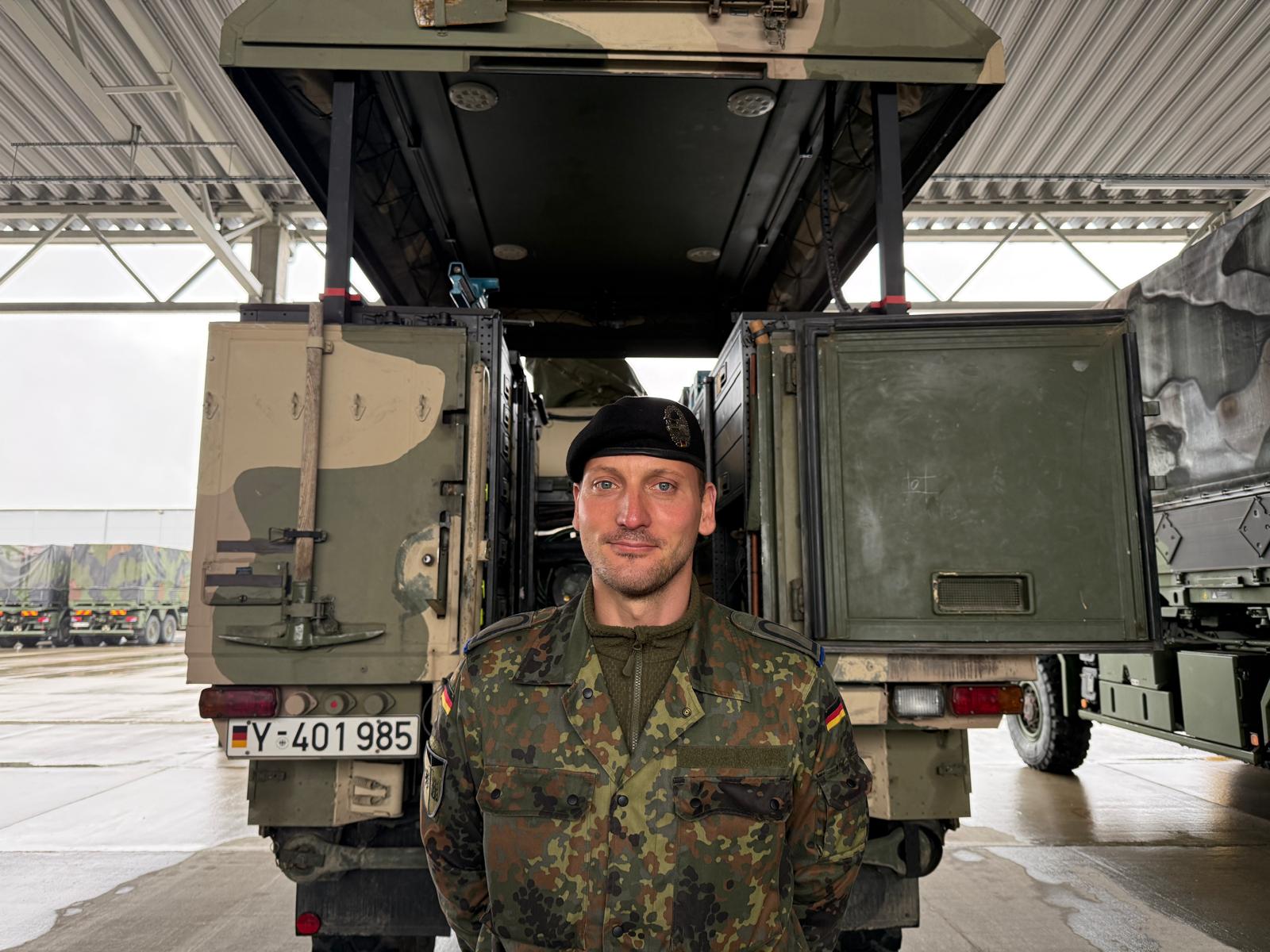
Germany’s newly formed brigade will be supplied with state-of-the-art equipment designed to repel a potential Russian attack, including kamikaze drones, Leopard 2 A8 main battle tanks, Puma infantry fighting vehicles, and Panzerhaubitze 2000 self-propelled howitzers. It brings together combat battalions from Bavaria and North Rhine-Westphalia, backed by artillery, reconnaissance, armoured engineers, logistics and signals units. Next month, more than 700 drones will take to the skies as the 45th Brigade puts new reconnaissance, strike and loitering munition capabilities to the test.
The arrival of the 45th Brigade marks a major shift in how NATO plans to defend the Baltics. Under the old “tripwire” strategy, a small force would be expected to hold off an attack until allies arrived to push the invaders back. Now, the aim is to stop an invasion from the outset. That means keeping tanks and other heavy equipment in Lithuania, ready to fight, rather than waiting weeks for them to arrive from Germany or other NATO countries.
One of the brigade’s main jobs is protecting the Suwałki Gap, a 40-mile strip of land along the border between Poland and Lithuania — the vital land link between the Baltic states and the rest of NATO. It’s the region’s Achilles Heel or “neuralgic point”, as the German Lieutenant Colonel escorting me puts it.
We drive through a small village and stop at a level crossing. A freight train rumbles past, heading west from neighbouring Belarus towards Russia’s exclave of Kaliningrad. Perched on the Baltic Sea, it is a Russian island inside the European Union, sandwiched between Poland to the south and Lithuania to the north and east. The wagons are marked “Sodruzhestvo”, the name of Russia’s top agro-industrial conglomerate. Lithuanian border guards constantly monitor the trains to prevent illegal military equipment from passing through the European Union corridor.
Western intelligence agencies have long suspected Russia may have nuclear weapons stockpiled in Kaliningrad. Since 2016, Moscow has stationed 9K720 Iskander short-range missiles there, capable of carrying nuclear warheads. Yet new research conducted by the Baltic International Security Centre (BISC), a nonprofit policy institute, suggests that the region has been “stripped bare” of ground forces and air defences because Russia is diverting resources to the war in Ukraine.
“They may have nuclear warheads,” says Edward Lucas, security expert and director of the BISC, “but they haven’t got anything to launch them on because the missiles are all busy bombarding Ukrainian cities.” He adds that there is no real difference from NATO’s point of view whether a nuclear warhead is launched from Kaliningrad or from a missile on a Sukhoi Su-57 bomber or from a submarine because “in the end, if Russia wants to go nuclear, it’s not going to be the nuclear warheads in Kaliningrad that are decisive”.
However, he stresses that the exclave remains an important hub for hybrid operations such as GPS electronic warfare or propaganda and, crucially, serves as a useful pretext for escalation. In September, Moscow accused NATO of plotting to blockade Kaliningrad and threatened nuclear retaliation. More recently, the Russian military website Voennoye Delo suggested that a hypothetical blockade might require Russia to seize a 100-kilometre swathe of Baltic territory to secure access to the exclave.
Such sabre rattling, Lucas tells me, has led to a complete overhaul of defence policy in both Poland and the Baltic States. “I can’t quote him by name,” he says, “but a Baltic official once told me, ‘If a seagull shits in the harbour, we know what it had for breakfast when it last went to Russia, who it dates, where it nests. And what its parents did during the Soviet era’.” In other words, monitoring Kaliningrad is a priority for the Valstybės Saugumo Departamentas (VSD), Lithuania’s counterintelligence agency.
Despite heightened vigilance, Lithuanians feel increasingly exposed. In May, residents of Vilnius received emergency alerts on their phones ordering them to immediately take cover amid suspected drone activity near the Belarusian border. It was the first major alert to send people in an EU and NATO capital scrambling for shelter since Russia’s full-scale invasion of Ukraine. Then, in September, an Italian fighter jet on a NATO mission shot down a drone over Lithuanian airspace. A Ukrainian military source identified the wreckage as belonging to a Geran-2, a long-range attack drone widely used by Russia.
Across Vilnius, bright yellow signs reading “Priedanga” — “shelter” — sprung up following Russia’s full-scale assault on Ukraine in 2022. But when frightened residents rushed to them in May, some found the doors locked. Others described them as unfit for purpose: dilapidated and covered in cobwebs. The chaos and complaints prompted Prime Minister Inga Ruginienė, who had sheltered with the President in a strategic government bunker, to apologise and promise a review. But many fear their country is woefully unprepared for worst-case scenarios. In 2016, the US think-tank RAND war-gamed a Russian attack on the Baltics and reached a chilling conclusion: without more NATO troops on the ground, Russian forces could overrun the Baltic states in just 36 to 60 hours. Lithuania has been a NATO member for more than two decades but that did not prevent an MP from Vladimir Putin’s United Russia party publicly questioning Lithuania’s independence in Russia’s State Duma four years ago.
Most Lithuanians know from bitter experience what it means to be controlled by Russia. Memories of the Soviet occupation, which lasted nearly half a century after the Second World War, are still fresh. Almost every family has relatives who were murdered or sent to gulags in Siberia. There’s a dark history with the Germans too. Vilnius was once known as the “Jerusalem of the North”, home to at least 55,000 Jews and a celebrated tradition of Torah scholarship. Across Lithuania, Jews made up nearly a tenth of the population. But under Nazi occupation, the country suffered one of the highest per-capita rates of Jewish murder in Europe.
Today, though, Lithuanians are grateful for German support. The government has pledged up to €1.7 billion to construct housing, training areas and support facilities while the Germans supply the military hardware and the troops. Bundeswehr soldiers are applauded in the streets and people buy them drinks. Lithuania’s national army has surrendered its new garrison at Rokantiškės to the Bundeswehr; men from its own infantry are sleeping in tents and portacabins until the Germans’ facility is ready.
Germany’s ambassador to Lithuania recently praised the new modern barracks at Rūdninkai, near the Belarusian border. Each soldier gets a private en-suite room, a queen-size bed and a kitchenette. With gleaming sports facilities and vast windows overlooking the pine forest, the barracks could almost pass for a hotel rather than a military base. For soldiers bringing their families to Lithuania, homes in or near Vilnius are less than an hour away. German schools and kindergartens have opened in both the capital and Kaunas, the country’s second-largest city.
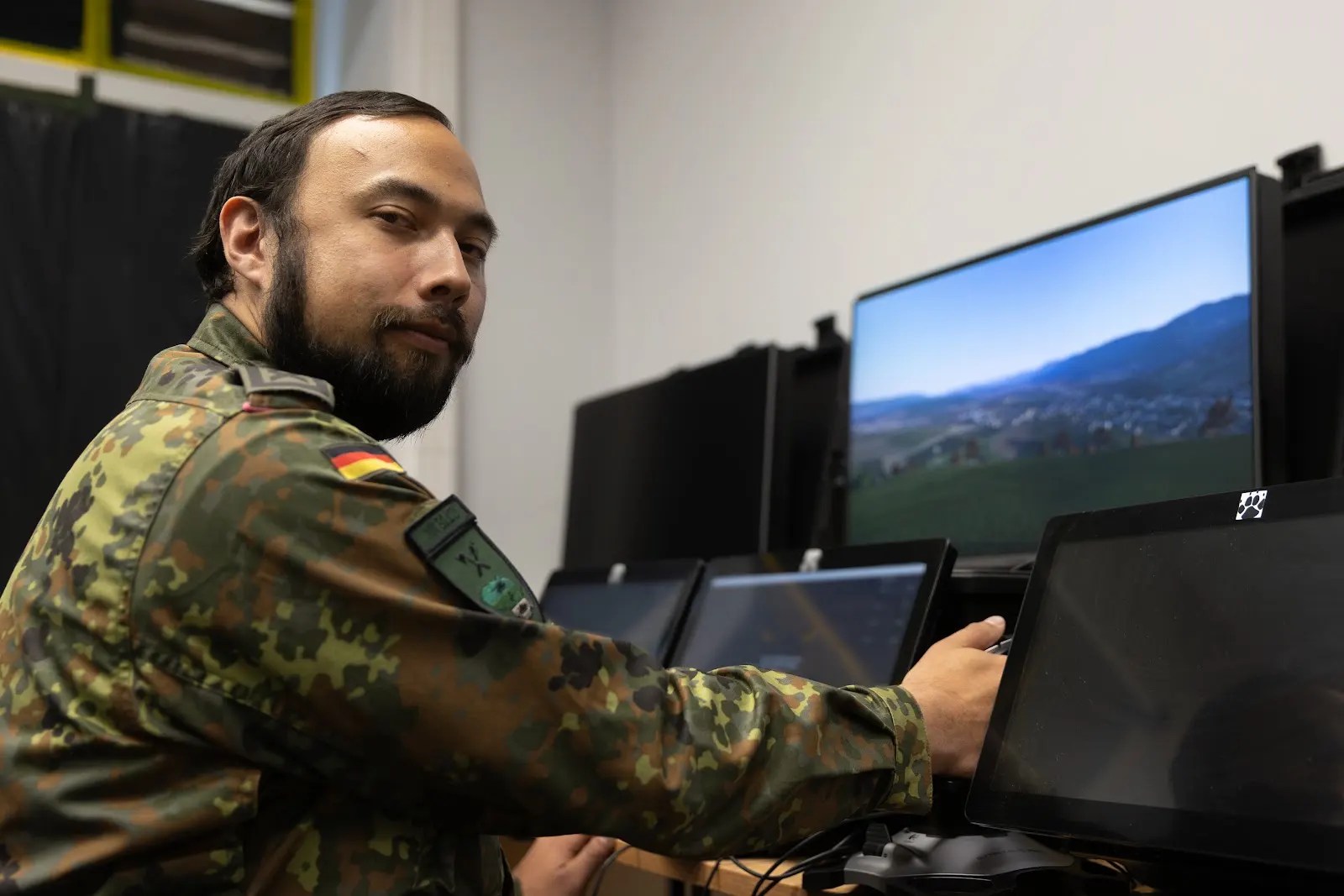
Despite the warm welcome and all the perks on offer, the Bundeswehr is struggling to find enough volunteers for the brigade, which is due to be fully operational by the end of next year. The German defence ministry says around 80% of the brigade’s 5,000 posts are filled, but key roles remain vacant, particularly IT technicians, tank mechanics and medics. These specialists are in short supply across the Bundeswehr, which struggles to compete with civilian employers.
Ambivalent attitudes towards the military may in part explain the Bundeswehr’s recruitment problems. In Berlin, soldiers were once warned for their own safety to change into civvies before going home from work. Germany’s unease with its army was shaped by the atrocities of the Nazi era and decades of anti-militarist sentiment. Now uniformed soldiers get free train tickets, and nobody bats an eyelid. Yet growing respect for the military has not erased divisions over plans to introduce a new form of military service. The prospect of a draft has already fuelled protests, particularly after the government introduced mandatory medical checks this January for 18-year-old men. Last month, tens of thousands of students walked out of class in cities across Germany carrying banners with anti-war messages including “conscription means cannon fodder” and “We are peaceful, what about you?”
All this gives political ammunition to those at the extremes of Germany’s political spectrum who resent government funds spent on Ukraine and who lobby to get sanctions against Russia lifted. Sahra Wagenknecht and Amira Mohamed Ali, co-leaders of the populist Left-wing BSW, have denounced Merz’s military service reform as “absolute madness” and empty warmongering. On the far-Right, the AfD is divided: while some back conscription for 18- to 25-year-olds, others rally behind the slogan “Keine Wehrpflicht für fremde Kriege” — “No Conscription for Foreign Wars”. They argue that young Germans should not be drafted to fight for “foreign geopolitical or power interests”, a thinly veiled swipe at NATO and German support for Ukraine.
During a coffee break at the Rukla base, I meet Staff Sgt Phil — Bundeswehr protocol insists that the media use only first names — from Hamburg, who trained as tank commander and drone operator. I ask him whether tanks are becoming obsolete in the age of drone warfare. He shakes his head. “They deliver a lot of firepower and can move speedily on the battlefield,” he says. “Plus you still need heavy armour to take and hold ground.” He adds that in Lithuania, German crews are fitting their Leopard tanks with anti-drone cages, electronic jammers and active protection systems to counter incoming threats.
He says Lithuanians he meets in cafes and shops often tell him they feel safer because of the brigade’s presence. In Germany too, he adds, he is now increasingly thanked for his service. Like many in the Bundeswehr he believes that conscription is needed — the sooner the better — because you cannot create a combat-ready reserve overnight. The war in Ukraine, he says, has forced a change in mindset: “We’re beginning to understand that we can no longer take our liberty for granted.”