




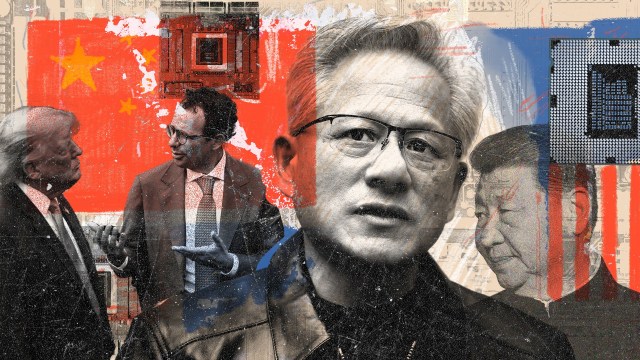
Was it a honeypot? (JG Fox/Getty)





Rubin, Nvidia’s flagship GPU, is a technological marvel almost beyond compare. No bigger than a mid-sized charcuterie board, it nonetheless boasts 336 billion transistors, 224 streaming multiprocessors, and 896 specialized processing units called Tensor Cores. Deployed wisely, the resulting computational horsepower is just about equal to the task of juggling one wife and three mistresses.
Or not. Farewell, then, Jensen Huang, whose philandering was almost as remarkable as his leadership of Nvidia. In 1993, he and two other engineers sat in a booth in a Denny’s diner and sketched out a plan for a new chip company. Huang led the startup from the outset, and it was thanks to his vigor and foresight that Nvidia came to supply the chips that today power the AI revolution.
Nvidia became the world’s most valuable company; Huang, evidently, became one of the most irresistible men in commerce. In the past few days, though, the now former CEO’s clandestine love life has unraveled. On 29 October, The New York Times disclosed that he had developed a “close relationship” with Alice Huang, a Chinese intelligence asset. Alice is no familial relation, but there was certainly some incestuousness to the acquaintance: not only was she an executive at a firm supplied by Nvidia, she was also, it soon transpired, Jensen’s mistress. News of another mistress, this time one of Huang’s direct reports at Nvidia, soon followed. Huang, under investigation, resigned. Hours later, a third mistress came to light.
Huang’s story, then, is both an epic, corporate bildungsroman and a riotous, geopolitical bonkbuster. But it is also a whodunnit, for intelligence reports tend not to leak accidentally, and Huang had many foes. Silicon Valley is ablaze with rumor: who wanted Jensen gone, and why?
There are several competing theories. The less refined conspiracists, noting that three Israeli executives were among those who could replace Huang, have immediately blamed you-know-who. “I don’t have enough evidence for it,” said the Left-wing streamer Hasan Piker of this fanciful hypothesis, “but that’s not going to stop other people from suspecting that that is what took place.”
A more compelling theory was advanced yesterday by my UnHerd colleague Wolfgang Münchau. Wondering whether some bad commercial news was imminent, he wrote: “The Nvidia share price has fallen by nearly a third from its peak in early October. Will we hear the interim CEO declare her shock when she looks at the books?”
The most widespread speculation, though, is predicated on Huang’s championing of a wide and fast-growing ecosystem of AI developers. Many in this ecosystem use “open-source” AI. Namely: AI whose code is publicly available and thus easily augmented — by Chinese and Western developers alike. Techno-optimists, Huang included, view open-source as conducive to innovation and prosperity; it also ensures Nvidia a long queue of customers.
Those who are more fearful of powerful AI, however, consider open-source to be tantamount to nuclear proliferation. As such, the AI safety community, out of which grew the frontier lab Anthropic, wants powerful AI to be developed only by a small number of companies, each continuously scrutinized by third-party inspectors. These arguments have received friendly hearings in the Democratic Party, which, buoyed by its success in the midterms, is coalescing around the view that AI ought to be robustly regulated.
That adds up to plenty of enemies for Huang. But there are more: the US government’s China hawks. Seeking to keep its chief geopolitical rival away from the AI frontier, the White House has restricted the sale of chips to China. Somewhere in Inner Mongolia, though, the Chinese startup DeepSeek has been training its best model on Blackwell chips, the precursor to Rubin. Huang, who has publicly lobbied for the controls to be removed, is accused of turning a blind eye to large-scale smuggling of chips — with the suspicions exacerbated by his closeness to Alice.
So: whodunnit? Some in San Francisco have pointed the finger at Dario Amodei himself. Amodei is the chief executive of Anthropic and one of the figureheads of the AI safety movement. Could he be responsible for Huang’s defenestration? Was he heading off a secret Huang plan to develop frontier-class open models?
That it was Amodei specifically seems unlikely. Still, with only a little squinting, the hand of a rival can potentially be discerned in the reporting. Intriguingly, one of the New York Times reporters who broke the story of that “close relationship” has related how a “tech industry contact” prompted him to look into Megaspeed, Alice Huang’s company. Tripp Mickle, the reporter, said on Tuesday that the source told him: “You really need to drop everything and look at this company.”
That conversation, according to Mickle, took place in August 2025. “And then about a month ago,” he continued, “we hear that our colleagues in Washington on the national security beat all of a sudden are hearing things about Alice Huang.”
Most telling here is the fact that the Times could refer to what ought to have been private briefings. Some part of the American deep state, it seems, lent the journalists a hand. It did so despite President Trump’s apparent affection for Huang — and despite the story’s potential disruption to Anthropic’s IPO, the success of which depends, to a significant extent, on investor confidence in the AI boom. The investigative journalist Glenn Greenwald, no friend to the deep state, writes that whoever wanted rid of Huang “wields extreme levels of power”. The briefing against Alice Huang, he said, was evidence-free, yet “instantly and uncritically ratified” by the American media. As for the infidelity: “Nobody actually believes that, in the age of Donald J. Trump, very powerful people rapidly fall due to extramarital affairs, right?”
Many additional questions present themselves, of which the most pressing is what happens next. Nvidia stock has nosedived, losing $550 billion of value. Huang, whom a Bloomberg report suggested is distraught, faces a congressional hearing. Perhaps the deep state will bring Nvidia to heel. Perhaps the leakers will be unmasked. Whether the American government will impose stringent regulation on the sector remains uncertain, and is likely to hinge on either an alarming demonstration of AI’s danger or simply a change of administration.
We can be confident, in the meantime, that the shenanigans, seen and unseen, will continue, that AI’s increasing geopolitical importance will manifest in further dossiers and defenestrations. Formerly the rockstars of technology, Huang and his peers have now been forced into the drearier role of hyper-scrutinized statesmen; scrutinized and threatened by their rivals, by their ideological enemies, by their own government and by foreign governments. More so than at any other time in modern history, senior appointments will need a clean record — which might come at the expense of some of the unorthodoxy upon which innovation depends.
For the moment, though, the honeytraps will continue. Security experts report that China is increasingly using the method to fish for intelligence about American startups. Opportunities for both espionage and espionage-related smearings abound. In San Francisco, the epicenter of frontier AI, there is a comically high preponderance of both nerdy men and what are affectionately known, even to themselves, as ABGs, or “Asian baby girls”. Huang is not the first businessman to develop a wandering eye, and he will not be the last.
What next, though, for the former CEO? For now, joked one wag, Huang’s nearly cleared diary will enable him to “spend more time with your wife”. Elon Musk, also the proprietor of a chip-making business, has said it would be an “honor” to hire Huang. Perhaps Huang might eventually return to his old job, as Sam Altman did when ousted by the OpenAI board in 2023.
In his final hours as Nvidia CEO, Huang reportedly called himself a “piece of shit”. In business, if not in marital, terms, he will be remembered as a titan, the man who, as much as anyone else, presided over the AI boom. Should the bubble burst, or should regulation arrive, it will not be on Huang’s watch. Similarly, if capitalist gravity eventually brings Nvidia’s market share back down to earth, Huang will not be to blame. The real threat to his legacy might be those GPUs in Inner Mongolia — and whatever other Nvidia equipment found its way across the border.