




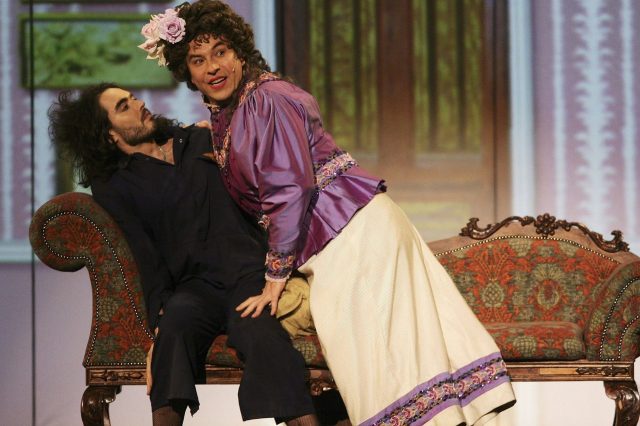
Have Russell Brand and David Walliams read Austen?(Getty)





It is a truth universally acknowledged that a charismatic, high-status man in possession of an overcharged libido will attempt to shag as many barely-legal teenagers as he can get away with. As the misdemeanors of assorted celebrity men have wound their way through courts and press, I happened to be revisiting two of Jane Austen’s novels for the first time in decades. This time, though, I was reading Pride and Prejudice and Sense and Sensibility not as a single twenty-something, but as the middle-aged mom of a tween girl. I can tell you: the caddish characters land very differently.
Analogies abound between these literary scandals, and the shockwaves effected by Brand’s conviction and David Walliams’ failed injunction. Are things any better today, though? There’s been plenty of hand-wringing already on the open secret of these men’s alleged sexual misbehavior; amid it all, my glum conclusion is no, not really. The goalposts have moved, but overall we’re no closer to robust safeguards against predatory men than in the Regency era.
The latest kite to fly, based on the Brand case, is to stagger the age of consent: that is, the existing age of consent for 16- and 17-year-olds should apply only where partners are no more than three years older. This measure will now reportedly be considered by Burnham and co. It’s not without precedent. Germany and the Netherlands both have something similar, intended to limit the exploitation of young girls by older men. But would imposing a ban on much older men having sex with 16- and 17-year-olds do anything to stop others following Brand’s example, or the alleged behavior of Walliams? I’m not convinced.
The pivotal scandal in both Pride and Prejudice and Sense and Sensibility turns on high-status men taking sexual advantage of much younger and lower-status women. Wickham and Willoughby are both charming, feckless, and selfish upper-class men in their twenties. Each of them seduces — and, in Willoughby’s case, impregnates and abandons — an adolescent girl of 15 or 16. Of course they’re both fictional, but Wickham’s and Willoughby’s immediately recognizable nature points to the likelihood that the pattern they represent is an enduring one.
The comparison with Brand isn’t exact. But Wickham’s and Willoughby’s manners and connections would, in class-conscious Regency England, have accorded both these libertines a potent glamour in women’s eyes. Both use this aura without compunction to charm pretty girls, for their own amusement: behavior with a clear echo today, in Brand’s exploitation of his celebrity status for sexual access.
The difference is that Brand’s actions occurred after the sexual revolution. Thanks to contraception and abortion, it has seemed much less urgent to police the sexual behavior of women. In this context, though the old social mores persisted for some time, by degrees a new morality has emerged in which (at least to begin with) everyone really did believe themselves free to do as they pleased. Much of the second half of the 20th century was spent telling ourselves we could dismantle all the old-fashioned rules about sexual conduct.
This produced some, with hindsight, pretty queasy-looking liaisons. In 1973, for example, the rock star Steven Tyler, then in his twenties, obtained legal guardianship of his 16-year-old “girlfriend” Julia Holcomb. Anything goes! There are numerous other examples from that neo-libertine era, of dodgy-looking “relationships” between celebrity men — the Wickhams and Willoughbys of their day — and teenage girls. Mandy Smith was 13 and Rolling Stone Bill Wyman 47 when he began “dating” her in 1984. Wyman would go on to marry her, when she was 16. She later struggled with mental health, and they divorced when she was 20. It’s equally painful today to watch episodes of Top of the Pops from the Seventies in which presenters manhandle teenage girls on camera: the gulf between the mores of then and now grows more noticeable by the day.
In the place of “anything goes”, we’re now reverse engineering something with clear echoes of the sexual mores of Jane Austen’s era, but without its moral clarity. The taboo on pre-marital sex shows no sign of returning, except as a fringe option. The age of consent, too, is treated more as a guideline even by officials: British case law has upheld the right of GPs to advise underage girls on contraception since 1986. But out of the post-Pill liquefaction of every social norm, a new consensus is still coalescing. In particular, this brings a welcome recollection that it’s not on to exploit an obvious power asymmetry for sexual gratification. Since the first #MeToo outpouring, Holcomb has added her name to a lawsuit against Tyler. Seventies DJs have been hauled over the coals for assault.
But this isn’t a return to Austen’s morality of marriage and happy-ever-after, so much as the same anything-goes, just now with some complicated footnotes. Accordingly, this sexual counter-revolution is markedly more bureaucratic than the gossip-enforced mores of Austen’s day: more Codes of Conduct and standards quangos than being bumped from anyone’s dinner list. In the wake of #MeToo, for example, a media oversight body was set up in England to support whistleblowers. Lisa Nandy has recently warned the industry that she’ll make membership mandatory if they don’t hurry up and volunteer for its governance. Is this progress? Vogue writer Claire Cohen recently gushed that the latest celebrity scalps could be “a tipping point if we manage not to squander it”, in ensuring better behavior by high-status men.
But even leaving aside the question of whether every #MeToo allegation was true or just, we might wonder if Cohen has realized how thin and unevenly distributed her moral revolution is, to date. I doubt a glossy mag today would dedicate a gushing, multi-page spread to the wedding of a fiftysomething rock star to a 16-year-old. And it’s surely good if media circles are, by degrees, rediscovering the reality that powerful men sometimes exploit their aura to get laid, and reconfiguring public mores so this is once again frowned upon, as it was in Austen’s day. But are we willing to preach this more broadly?
It remains, for example, true to this day that thousands of past and present victims of Britain’s grooming gangs have yet to receive justice. These girls faced an asymmetry of age and resources analogous to that of Bill Wyman and Mandy Smith, or indeed (allegedly) Russell Brand and Mia Latter. Many were well below the age of consent even without the “staggered” amendment proposed by Latter. But the journalists calling for this to be a “turning point” on open secrets in the media, or otherwise baying for horny, male, celebrity blood, are often more circumspect about addressing grooming, for all that the scale was vastly greater, and the abuses infinitely more cruel.
The silence from the political Left is even louder: Labour has rushed to find ways it can consider tinkering with legislation based on the Brand conviction, but has been slow-walking the promised national inquiry on grooming for almost 18 months now.
Nor does either the press or Labour have much to say on the social duty we all have to help keep young girls safe from predators. The fictional victims of libertine men in Austen’s famous novels get into trouble because no one is keeping an eye on them: notably, their dads are either dead or not interested. Mandy Smith had no father in her life. Many of the grooming gang victims were in the care system. Perhaps it’s just that ours is a culture that likes quangos and rules, and recoils from social obligations, and there’s no obvious way to solve grooming gangs via quangos and rules.
Certainly it’s unlikely that fiddling with consent laws would do much on this front, or make life less risky even for nice girls targeted by horny celebs. Even with statutes designed to take age-gap power-asymmetries into account, the Netherlands also has a grooming gang problem. Nonetheless, while #MeToo was overly broad and sometimes unjust, this latest spasm, which we might call #MeThree, does point in sort of the right direction. That is, away from the blind libertinism of the 20th century. It’s far from adequate, so far. Overly bureaucratic, reliant on policies, procedures and institutions, #MeThree’s biggest blind spot leaves it failing women and girls further down the social scale: a failure to recognize that regulation isn’t enough.
Even making the age for everything 18, as Kemi Badenoch has suggested, would probably just result in more people ignoring official rules. But if the proponents of #MeThree keep noticing these patterns and asymmetries, they might even end up figuring out that it’s not enough to have legalistic stuff about relative age gaps that gets ignored half the time anyway. From there we might even get to a public consensus on the simpler age-old realities: some men, even high-profile ones, can be predatory; young girls are vulnerable to the extent that no one is watching out for them, and no amount of moral exhortation can do away with this unfortunate truth altogether. Nothing is foolproof, but clear social mores and watchful older relatives would almost certainly do more to protect vulnerable girls than a gloss of HR legalism on a sexual free-for-all. Figure this out, and perhaps #MeFour will go full Jane Austen again.
