




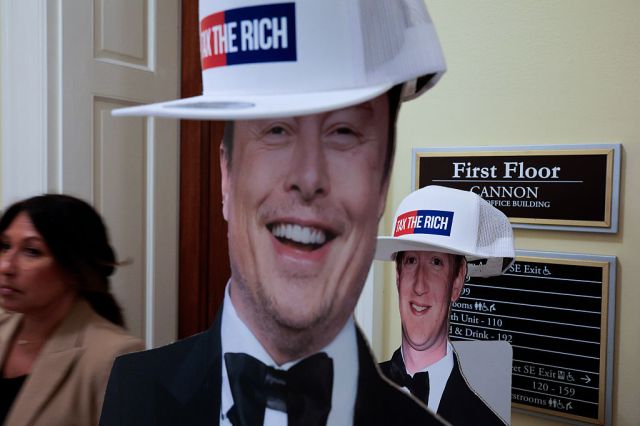
The ‘one time’ billionaire tax won’t end in the Golden State. Credit: Getty.





The most important decision in the upcoming midterms involves not candidates, but an idea that could change the very nature of America: California’s Proposition 40, which would impose a “one-time” tax on billionaires’ assets.
If passed, the measure would open the door for similar assaults on the unrealized gains not just of billionaires, but for less exalted people with high net worth. Ultimately, if the nation’s ever-expanding welfare state is to be funded, wealth taxes could enable the government to raid savings, property, and stocks held by a large and expanding upper middle class. That group comprises roughly a third of the population, many of them owners of successful small businesses. The billionaires are just the first easy targets; the socialists will be coming for the equivalent of Stalin’s kulaks next.
All this threatens a country whose ethos has always, on both sides of the aisle, been the accumulation of wealth. Of course, most Republicans, the natural allies of the rich, oppose the California ballot measure, but given their lack of popularity in the state, that is hardly decisive. The real battle is within the Democratic Party, where the establishment, including Gov. Gavin Newsom and his heir apparent, Xavier Becerra, oppose it. So, too, do many unions that fear the economic and tax consequences of the measure.
But even if Proposition 40 goes down — due largely to a record-breaking $350 million campaign against it, financed by the state’s oligarchs — its impact will linger. When the Democrats retake the US Congress this year, and perhaps the White House in 2028, wealth taxes will become a part of their agenda. Chastened by the initial support for Proposition 40, Gavin Newsom, the supreme Democratic weathervane, has already embraced the idea of adopting wealth taxes nationally.
The ascendant progressive wing of the Democratic Party will almost certainly demand a national wealth tax too. It will be led by Silicon Valley’s Rep. Ro Khanna, who, like Rep. Alexandria Ocasio-Cortez, may be seeking the White House. This kind of redistributionist policy stretches to outright confiscation, as can be seen in the measures proposed recently by Bernie Sanders to nationalize AI companies. Such initiatives could define politics, particularly among Democrats, in the coming years.
It is logical that the wealth tax — which proposes a one-time grab of 5% of the net worth of all billionaires in California — arose in a state whose vast welfare system is dependent on the assets of a very few people, largely in Silicon Valley. According to the state’s Legislative Analyst’s Office, the top 1% of its taxpayers generate about 40% of the Golden State’s personal-income-tax revenue. The huge growth of oligarch money, notably fueled by capital gains on stock, has allowed Newsom to expand the state apparatus by an inflation-adjusted 40%, albeit with management characterized by fraud, waste, and simple incompetence.
New York, the other focal point for socialists, also depends on the rich. Wall Street supplies a fifth of state taxes; salaries in the securities sector are roughly five times higher than the private-employment average. Like California’s, the Empire State’s economy lives or dies on the AI boom, as recently warned by state Comptroller Thomas DiNapoli. And to date, the high taxes in both states have not prevented the minting of new billionaires, upon whom the local government can depend, even as some of the very richest leave. Since 2022, California has gained 76 new billionaires, easily the most in the nation; New York added 24, third behind Florida.
In both New York and California, the bargain has been this: you grow and get rich, but then help pay off our constituencies, notably teachers and other public employees. Then you extend more welfare to an increasingly redundant population that suffers poverty rates that rank among the nation’s highest, with California coming in second in the nation on the supplemental poverty measure index, which adjusts calculations for geographical cost of living factors, taxes, and non-cash benefits. New York City, the eastern mecca for the socialists, suffers a poverty rate that by some measures reaches 25%, almost twice the national average, with the Bronx reaching over a third, in large part due to high costs.
The relationship between the billionaires and their socialist detractors reeks of contradictions. The Democratic Socialists of America want a bigger welfare state to tame capitalism but can only finance it by confiscating the wealth of the oligarchs they hate. The tax’s proponents in California, mostly from the government-funded health sector, claim it would bring in $100 billion, essentially underwriting medical services for much of the population. Others, including the Hoover Institution and the National Bureau of Economic Research, think the short-term gains will be less than half the $100 billion windfall that the proponents suggest.
The indications that some of the wealthy will flee from ever greater taxation are clear. California’s tax rates, even before the proposed wealth tax, have already accelerated; much the same can be said about New York. In 2022-2023, the loss of affluent taxpayers reduced revenues by almost $12 billion in California; in much smaller New York, revenue dropped by $10 billion; blue states Illinois, Massachusetts, and New Jersey also saw revenue loss from the flight of the rich.
The pain from this financial hegira has been cushioned by the stock market’s zany ascent, driven by AI. For example, the coming IPO for Anthropic could create more billionaires, with seven, all millennials, slated for payouts that could reach north of $30 billion. Bonuses on Wall Street, another beneficiary of the AI boom, are at record levels. Figures released by DiNapoli, the New York comptroller, show that New York’s security-industry profits for the first half of 2026 surged a stunning 51.3%, year over year, to $45.9 billion.
But what happens when the music stops? This is not a theoretical question. The absurd valuations of tech firms are already making some analysts nervous. Indeed, a growing array of skeptics already suggest that the models for AI may not generate the income to offset the industry’s huge expenses; global research and advisory firm Gartner, for example, predicts that planned expenditures for AI infrastructure by 2030 are twice the projected revenue. Even if Anthropic’s coming IPO will expand billionaire wealth, some AI-oriented IPOs have been put on hold as confidence ebbs.
Equally worrisome, financing for new data centers is growing scarce while opposition to construction has burgeoned, even in deep-red states, notes energy analyst Robert Bryce. Pressure against the centers is, if anything, more intense in the very states — California and New York — most dependent on the bubble.
Any serious slowdown in the AI boom could prove devastating to New York and California. Neither can afford a revenue drop. California, according to its own Legislative Analyst’s Office, already faces structural budget deficits ranging from $20 billion to $35 billion annually over the next several years, even without a market downturn. New York State and New York City also face mounting deficits, even with all the new cash coming in from Wall Street.
After all, California’s economy was particularly battered when the last tech bubble burst, and today, as other industries have faded, the state is even more dependent on the whims of the technoids. In the dotcom crash at the turn of the millennium, the state’s income-tax revenue plummeted, and capital-gains revenue fell to $5 billion in 2003, down from $17 billion in 2000. This created a shortfall of more than $20 billion. Even the relatively small tech correction in 2022-2023 and 2023-2024 brought revenues $65 billion below estimates. Newsom has already sounded the alarm about a similar financial drought this time around.
New York faces an equally dismal prospect, given its dependence on Wall Street, as was demonstrated in downturns in both 2000-2001 and 2008, which greatly reduced the state’s revenues. And this dependence leads to dangerous volatility; California and New York are among the most exposed to rapid shifts in the market, notes Pew. They are far more exposed than Texas, Florida, and other big red states, where more diversified economies encompass sectors such as energy, construction, and manufacturing.
Yet these warnings won’t necessarily stop the demand for wealth taxes. Once seen as exemplars of American success and innovation, the tech firms in particular have become bêtes noires, widely despised and distrusted. The percentage of Americans expressing “a great deal” or even “quite a lot” of confidence in big tech has plummeted to 20% this year, down from 32% in 2020. Recent movies about Elon Musk, Mark Zuckerberg, and Theranos founder Elizabeth Holmes portray not heroic entrepreneurs, but grasping, power-hungry, and amoral money gluttons.
Conservative moralists may see this as simply envy over others’ success, but the oligarchs are not exactly making a case for themselves. Even as they make record profits, many of the top tech companies are laying off thousands of employees, and some like Zuckerberg have actively announced their intention to winnow employment at their own companies by using AI. Just this week, Microsoft offered buyouts to 60,000 workers, a quarter of its global workforce.
To be sure, the AI boom does offer some advantages, including a demonstrable increase in productivity and potential vast opportunities for small-scale entrepreneurs. But more efficient companies, including small ones, can’t cancel out the stark reality of labor’s loss of its share of income to capital, now the most unequal in 80 years. The top 0.1% of the population’s share of net worth over the past two decades has soared to 15%, from 5%. Silicon Valley, once a beacon for democratic capitalism, has become one of the most unequal places in North America, with the wealthiest 10% controlling 75% of the wealth, while the bottom half of the population owns less than 1%. In a recent survey, 60% of Silicon Valley residents say the region is on the wrong track and almost half say they are likely to leave.
The AI pioneers, deeply entwined with the platforms like Meta, Google, and Microsoft, have been particularly inartful. Most Americans may not much appreciate the oligarchs’ notions of diminishing the value of labor, or even jobs. Anthropic CEO Dario Amodei’s vision of the future is that many of our needs — and our tasks — will be fulfilled by “Machines of Loving Grace,” which will provide “a general labor substitute for humans.” Amodei adds: “It can’t be more than a few years before AI is better than humans at essentially everything.”
Of course, not all non-elite work will disappear. Humans, notes a top Anthropic executive, can still find work in “grounds maintenance, like food and serving, personal care, personal service.”
Not surprisingly, fewer than a quarter of Americans expect AI to have a positive impact on education, arts and entertainment, the economy, personal relationships, or happiness over the next 20 years. Sam Altman, who runs OpenAI, openly suggests his systems could result in a global catastrophe, even if it makes huge profits for a handful of companies.
But even if the AI boom deflates, the notion of wealth taxes will not. And it won’t stop with billionaires, since they can move and have the best advice to reduce taxes. The real, and inevitable, target will be the largely boomer upper middle class. After all, the top 10% of boomers account for 71% of the generational wealth.
Such efforts will divide the ascendant Democrats, as well-paid, highly educated professionals constitute much of their base. Opposing them will be the “Lulu-Lenins” driving the socialist revival emerging from the discouraged, underpaid, overeducated, and largely childless urban population. In recent polling from the Public Policy Institute of California, 75% of young adults aged 18-34 say they plan to vote yes on the billionaire tax. This group of Californians makes up about a quarter of the total number of voters statewide.
Some analysts, like Hank Adler, a professor of accounting at Chapman University, suggest there are better, less damaging ways to raise revenues. Wealth taxes, he argues, essentially target money that can be used for investment and remove the incentives for deductions tied to philanthropy. Adler has had clients among smaller firms who will essentially be forced to choose between investing in people and technology or paying up for the pensions of public employees and the programs of the NGOs.
A better alternative to wealth taxes could force the ultra-rich to pay up but not at the cost of prosperity. These include, Adler suggests, lowering the limits on exemptions to estate taxes, and charging higher fees for consumption of luxury goods. Adler and other critics note that similar billionaire-tax measures in Europe have largely been reversed. Indeed, the idea for the wealth tax comes from French economists, a country whose combination of a huge welfare state and a poorly performing economy has generated bitter class and ethnic conflict.
The best solution lies in a tax program that seeks not class vengeance, but instead funds projects that increase jobs and create opportunities. This was done nationwide in the 1930s via investment in urban infrastructure and in New York in the 1960s, and — most spectacularly of all — by California Gov. Pat Brown’s building programs a half century ago.
Ultimately, the solution lies somewhere between the socialist war on success and the libertarian “let-them-eat-cake” approach, which essentially ignores the fact that rampant inequality and concentration of wealth undermine support for the free-market system. The radicals may be wrong in their prescriptions, but the need to address today’s neo-feudal reality remains the greatest priority.
Joel Kotkin is a Presidential Fellow in Urban Futures at Chapman University and a Senior Research Fellow at the Civitas Institute, the University of Texas at Austin.
 joelkotkin