




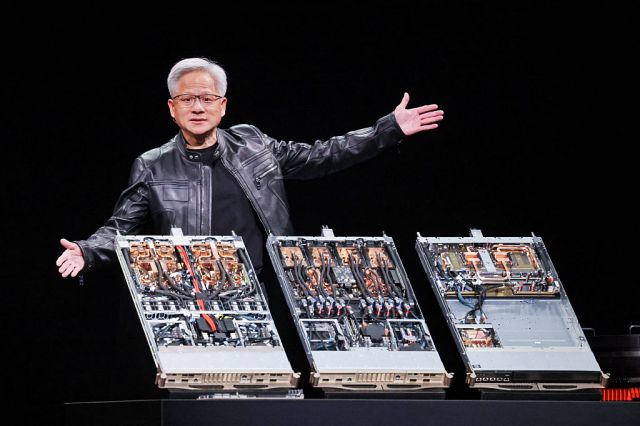
“Sex, power, and geopolitics are never far apart.” I-HWA Cheng/AFP /Getty)





Sex, power, and geopolitics are never far apart. In 1917 the Dutch exotic dancer Margaretha Zelle, better known by her stage name “Mata Hari”, was executed by firing squad, accused of espionage. To the end, she denied the charge, and later historians have claimed she was scapegoated. But however unfairly, “Mata Hari” entered popular usage, as a byword for that most potent of femmes fatales: the seductive, treacherous “honeypot”. Now, as the AI race hots up, Mata Hari has come for the tech world. Observers on either side of the US-China rivalry might wonder: are the tech world’s nerdy denizens ready for a frontline role in the grandest geopolitical struggle of our time?
The dupe of this latest Mata Hari scandal is Jensen Huang, CEO of the chipmaking firm Nvidia, which he has led since founding it in 1993. Semiconductor chips are “the building blocks of the modern digital economy”, found in everything from laptops to cars, sensing devices, and smartphones. Nvidia designs the most coveted chips, those that are used by AI models such as Claude and ChatGPT, a position that has propelled the company to prominence as one of the most valuable firms in the world, and Huang to rockstar fame. With a fortune that Forbes estimates now places him in the top 10 richest people on the planet, Huang has acquired cultish celebrity: one of his leather jackets raised $960,000 in a charity auction.
But over the weekend, Huang sent a letter to all Nvidia staff, apologizing for an extra-marital affair. “Corporate CEO has sidechick” doesn’t sound like it should be such a big deal, but this one’s different. The affair was with Alice Huang, also known as Huang Le, a Chinese national and senior executive at the Singapore-based cloud provider Megaspeed. This firm was already suspected of smuggling restricted American tech to China, and Ms Huang suspected of being a Chinese spy. The discovery has sent shockwaves through an already jittery tech market, knocking 8% (approximately $350 billion) off Nvidia’s value.
More than a sex scandal or a story for the business pages, l’affaire Huang is high geopolitical drama, for the light it shines on the stop-at-nothing rivalry between the USA and China on tech. When Bill Clinton advocated China joining the WTO in 1999, it was believed that China getting richer would inevitably make it more democratic, catalyzing the replacement of the CCP with a more Western-like regime. As we all now know, that’s not how things worked out. Instead, the US sacrificed its own industrial base to fuel the rise of a peer rival. But as if that’s not bad enough, today the eagle and the dragon are locked in a neck-and-neck race to preeminence in AI development. It’s this context that makes it so shocking that Jensen Huang, one of America’s nerd princes, should have found himself trapped by a honeypot spy, loyal to America’s chief rival.
So intense is the competition between American and Chinese AI labs, and so contested is access to the most advanced hardware that powers them, that in 2020 export restrictions were imposed on Chinese import of American semiconductors. Megaspeed, meanwhile, has been under suspicion for some time of trying to find ways round these restrictions. This firm rents data processing power to AI firms across Asia, and uses $1.4 billion of Nvidia chips to power its data centers. But in 2025 an inspection found the number of chips in use was much lower than the number Megaspeed had purchased. Where were the others? Hawks feared they had been smuggled to China.
The battle for semiconductors is granted another twist by the persistence of a supply bottleneck, that both constrains the AI build-out and affords a persistent sore point to China: Jensen Huang’s island of birth, Taiwan. Nvidia subcontracts the most complex part of its chip manufacturing to factories in Taiwan, an island around the size of the Netherlands and roughly 100 kilometers off the coast of mainland China. Taiwan became the home-in-exile of the Chinese Nationalist government, after their displacement by communists in 1949 — but Beijing insists on the PRC’s right to govern Taiwan too. Chinese maps show Taiwan as part of the Middle Kingdom, and Christian Dior was forced to apologize to Chinese customers in 2019 after making a presentation that included a Taiwanless map of China.
Taiwan’s principal defense against being annexed by Beijing has long been its dominance in semiconductors. A farsighted program established by Taiwanese technocrats during the Seventies was delivered first by acquiring semiconductor know-how from an American firm, then training a generation of engineers, and finally developing a model that enabled Taiwanese plants to serve US firms without being perceived as a competitor. Aided by this long-term strategy, and a now richly developed base of secondary suppliers and expertise, this precariously positioned island secured a position as chokepoint in one of the most vital technologies of the 21st century. And this in turn has secured ongoing Western support for its independence: what former Taiwanese prime minister Tsai Ing-Wen called its “silicon shield”.
Will it last? That’s less clear. The tectonic plates may be shifting: the US has poured considerable effort and money into reducing its dependence on overseas semiconductor manufacture. In 2021 Intel and TSMC both responded to US political pressure by announcing the construction of new semiconductor plants in Arizona. Then, in 2022, the bipartisan CHIPS Act provided the US Government $50 billion to invest in semiconductor research, development, and manufacturing within the USA. And while some had expressed skepticism on the “reshoring” project, it seems to be picking up speed: buoyed by AI demand, Intel recently announced that its delayed Ohio semiconductor plant will be re-started.
With semiconductor manufacturing re-shored, would “honeypot” scandals come to an end? I doubt it. There have been many such scandals throughout history, and in each case the basic mechanism is the same: some powerful man gets persuaded by the one-eyed monster not to think too hard about why an attractive woman is suddenly so interested in him. Only the specific configurations of power and money vary.
But as long as powerful rivalries and information asymmetries exist, there’ll be plots to even the scores through seduction. With the US-China rivalry in full spate, the tech bros should perhaps be more braced than they seem to be for an army of Mata Haris. Even if Taiwan loses its unique position, or one side definitively wins the AI race, there will always be new geopolitical tensions, and new information asymmetries.
But if there are lessons in this story for the nerd kings of America, there are also lessons for us in Britain — both in those ways we can’t be China or the USA, and also perhaps in those ways we could be more Taiwan. There’s no meaningful sense in which we can compete as peers with two continent-sized empires. But we might infer from l’affaire Huang that it’s a bad idea to lose all the China experts from your government. Whoops. Also maybe not to take the Chinese government at their word, when they pinky-promise that the mega-embassy they want to build with secret underground rooms, near important buried data cables, isn’t a listening post.
Another, perhaps more strategic consideration might be wondering what Britain could learn from Taiwan, about how to live next door to a much larger geopolitical bloc without being too badly bullied. Taiwan shows how a nation that’s not big enough to lead on everything can still preserve independence, by being indispensable in one vital sector. As the US continues its project to re-shore semiconductor manufacturing, and Xi Jinping pledges to assimilate Taiwan, it might not last forever. But the strategy hasn’t failed yet.
What’s the equivalent for Britain? Perhaps it’s a wild idea, but my starter for ten would be offshore data centers. These are experimental, but not completely so: China launched the first underwater data center earlier this year. I gather the water temperature around the British Isles is well-suited to the cooling needs of such installations, and a prototype is scheduled to launch in the North Sea soon. Of course housing vulnerable and strategically important infrastructure off Britain’s coastline would necessitate restoring our degraded naval defense capability. But this too would be a happy return to historic national norms.
Jensen Huang, at least, believed in Britain, even if we don’t. Before his personal life blew up, he visited to mark Nvidia’s investment in British startups, while lauding our potential and intellectual superpowers. While recent evidence suggests he’s perhaps not always a flawless judge of others’ motives, his track record suggests he understands a thing or two about building. And we could do with building. Torn as we currently are between the US and EU, we need less effort on “soft power”, “moral leadership”, and pointless acts of post-colonial self-flagellation, and more on a realist effort to build out resources our neighbors need badly enough, to come to our aid in extremis.
Actually doing this would necessitate being governed by engineers and those who think long-term, rather than bee-brick bureaucrats and decline managers. This would certainly be a change of gear. It might even require a bit of Mata Hari-ing here and there. But I’m with Jensen Huang: it can be done. He might be a flawed messenger but let’s take him at his word, and be more Taiwan.
