




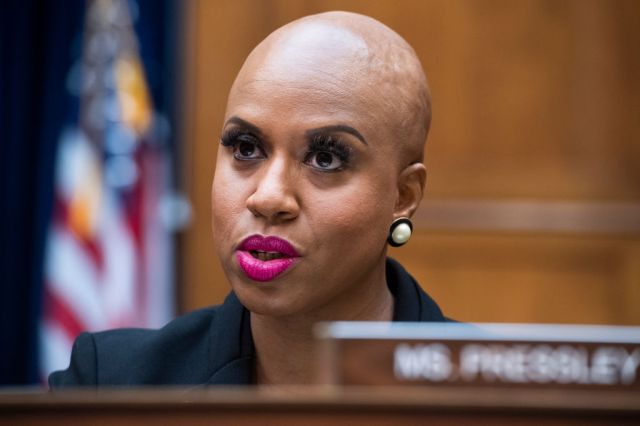
Rep. Ayanna Pressley (D-Mass.) placed reparations at the top of a recent call to action. Credit: Getty





November’s blue tsunami was unquestionably good for the Left flank of the Democratic Party. Six new members of the Democratic Socialists of America were elected to the House. They will be joined by a good number of non-socialist progressives in both chambers who agree with plenty of their short-term goals. One of the highest-profile incoming senators from a purple state, Michigan’s Abdul El-Sayed, ran on the slogan, “Money out of politics, money in your pocket, Medicare for All.”
Many of these progressives see an opening to push ambitious Left-wing policies. Corporate-friendly centrists like Hakeem Jeffries and Chuck Schumer — the incoming House speaker and likely majority leader, respectively — will no doubt balk. As will President Trump. Even so, the Left has every reason to propel its ideas to the center of the national conversation.
But it matters which progressive policy ideas the Left advances. An agenda to take power away from wealthy oligarchs and uplift the working class, rooted in broad universalist appeals, can put centrists and the GOP on the back foot. Unfortunately, this isn’t what some progressives have in mind. Instead, some prominent figures are showing themselves inclined to revivify the racial and cultural particularism that defined — and derailed — progressive politics in the 2010s.
Take a call to action recently posted on social media by Rep. Ayanna Pressley (D-Mass.). “We need to show people what Democrats can do with our majority,” the notice read. “Reparations. Abortion justice. Medicare for All. Abolishing ICE. Childcare. Paid leave. And more. If Trump wants to veto any of this, then the people will know exactly where he stands. And we won’t stop fighting until we win.” Rep. Ro Khanna (D-Calif.), one of the brighter lights in the Left-populist constellation, retweeted Pressley’s message.
As a proud socialist, I share enough of Pressley’s worldview to nod along with the vast majority of this. Her decision to start the list with “reparations,” though, is baffling.
To begin with, it makes precious little sense on a strategic level. Achieving a reform as ambitious as Medicare for All, for example, would be immensely difficult. But it’s at least possible to see a path from here to there. The same can’t be said of racially targeted reparations. Any possible scheme for widespread redistribution of wealth would encounter deep resistance from deep-pocketed interests. The only way to overcome that resistance would be with a movement that commanded the support of the great majority of the population. No one seems to be able to explain how we’re supposed to mobilize a majoritarian coalition to fight for a proposal whose benefits would definitionally exclude the majority.
The proposal is also flawed on its merits. As the Marxist scholars Adolph Reed Jr. and Walter Benn Michaels argued in their landmark 2020 essay, “The Trouble with Disparity,” the issue is not simply that redistribution for poor and working-class black people can’t be achieved without extending it to poor and working-class white people (though that is certainly the case). It’s also that we shouldn’t seek a form of redistribution that would leave so many behind. Doing so, as Reed and Michaels wrote, would bring about a “differently unjust” society rather than a just one.
Principled egalitarians should want to give everyone a decent life and a meaningful say over the economic decisions that impact them, because the dignity of every human being demands no less. We should object not to the racially disproportionate distribution of poverty — but to poverty itself.
Compare two Americans at the bottom rung of the economic ladder. One ended up there as a result of an intergenerational chain of cause and effect running through redlining and Jim Crow. For the other, however, it was the closure of unionized coal mines. The operative fact is that both are miserable. The difference between their circumstances doesn’t make the second less deserving of material uplift than the first.
No serious person denies that contemporary disparities are downstream of a long history of racial injustice. After all, it was within living memory that the “Whites Only” signs were removed from the windows of restaurants and hotels in the South. Banning de jure discrimination, moreover, doesn’t lead de facto discrimination to disappear overnight.
Recognizing these home truths about the origins of the problem, though, tells us nothing about whether the most plausible or effective solution is universalistic or racially targeted. It’s easy to nod along to the idea that a problem that arose in a racially targeted way must have a racially targeted solution. Taken seriously, though, this is a non sequitur. A wound that was caused with a knife is not necessarily best healed with a knife. Nor do these facts about the relevant history tell us much of anything about the philosophical question of whether demographic disparity should be at the center of our vision of justice.
The libertarian philosopher Robert Nozick, who would have opposed just about everything else on Pressley’s list, expressed friendliness to reparations in his book Anarchy, State, and Utopia, published in 1974. This wasn’t some deviation from his usual politics sparked by white guilt. Nozick, who was in many ways brilliant, was being deeply consistent. He was prepared to defend a massively unequal wealth distribution as long as it came about in the “right” way: through a chain of market transactions in which no one’s rights were violated. On this conception, the victims of intergenerational patterns of wealth distribution rooted in racial discrimination might have a claim to redress. By contrast, the white victims of “normal” capitalist processes in, say, rural Appalachia deserve nothing.
This is the polar opposite of the historical position of the socialist Left. The last section of Karl Marx’s Capital describes the bloody process of enclosures in which the majority of British peasants were driven off their ancestral lands in the centuries leading up to the emergence of modern capitalism. This happened, Marx wrote, “without a farthing of compensation.” But he didn’t end the book with a call for those farthings to be delivered now. He didn’t want to look at everyone’s family tree to see who had a claim to redress and give 40 acres and a mule to every factory worker whose peasant ancestors were unjustly evicted from their land.
Instead, Marx explicitly argued that rolling “back the wheel of history” — to a pre-enclosure pattern of property distribution that was, after all, itself unjust and unequal in a thousand ways — would be both impossible and undesirable. He argued that the working class should “expropriate the expropriators” and move forward to a better society in the present: not just for those with a clear historical chain of grievance, but all laboring under capitalism now.
At our best, socialists have been universalists in two senses. The first is moral. We think everyone has a right to decent wages, health care, education, workplace autonomy, and so on, simply on account of being a person. Second, we think that the most effective way to fight for a more equal society is by appealing to and organizing the broadest possible “universe” of those who would benefit from these reforms.
We’re often told that strategically prioritizing measures that would benefit the entire working class signifies indifference to other forms of injustice. The feminist philosopher Anita Srinivasan, for example, claimed in her 2021 book, The Right to Sex: Feminism in the Twenty-First Century, that the “central insight of intersectionality is that any liberation movement — feminism, anti-racism, the labor movement — that only focuses on what all members of the relevant group (women, people of color, the working class) have in common is a movement that will best serve those members of the group who are the least oppressed.”
Srinivasan presented this “central insight” as if it were a self-evident truth. A bit of reflection, though, should tell us that it isn’t even true. The very disparities highlighted by reparations advocates mean that larger shares of black than white Americans will lack health insurance or be unable to afford college. If so, it follows that they will disproportionately benefit from Medicare for All and tuition-free higher education.
If “disparities” are what matter, then why doesn’t universalist redistribution count as a solution?
Similar points apply to other forms of social injustice where legal equality has already been achieved. Many women are trapped in inegalitarian or even abusive relationships in part by their inability to make rent on their own or a fear of losing spousal health insurance. Or consider the position of a member of any minority group whose boss makes bigoted comments at the workplace. If you worry that giving the boss a piece of your mind would lead to losing a job you depend on, and that trying to get the court system involved would suck away time and money you don’t have, you might well end up deciding to grin and bear it. Universalist policies to change labor laws or provide more jobs in the public sector can begin to shift these dynamics.
“Class” shouldn’t be treated as just one more variable on an ever-expanding list of oppressions. As the late sociologist Erik Olin Wright liked to put it, class is “what you have to do” — say, starting a business or working for someone else who has — in order to get “what you have.” A politics that prioritizes class is a politics that focuses on securing everyone’s ability to live a decent life and exercise some control over their collective destiny. This, in turn, is often the most potent way of combating other kinds of injustice.
Democratic socialists (and socialist-adjacent Leftists like El-Sayed) excited many voters with their strong advocacy of policies like Medicare for All. But the Left’s successes in the midterms were part and parcel of an unprecedented wave of Democratic victories inspired by the public’s disgust with Trump. There’s no guarantee that the political wind will continue to be at our backs going forward.
A Left that prioritizes universalistic class politics will be well positioned to make further inroads. But one that muddies the waters by trying to mix and match those politics with racially means-tested “Redistribution for Some” will lose. And it will deserve to.