




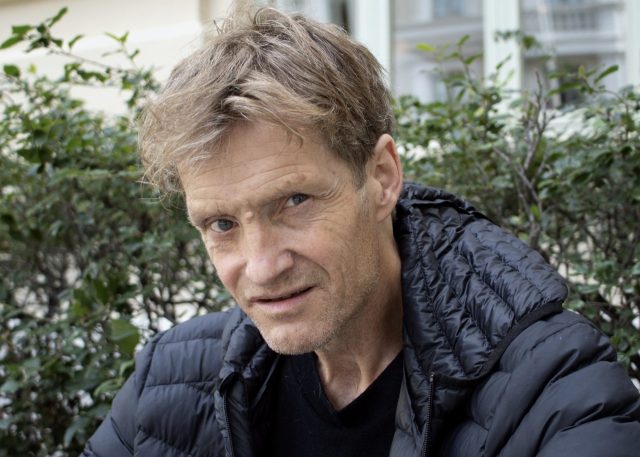
The Norwegian writer Thure Erik Lund is an influence on Knausgård. Credit: Thure Erik Lund





At some point in the first volume of Karl Ove Knausgård’s My Struggle, the author-narrator is struggling with feelings of inadequacy about his new novel, “a strange hundred-and-thirty-page affair,” about which he is still “enormously unsure.” So he asks a friend, and fellow writer — “Erik Thure” — to read it: “He rang me late one evening, both his mood and choice of words peculiar, as though he had taken a few drinks so as to be able to say what he had to say, which was simple: it’s no good, it isn’t a novel. You have to tell a story, Karl Ove! He said several times. You have to tell a story!”
I don’t know for certain whether “Erik Thure” refers to Thure Erik Lund, the Norwegian cult novelist a decade Knausgård’s senior, but this advice rang in my ears while reading Lund’s The Mystery of What Befell in the Ditch, recently translated by David M. Smith, and the first of Lund’s works to appear in English. Lund, along with Knausgård and playwright-novelist Jon Fosse, makes up a trio of Norwegian writers having an outsized impact on world literature. The “story” that Lund tells — through the increasingly crazed but enlightened voice of his alter-ego narrator — is of a rambling and mostly plotless kind. Yet it is, at the same time, a “mystery” story in the old sense, one that summons the greatest questions and doubts about ourselves, one that against all the apparent odds, excites, rocks, and compels the reader as few novels can. At stake is the value — and the danger — of intellectualism.
Lund has published more than a dozen books, both fiction and essays, the most recent being Identitet, in 2017. Ditch was first published in 1999, and is the first in a sequence of novels that have marked Lund’s distinctive place in Norwegian letters, all revolving around the central figure of character Tomas Olsen Myrbråten. Knausgård has called Lund the “greatest Norwegian contemporary writer.” It is a crowded field, a generation that has also produced not only the global success of Knausgård’s own autofictional project, but also the slow international rise and then sudden peak of Fosse, winner of the Nobel Prize in Literature in 2023. Knausgård’s praise alone — he calls Lund “the most vital writer I know” — should send the curious out to pick up a novel that is quite unlike anything else.
This trio can reasonably be said to have pushed the novel into new territory –– whether it’s Knausgård’s aforementioned series of autofictions, Proust-rivaling in scope and capacity for detail, which is (or ought to have been) the absolute and closing statement of that form; or Fosse’s lyrical inner-monologue narratives (culminating in Septology) of drifting souls in rural, seaside Norway, like a Beckett reborn with more warmth and less humor. And then there’s Lund, whose work was previously called “untranslatable” by Knausgård, who carries a political charge and confrontational energy and engages in wild linguistic play.
The novel opens with what is, in essence, a dramatic device: the name of our narrator, Myrbråten, is placed directly before his monologuing voice begins to speak. It only happens once, but here Lund is subtly distancing himself and a character who might be taken to be a mouthpiece — one whose initials (T.O.M.) also happen to spell out the word for “empty” in Norwegian. “It is no longer me who cries,” Tomas says in his opening remarks, “but the world, the world crying, in me.” So, Tomas both is and isn’t speaking, just as he both is and isn’t a character. Something is instead being summoned — perhaps it is simply an ambiguous indeterminacy, an empty space through which truths might escape.
Yet the voice of Tomas will be our sole guide to the strange and increasingly twisted story. It is a voice that is by turns urbane, offhand, stonily sincere, unceasingly ironic, unhesitating, rambling, repetitious, revelatory, lost, driving forward and always unpredictable. It tells a story without a single true line of dialogue or more than a handful of scenes — although many of those come out viscerally, hauntingly well — moving in long, loping paragraphs. With the voice’s totalizing consciousness, Lund reminds us just how strong the influence of the Austrian novelist Thomas Bernhard has been on fiction in the past 30 years or so.
Tomas tells us that he spends daily a “couple long, drawn-out hours at the kitchen table crying. Nothing more than this utterly miserable business: to sit slumped across the table, crying over the awfulness of the world.” A rictus grin is firmly established from the outset. Lund spends his first 50 or so pages in what is essentially a mode of relentless belligerence. It’s like reading a castoff by the Unabomber, a viscerally satisfying, disturbing, and startlingly prescient screed against what Tomas terms “the new, synthetic state of nature,” “the modern science-and-technology-based industrial society,” the “info-technological world-machine,” and “the new narcoticism” that underpins all of it.
On virtually every page of this heady first section Tomas reminds us that his central problem, both a curse and a blessing, is that of being a “life-of-the-mind individual” in the midst of an increasingly world-consuming “technonarcoticist culture.” “Life-of-the-mind individuals,” he declares, are “characterized by the fact that everything they do, they do because they must.” And this condition, in a world ever more under the machinic impulse of “money’s representative unreality,” comes to resemble an affliction, a pathology. For at the same time “we [life-of-the-mind individuals] have no choice but to believe, to believe in the good. In our time, this is hell.”
The novel’s story, then, such as it is, is Tomas’s transformation. As a frustrated writer, his concerns have, rather improbably, found “sudden manifestation in the form of a long essay assignment, a so-called cultural-historical think piece, commissioned by the Royal Norwegian Ministry of Culture.” It is while he is working on what he repeatedly and snidely dubs his “think piece” — which is to be all about “the problem of cultural relics” in Norway — that “I set off on some trips around the country. And the more I traveled, the more disastrous Norway appeared to me, the more perverted.”
Lund’s unfolding, eviscerating critiques of his homeland could easily be transferred to any country you care to name, as the hollowing forces of global capital combine year on year to make every place resemble every other place, and each place into all the same kind of “neo-fictive Globoland.” Norway, or at least an essential “Norwegianness” is being turned into a commodity for tourism and a friendly, globalized image, while folk cultures and once-alive communities become “cultural relics” to be transformed into money, all on the way to being replaced by “GloboNorway.”
Like Lund, Tomas was raised in the country but has matured in the city; concern over the clash between urban and rural and that false divide between “nature” and “culture” drives him to conclude his road trips with a return to his home village. And it’s here that the book’s second part takes place; Lund moves also into a new terrain of language, a kind of contrived country-speak for which Smith, the translator, turned to his upbringing in the American South for a Twainian-Faulknerian equivalent. It’s disorienting, at first. Then it’s hilarious. And finally disturbing.
Tomas seeks a return, back beyond his intellectualizing conditioning in the city, to a pure harmony with “nature” — first in the village, then, when that goes wrong, up in the strange, surreal and somehow out-of-time realm of “Graygrizzle Flats” under the influence of an Austrian archaeologist-inventor named Walter, where a cult-like group of archaic religious fanatics still dwell; finally, he’s cast out of there, too, and ends up in the final section as a truly de-civilized man: “the Forest Outlaw.”
And yet the real story Lund seems to be telling must be experienced, first and foremost, through his delight in language and a simultaneous, deep distrust of its power over us. As Smith explains in his translator’s afterword, “life-of-the-mind individual” is his considered rendering of the original Norwegian word which Lund used, åndsmenneske, which any dictionary would normally translate simply as “intellectual” in English. But the Latinate smoothness of this choice (not to mention, perhaps, a certain cultural baggage around the term that suggests, at least to me, an old-fashioned, somewhat midcentury frame of reference) would have lost the essence of the original Norwegian word, which Smith writes has “deep roots.” With åndsmenneske, you have ånd (mind, spirit) plus menneske (person, human). In Lund’s writing, moreover, “the word itself becomes defamiliarized” through Tomas’s constant, ironically repetitive, use of it. Smith’s choice here was a typically good one –it carries, semantically and sonically, the sense of an inherent awkwardness.
What help might language provide for the sorrowful intellectual, writhing against the increasingly tight confines of the Globo-culture?
Throughout Ditch, Lund writes restlessly in pursuit of linguistic invention, the kind that Anglo fiction seems to have largely abandoned. He employs neologisms, word compounds, and long, rhythmic sentences. The capacity for compound words in Norwegian allows for playful flexibility: some favorite renderings are “problemscapes” and “ennothingment.” And the constant clash and switch between “oral” and “literary” registers also enlivens Lund’s prose’s flow, rendering it at once thrillingly improvised and totally controlled. Such a contradiction, of course, mirrors Tomas’s predicament: he uses language to free himself, yet his prison is made up of it.
The reader might take joy, and some hope for the future from the virtuosity on display here, both Lund’s and Smith’s. Any good translator will actively embrace the innate and irreconcilable differences between the two languages with which they are working. Smith has achieved that — it’s a long time since I came away from any English-language fiction published in the past quarter century with this much excitement in its “vocabulations,” to steal another of Smith’s renderings, still less found myself reeling afresh at the latent energies of language from any contemporary novel. Smith’s work on Lund is a triumph of wit and invention.
At the same time, Ditch is centrally concerned with the great dangers of language: the ways it is at once indispensable and deadly to the human, to our sense of being. As AI is making clear, mistaking language’s representations for realities — and equating language processes with “intelligence” and “truth” — has unfortunate, and even perhaps insane, consequences.
For this and many more reasons, Thure Erik Lund is a writer we are lucky to have been given in English at this moment. His work will probably not be embraced by as wide a public as Knausgård’s, or indeed Fosse’s, has been. But this clause-cramped and wild-eyed novel has made me feel freer inside, and we need more of that. So, we must hope David M. Smith finishes the untranslatable task he has started, and gives us the rest of Tomas Olsen Myrbråten’s adventures.
Gus Mitchell is a writer from London. His work can be found in Jacobin, Commonweal, and on Substack at Magic Against Death.
 gustophagus