





(Juanma Jimenez/Getty)





On one level, Western European countries are all failing in their own unique way. In Germany, the problem is a combination of deindustrialisation and China shock. In France, it is dysfunctional politics. And in Spain, it is housing.
But this group of countries has more in common than these disparate problems suggest. They all have welfare states they can no longer afford. They are not spending enough on their public infrastructure. Their productivity growth is low. And they borrow too much. The cast differs, and so do the details, but they are all versions of the same story. Tolstoy wrote that unhappy families are all different, but he hadn’t encountered modern Europe.
Among those European families, Spain is in some ways distinct. Pedro Sánchez, Spain’s Socialist prime minister, stands out from the bland characters of EU leaders in the European Council. I consider him the last of the big beasts of old-school socialists in Europe. Apart from him, the Socialists and Democrats group in the European Parliament consists of an unidentifiable mass of centrists whose politics are all alike.
Their similarity is no coincidence. German-British sociologist Ralph Dahrendorf once described the 20th century as a social democratic one, and his description is spot-on. In most European countries, the centre-right was often seen as the natural party of government. But the centre-left won the battle of ideas, and has lost its distinctiveness. The outlier was the UK, where Margaret Thatcher moved the Conservative Party away from this social-democratic consensus in continental Europe.
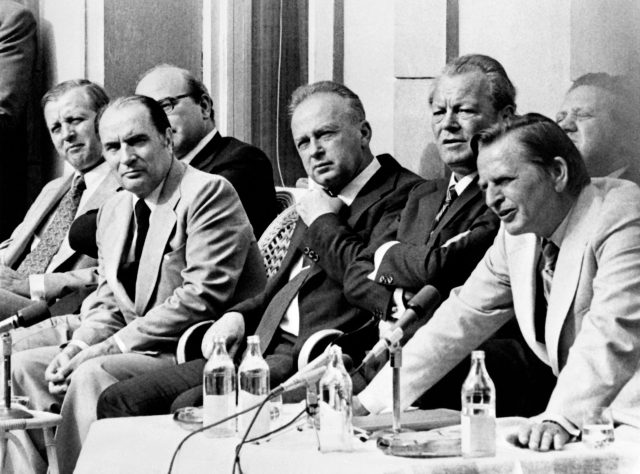
That consensus began with larger-than-life political radicals including Clement Attlee in the UK, Bruno Kreisky in Austria, Willy Brandt in Germany, Olof Palme in Sweden, and François Mitterrand in France. The next generation of centre-left leaders were Tony Blair and Gerhard Schröder — both successful and both discredited.
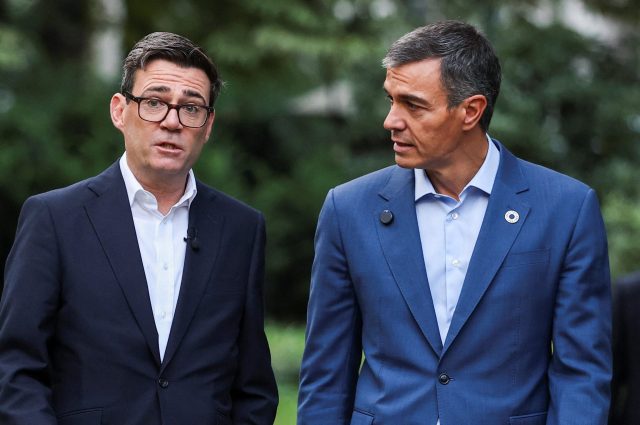
But Dahrendorf’s social democratic century is over. Amid his bland peers, Sánchez is one of the few recognisable old-school socialists in Europe. He has picked big fights — with Donald Trump over Iran, and with Benjamin Netanyahu over Gaza. Trump called his country a “wasted cause”, and a terrible partner in Nato. Netanyahu accused him of supporting terrorism. I myself disagree with his Socialist policies vehemently. But I respect him as a real politician, as opposed to the unbearable consensus types that have been governing the EU for most of this century.
In October, Sánchez decided to call a snap election, which will take place on 29 November. At the last elections, three years ago, he ended up winning against the odds. Back then, his big campaign theme was the protection of the welfare state. There is a chance that he might lose this time. He has been in power for eight years, and the mood everywhere in Europe is anti-incumbent. The odds of a change of government are shortening.
What triggered his decision to call an election nine months ahead of time was Spain’s housing affordability crisis, a common theme familiar to anyone in the UK, in Germany, and parts of the US too. In Spain, the crisis reached its symbolic moment with the televised eviction of 87-year-old Maricarmen Abascal from her Madrid home, where she had lived for 70 years. She died shortly after her eviction. The housing crisis has given Sánchez a stick with which to beat the opposition, who voted down his emergency housing measures, as well as a cause through which to mobilise his own supporters.
In an odd way, Sánchez reminds me of Schröder. Their politics could not be more different. But they were similar types of politician, both high-stakes political gamblers. Both succeeded to snatch an unexpected victory from a predicted defeat. Schröder’s luck ran out in 2005, and it looks like the same thing might now be happening to Sánchez.
The election is currently being overshadowed by Wednesday’s train crash near Toledo, south of Madrid. At least 69 people died. The Spanish newspaper El País called it a tragedy that rewrites the election campaign. Until then, Sánchez’ Socialists had been on a roll to mobilise their core supporters and other progressive forces on the Left. After the crash, all the parties suspended their campaigns.
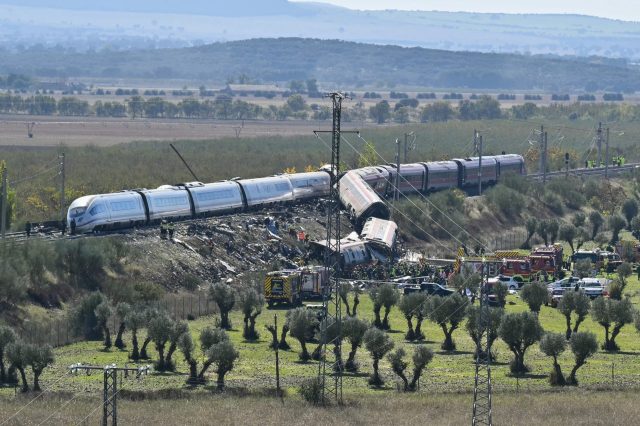
Apart from a loss of campaigning momentum, there is a more troubling issue for Sánchez. The accident has thrown a spotlight on a sore point of his record in office. Like other European countries, Spain did not invest enough into the railway infrastructure — rail safety included.
But it gets worse. The Sánchez government immediately blamed human error for the accident, but subsequently a darker picture emerged. Recordings leaked from the railway company’s control centre suggest a whole series of systems failures. The system that supervises train movements and speeds went out of service; there were problems with the railway communication service, which is based on the outdated GSM-R telecommunication standard; and there were reports of a drop in voltage on the railway line. The system might also have been failing to detect where trains were on the tracks. Everything Spaniards are learning about the incident suggests a railway system that is not fit for purpose, and which therefore raises troubling questions about the Spanish government’s investment decisions.
With four weeks to go until the elections, the topic of conversation in Spain has shifted from housing to railway safety. Worryingly for Sánchez, people are starting to blame his government for not doing enough. Equally worryingly, it would not be the first time that a Spanish government has lost power in this way. In 2004, a bomb exploded in Madrid’s Atocha train station, killing 193 people. The centre-right government immediately blamed ETA, the Basque separatist organisation. But that account was almost immediately debunked, with the bombings instead being the work of an organisation linked to Al-Qaeda. The government lost the election largely because it lied about what happened — inflaming existing distrust.
That story should therefore remain a cautionary tale. When events like these change elections, it is because of some underlying grievance. Last week’s train crash reminded Spaniards of an accumulation of crises, one of which is their country’s neglect of its transport infrastructure.
And that’s more or less the picture in other European countries too. France has one of the best railway networks in the world, a crown jewel of public sector excellence. But under the leadership of Emmanuel Macron, the investment dried up. German trains used to be famous for their punctuality, but the country has now got one of the least reliable train systems in Europe. I recently had a surreal experience at Dortmund train station in Germany where I heard a constant stream of station announcements, each one an apology for cancelled or late trains. For many Europeans, dysfunctional public transport systems are a day-to-day reality.
What if Sánchez loses the election? Successful politicians are often revered by their contemporaries. After Blair and Schröder left office, both became hate figures. My hunch is that Sánchez, too, will be one of those. History will not see the formidable campaigner, or the politician who stood out from the crowd, or the high-stakes political gambler. Future generations will care only about the legacy. I struggle to see how that judgement will be a flattering one. This is true not only for Sánchez but for the other European leaders too.
This is why Europe’s unhappy families, despite their differences, are ultimately similar. They all failed to invest in domestic infrastructure and security. They also allowed their countries to become over-reliant on others. Sánchez’s grandstanding in foreign policy might have been more credible had Spain not chosen to run down its defence spending, in defiance of the Nato spending targets that previous Spanish governments agreed to.
Some of Spain’s problems, though, go back much further. The country has no track record of investment in science and technology; in fact, the last time a Spanish citizen received a Nobel prize in the sciences was in 1906. That’s not necessarily bad news for Spain, which has no old-industry heritage that holds it back. Spain could have become, had it chosen to, a modern economic hotspot like Texas. The plains of Spain are as sunny and cheap as the flatlands of Texas.
But unlike Spain, Texas has become a hotspot of AI investment in the form of data centre construction. Spain has started to attract some investment, but nothing of the scale as Texas did. Texas is projected to get as much investment this year alone as Spain’s entire projected investment for the period from 2025-2030. Nobody will blame Sánchez for the lack of Spanish scientific success, but AI was a low-hanging fruit, left mostly unpicked.
There are positive things to say about Spain too. The successes in men’s and women’s football have undoubtedly raised Spain’s standing in the world. Sánchez is the most recognisable Spanish politician since José María Aznar. Spain’s economic growth looks better than those of other European countries, unless you look closer and find that it is mostly due to immigration.
When you look even closer, you see that Spain, France, Germany and Italy are versions of the same underlying story. It’s just not their century any more.
