




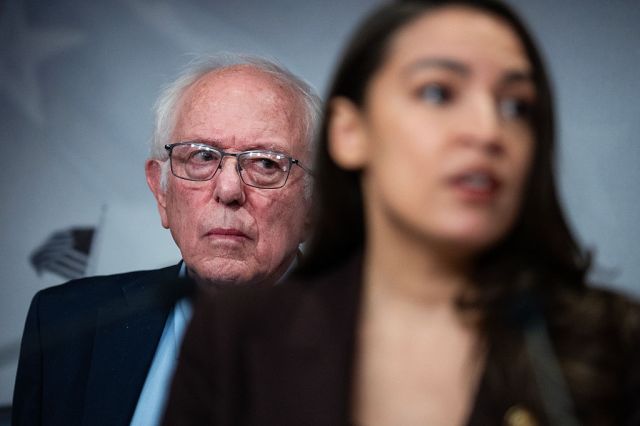
The path to power has been cleared for Rep. Alexandria Ocasio-Cortez.





The morning after Michigan now-senator-elect Abdul El-Sayed won the Democratic primary in August, The New York Times’s Michelle Goldberg nervously laid out the stakes. “Either El-Sayed wins and shows anxious liberals like me new horizons of political possibility,” she wrote, “or he loses in a year when Democrats are expected to dominate and offers a hard lesson on the necessity of pragmatism.”
El-Sayed, speaking to Goldberg, pitched his insurgent campaign as a test of an “alternative hypothesis.” Voters hated the establishment so vehemently that they were willing to hold their noses and vote for Donald Trump twice; they might do something stranger if offered a real alternative — like a Bernie Bro Muslim who antagonized the Democratic establishment nearly as often as he did the GOP.
On Tuesday night, El-Sayed looked like Nostradamus. He predicted he would beat Mike Rogers by seven points, and he won by nearly six in a state Trump carried two years ago. He did it as a Muslim candidate with a Muslim name, whom Trump and other Republicans repeatedly accused of being a jihadist. Haley Stevens’s entire case in the primary was that El-Sayed could not win. Her final act, pulling her endorsement and backing Rogers, was an attempt to make that true.
Elsewhere, the populist Left won in places it had no business winning. Bernie Sanders spent the fall crisscrossing districts Trump carried, and his and AOC’s endorsees have turned up on the winning side of the map: Troy Jackson, a former logger and labor leader, unseated Susan Collins in Maine. Sam Forstag, a smokejumper and union leader, claimed victory in Montana. Randy Villegas, a professor and auto-shop owner, won in California’s Central Valley. DSA member Melat Kiros knocked off 30-year incumbent Diana DeGette in Denver and became the first member of Gen Z elected to Congress. And in the Senate, a party that spent years being told to run to the center flipped seats in Texas, Ohio, Kansas, and Iowa by talking like the populist Left on prices, health care, and contempt for the wealthy and powerful.
In doing so, the Left might have finally killed the old “Third Way” theory of the Democratic Party, much like MAGA and Trump’s victory in 2016 upended the old corporations-first, free-trading, globalization-friendly GOP of the Paul Ryan era.
The Third Way, for readers who missed the 1990s, was the project of making Democrats electable by making them more like Republicans. Born in the Democratic Leadership Council and perfected by Bill Clinton, the theory held that the party had lost the country in the Reagan-Bush era by looking like a union hall with a welfare office attached. The cure was to triangulate: embrace free trade, balance budgets, be tough-on-crime, cozy up to Wall Street, and promise that markets would deliver what government used to. A think tank, also called Third Way, still carries the banner in Washington.
This strategy was perfected by Rahm Emanuel, who, as head of the Democratic Congressional Campaign Committee in the mid-2000s, took credit for the blue wave of 2006 during the tail end of the George W. Bush administration. Rahm-ism was about trying to please Lindsey Graham and Barney Frank alike with a mix of fiscal conservatism and cultural liberalism led by milquetoast technocrats, which would attract independent voters on the notion that independents demanded a mythical midpoint between the two parties’ agendas.
The logic of the Third Way continued into 2026, as Stevens and other moderate Democrats insisted that the Left had the enthusiasm, but ultimately could not win big elections in November. But on Tuesday, independent voters — and just about everyone else — swung hard to the Left. The blue wave was especially prominent among Latinos, Catholic voters, and voters younger than 30, with one poll suggesting that Gen-Z voters shifted 46 points since 2024. A NBC national exit poll also found that 17% of midterm voters call themselves democratic socialists, and 97% of those voted Democratic. Among voters 18 to 29, a full third say they are democratic socialists, while only 10% say they are MAGA.
Ted Cruz may accidentally turn out to be the best political analyst of the 2026 cycle. Stumping for Mike Rogers in Michigan last week, the Texas senator made a prediction he clearly intended as a threat: if Abdul El-Sayed wins, he said, the Democratic nominee for president in 2028 will be Alexandria Ocasio-Cortez. Tuesday’s results could prove him right.
Now for the reality check: All of this doesn’t mean, as some archly suggested on social media on Tuesday, that “woke is back” and that Democrats are going to start putting their pronouns back in their email signatures, or wheeling out guillotines to use on Elon Musk — let’s hope not. Despite what Trump and the GOP have warned, there is no communist revolution around the corner. Maybe not even a New Deal-lite. “Democratic socialist” in an exit poll covers, in practice, everyone from the person who has a copy of Capital in their tote bag to the person who would like insulin to cost less. Ask many of these self-proclaimed socialists what they want, and the answer tends to be: lower prices, universal health care, and some relief from an economy suddenly being rewired by AI and an expensive war in the Middle East.
To give credit to the Left, it has promised to deliver affordability and economic benefits and it has toned down calls to end white privilege, abolish the police, and get you fired for your problematic Halloween costume. The Left has begun following the example of Zohran Mamdani, who won New York City on a sunny campaign to freeze rent and make buses free, and proved you can mute the worst of Woke 1.0, keep the substance, and talk like someone who wants to win. You can see the shift in Alexandria Ocasio-Cortez, too, whose turn toward a more welcoming, kitchen-table progressivism got the full Times profile treatment, in which she claimed to want a progressive movement “that is not rooted in judgment, castigation or being closed off.”
Yet the Democratic Party — as a brand and institution — is still weak and unpopular, with a platform that fits on a bumper sticker: Stop Trump. Voters, ultimately, may have hired the Democrats the way you hire a bouncer, for whom or what they will keep out. Plus, midterms historically punish the president’s party; the second-term version is especially brutal, and this president arrived at the polls with historically bad approval numbers and a catastrophic Iran war. Voters were in a Vote Blue No Matter Who mood, a doctrine that turned out to be very flexible about who.
Ultimately, everything about this moment feels contingent. What happened Tuesday was a blue tsunami, to be sure, but it also looks less like a realignment than like another turn in a long dealignment, in which the electorate keeps hiring and firing whoever promises relief, because no one can stop creeping American decline. El-Sayed and the rest of the new Left have just been handed that job, and nobody, including them, is sure how to do it.
