




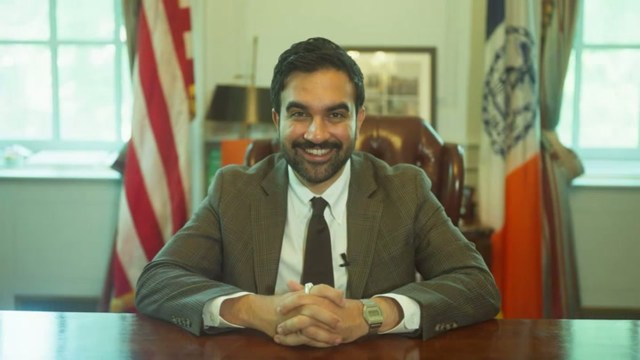
Zohran Mamdani has been posting his way through the hurdles of big-city governance. Credit: NYC Mayor's Office





By this time last year, Zohran Mamdani was already the presumptive next mayor of New York. He had bested former Gov. Andrew Cuomo in the earlier Democratic primary, and the GOP’s nominee was an eccentric — the cat-loving, beret-wearing Curtis Sliwa. The Republicans stood no chance.
To this turn of events — a Muslim socialist chief executive of America’s largest city — the Right responded with characteristic restraint. “Democrats in New York City have chosen a true extremist and Marxist,” warned House Speaker Mike Johnson, “and the consequences will be felt across our entire nation.” The hard-Right commentator Laura Loomer posted: “The Islamic takeover of America is in full swing.” Then-Rep. Marjorie Taylor Green (R-Ga.) posted a cartoon of Lady Liberty dressed in a burka.
Nearly a year on, the Big Apple has yet to succumb to an Islamo-communist takeover. Nor has it, much to the chagrin of the Left, transformed into a socialist utopia, with free electric buses gliding through the streets, public grocery stores on every block, and children playing freely under the supervision of nonbinary government employees.
In fact, what’s notable about Mamdani’s first nine months in office is not what he has accomplished — but what he hasn’t. Despite all the predictions of a communist revolution with Islamic characteristics, the Big Apple today doesn’t look all that different from, well, 2025. We were promised Islamo-Marxism; all we got was a progressive Democrat who likes the camera.
What gives?
The more germane detail about Mamdani’s biography isn’t his faith or his socialist ideals. It’s that he is an urban Millennial who — avert your eyes, mullahs — met his wife on Hinge. In other words, he is a creature of social media, instinctively attuned to the demands of online self-promotion. His constant TikTok-length videos and mostly symbolic initiatives — free tickets to the Met Opera! government babysitters to allow couples to take date nights! arresting Benjamin Netanyahu! — have helped him project the image of a radical new politics while mostly allowing the city’s various bureaucracies to conduct business as normal.
Those bureaucracies, moreover, are formidable in their own right. And some of them are answerable not to City Hall, but to the state legislature and the governor’s mansion in Albany. Thus, in addition to his own taste for symbolic politics, Mamdani is hemmed in by the realities of governing.
During Mamdani’s inaugural address, the new mayor promised a “new era.” He pledged that the city would “govern expansively and audaciously,” replacing the “frigidity of rugged individualism with the warmth of collectivism.” His suite of expansive (and expensive) policies — free public buses, universal childcare, a rent freeze, and public grocery stores — gave proof of this collectivist embrace. On Jan. 1, 2026, it really seemed as though a new socialist dawn was breaking over the world’s financial capital.
The record since is more mixed than either his admirers or his enemies allow. First, the achievements: a rent freeze for many New Yorkers, $1.2 billion in state funding for childcare, and a $22 billion pledge to build or preserve 400,000 affordable homes over the next decade. But the policies that defined his campaign haven’t panned out quite as well. His plan to launch five public grocery stores by 2029 is already mired in legal challenges, as is his controversial tax on expensive second homes in the city. Meanwhile, budgetary constraints and divisions within his own party have stalled progress on free buses.
Mamdani has been merrily posting his way through these setbacks. Whether it was singing “The Wheels on the Bus” with Barack Obama at a school, cutting an ad featuring Charli XCX music in support of Gov. Kathy Hochul, or brandishing green plantains at a grocery store, Mamdani has shown a gift for political optics. Through hundreds of zippy, viral videos, he has cultivated the impression of a hyper-productive mayor Citi-biking around the five boroughs to address the concerns of ordinary New Yorkers.
By (literally) rolling up his sleeves on camera, Mamdani has turned the less glamorous aspects of the job into a hallmark of his mayoralty. Since January, he has shared cheery videos of him fixing water fountains with plumbers, shoveling dirt onto the Williamsburg Bridge bump with city transportation workers, and filling potholes with repairmen. He has also scored easy populist wins with free opera seats for the public and discounted World Cup and US Open tickets to the public.
Conservatives have responded by variously casting Mamdani as a reincarnated Deng Xiaoping or a closet Islamic extremist biding his time. They have seized on his decision to wear an Arsenal kurta during Eid prayers and his greeting Rep. Alexandria Ocasio-Cortez with a smile at the 9/11 memorial. The latter brouhaha was quickly debunked after the full footage revealed that he’d only briefly embraced AOC before turning his attention, solemnly, to the reading of the names of the victims; meanwhile, Right-wing officials — not least JD Vance — were seen smiling or chuckling at various points, too.
That isn’t to say that his symbolic politics have lacked for missteps. A city-produced map of “Immigrant Enclaves” conspicuously excluded Little Italy, triggering a Sopranos-style eruption in downtown Manhattan. (The map, meanwhile, included a reference to “Little Palestine,” a phrase that has never crossed the lips of an actual New Yorker.) The mayor’s video protesting financier Ken Griffin’s house in Manhattan was roundly criticized as an ill-judged attempt to turn a billionaire into a political prop. And his grandstanding on arresting Benjamin Netanyahu — which he walked back a few days later — was a weak attempt at serving red meat to his Left-wing base.
But by portraying Mamdani as an Islamo-communist hellbent on turning New York into Gaza-on-the-Hudson, his opponents have allowed the mayor to present himself as a moderate, even technocratic, leader more interested in reducing the cost of groceries than imposing Sharia law. Worse still, these attacks have distracted from more substantive concerns about Mamdani’s policies and ability to govern. Most pertinently, can a 34-year-old with five years in the state legislature really deliver the most ambitious agenda in a generation?
Today, Mamdani is the most popular elected official in the city. Some Democrats have even lamented that the Uganda-born mayor can’t run for higher office. But it is also possible that his symbolic gestures will soon wear thin — not with Republicans, but his own supporters. Recently, the Democratic Socialists of America and various Mamdani allies attacked the mayor over his failure to fire NYPD Commissioner Jessica Tisch, hated by the Left for being a tough-on-crime law-enforcer and a Zionist to boot. Mamdani has not only retained Tisch from his predecessor’s administration, but given her wide berth to do her work.
For as long as he keeps Tisch — and the relationship between the two appears strong — Mamdani has an answer to the accusations that he is weak on crime, a common critique of Left-wing leaders. For now, crime in the city is at record lows, and subway ridership is nearing pre-pandemic levels, but a recent spate of subway killings and rise in felony assaults and hate crimes could yet test his approach to public safety. Posting slickly edited social media clips on his channels won’t suffice.
Who, then, is the real Zohran Mamdani? Is he a run-of-the-mill social democrat who realized that the key to governing was to play the radical, without actually being one? Or is his newfound pragmatism a way of demonstrating that a democratic-socialist future needn’t mean street-level disruption, chaos at City Hall, or intra-Democratic turmoil? Perhaps even he doesn’t know. But at some point, the mayor’s honeymoon will end, and Mamdani will have to show what he really stands for.
