




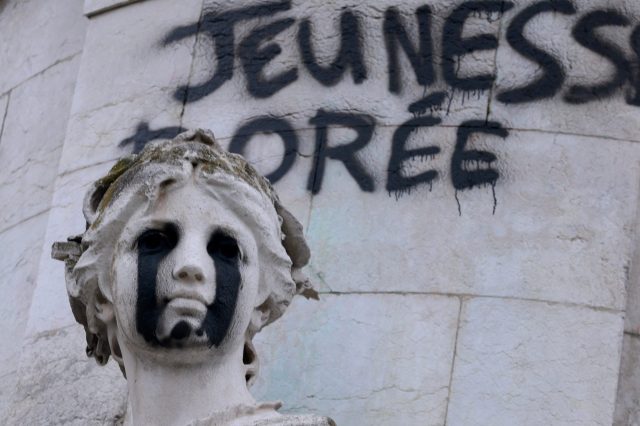
“The young are a minority in every European society.” (Kenzo Tribouillard/Getty)





All over Europe, the young are in revolt. The student protests in France have drawn most of the attention, not least because of the violence into which they descended, with rioting, looting and the torching of public buildings. But in recent weeks young people have also taken to the streets in a string of other countries, in some cases violently — in Italy, Spain, Portugal, Belgium, Greece, Ireland, Germany, Austria and elsewhere. Meanwhile, in Serbia, a student movement that spent two years in the streets has just won a general election, ending Aleksandar Vučić’s long reign.
The triggers may differ — schools in France and Belgium, housing in Spain and Portugal, the cost of living in Italy, corruption and a mixture of the above in Serbia — but the root is the same. These are the protests of a generation that believes it has been robbed of its future. It’s a conclusion that’s hard to argue with. The social contract its parents knew — work hard and you will, at the very least, secure a home, be able to support a family and be better off than those that came before you — has collapsed. For many young Europeans without inherited wealth, adulthood means drifting from one precarious job to the next, earning barely enough to cover the cost of rent and groceries, let alone start a family. That is, if they find work at all. Meanwhile, they have watched the institutions that were supposed to give them a start in life and cushion its blows — schools, universities, health and youth services — wither under austerity and privatization.
There is no doubt that young people have overwhelmingly borne the brunt of the neoliberal policies pursued over the past decades. That neoliberalism has driven inequality to new heights is widely acknowledged; what is less often noticed is that this inequality is increasingly drawn along generational lines. The geopolitical analyst Arnaud Bertrand recently shared some pretty extraordinary statistics on X regarding France: the over-60s — roughly a quarter of the population — hold around 60% of the nation’s wealth. They also receive nearly two-thirds of all social spending by the French government, in the form of pensions that, under the current system, are paid for by younger generations. This continuous bottom-up generational transfer of wealth is even more extraordinary when one considers that the average French retiree now has an income higher than the average worker.
Yet though the protesters often explicitly frame themselves in generational terms — most obviously Germany’s “Gen Z regelt” (which roughly translates as “Gen Z’s got this”) — their demands aren’t phrased as claims against the old. This is surely the right approach. Blaming the boomers would be a mistake. They simply had the good fortune to grow up in an era of full employment, affordable housing and decent pensions, and there is nothing scandalous about aging societies spending more on the old. Moreover, much of that wealth is concentrated in the hands of a small minority of boomers; not all older people live a luxurious life, of course. Ultimately, the problem is not that pensions are too high; it is that the young are being denied what their parents took for granted. The generational divide is simply how a decades-long class war from above is experienced by those who came of age after workers had already lost it, and who inherited a political-economic regime built to transfer wealth upwards. In Europe, that regime has been written into the institutional architecture itself — the euro, the Maastricht treaty, the fiscal rules — which systematically favors asset holders over wage earners, and established workers over new entrants.
The mechanisms are well understood. A decade of quantitative easing inflated the property and financial assets held by the old while wages stagnated, locking the young out of home ownership. Labor market reforms — from Italy’s Treu package and Jobs Act to Germany’s Hartz laws and France’s El Khomri law — preserved the security of those already inside while consigning newcomers to a revolving door of temporary and increasingly precarious contracts in the name of “flexibility”. After 2010, austerity fell disproportionately on education, youth services and public investment. Existing pensions were largely shielded, while future ones were quietly cut. As a result, across Europe, government spending on older people has risen, while public investment has been gutted. Then came the pandemic, which cost Gen Z years of schooling, work and social life, followed by a surge in inflation, made worse by an energy shock that Europe’s leaders largely inflicted on themselves.
As if that weren’t enough, the young are now being told to accept further cuts and deteriorating living conditions to make room for rearmament and an open-ended war — for which, it seems, there is always money. Just a few weeks ago, as French police were firing tear gas at teenagers, EU leaders tasked the Commission with finding another €70 billion for Ukraine in 2027, on top of the €45 billion already earmarked. The fiscal rules that were never relaxed for schools or hospitals are being bent for defense, through national escape clauses and joint borrowing for weapons procurement. And the young have noticed. They are told there is no money for their classrooms, while new billions are found for a war with no end in sight — a war that, as conscription returns to the European agenda, they may even be asked to fight. In many countries, young people are starting to explicitly link the cost-of-living crisis with the rearmament drive.
The real question, then, is not why the young are revolting, but why it took them so long. The economic roots of these protests are undeniable. But are they the whole story? Most conservative commentators have focused instead on the presence of second-generation youths of Arab and African background, and on their leading role in the violence and looting, above all in France but also in Italy. For much of the Right, the riots simply confirm what it has been saying for years: that mass immigration has been an unmitigated disaster, filling European cities with a largely Muslim underclass that has no interest in integrating, and that, in the crudest version of this narrative, is cast as bent on destroying the very fabric of Western civilization, in some cases with the help of the “far-Left”. The demands of the overwhelmingly peaceful protests, meanwhile, go largely unheard.
There is an irony here. The populist Right never tires of complaining that a “globalist establishment” has impoverished and deindustrialized Europe. Yet when young people take to the streets, sometimes violently, against that very establishment and the consequences of its policies, it cannot bring itself to believe that they might have genuine grievances. Instead, it instinctively assumes that someone must be pulling the strings: Islamists, Antifa, Mélenchon.
It is, of course, right to distinguish between the peaceful protests demanding economic reform and the rioting and looting that accompanied them. But are they really two entirely separate stories? There is no question that much of the looting, in France as in Italy, had a strong second-generation component drawn from the banlieues and the marginalized peripheries of Italian cities, with little discernible ideology behind it. Nor is there any point denying the costs of mass immigration, from public safety to the pressure on public services. Many of those involved in the violence were clearly acting out of opportunism. And the growth of separate communities of different social and religious backgrounds, often living in conditions of extreme exclusion, is clearly a social time bomb, one that has already done serious damage to social cohesion — and those on the Left who deny this reality are as blinkered as those on the Right who fixate on it at the exclusion of everything else.
One might go further and argue that mass immigration has itself been part of the neoliberal social engineering of recent decades, not least by creating a reservoir of cheap labor. One might also argue that rioters running amok at peaceful demonstrations damage the protesters’ own cause, drowning out their demands and handing the security forces a pretext for a crackdown. There have even been claims that the French police deliberately allowed the destruction to happen in order to justify mass repression.
These are all valid arguments. But they raise an obvious question: why do the protesters raging against the status quo not turn their anger on these immigrants and instead often march alongside them? Are they simply blinded by naïve Left-wing ideology? Or is something deeper at work? It is more likely that they experience their struggle primarily through a generational lens, one that cuts across ethnic, and to a certain degree class, lines. That seems far more convincing than the “islamo-gauchiste” theory, which holds that this cross-ethnic alliance is not spontaneous solidarity at all, but something engineered by Left-wing parties such as Jean-Luc Mélenchon’s La France Insoumise. That may hold to some degree in France, but it doesn’t hold in Italy, where there is no Italian LFI, no comparable alliance between the Left and Muslim voters, and yet the same mixed crowds appeared in the streets, as elsewhere.
Yet reducing the violence solely to its second-generation component is also misleading, and far too comforting. Young people of European background have taken part in it too. The crowds that recently rioted in Milan included kids with Italian-born parents alongside those from immigrant families. So we have to ask to what extent this violence is also a reaction to a system that offers no avenue for political change. This is not to justify it. Violence, in and of itself, leads nowhere emancipatory. But we cannot escape an uncomfortable fact: an increasingly authoritarian system that is actively committed to blocking any democratic systemic change, with no social intermediaries between power and the masses, and no forces capable of giving the revolt a direction and a political content, of placing it under the guiding idea of social emancipation, is bound to breed violence. And then there is the merciless generational arithmetic: the young are a minority in every European society. They cannot win elections on a generational platform.
But the violence — and especially the wanton looting — also expresses a deeper malaise, one that goes beyond economics. It reflects the nihilistic void into which Western societies have sunk: when individualism, purposelessness, anxiety and despair become the norm, we shouldn’t be surprised if the result is collective depression, or rage. At a time of moral decay at all levels of Western societies, particularly among its political and corporate elites, who systematically display little respect for either human life or (other people’s) property, is not a little delusional to expect the youngest and most disadvantaged to hold themselves to a higher moral standard than their rulers?
Writing about the riots in England in 2011, the German social psychologist Götz Eisenberg described the young as the “surplus generation” — no longer needed by society, its labor expendable, deprived of the chance to build an independent life through its own efforts, yet constantly dazzled by the promise of self-realization through consumption, a state that is increasingly beyond its reach. Fifteen years on, his diagnosis is more relevant than ever — and indeed Britain remains a social powder keg that could once again explode at any moment. Violence is no solution to social problems, but neither does it arise in a vacuum. Where political and economic power has become anonymous, anger turns on the nearest symbols, such as a Louis Vuitton boutique. A shop window can be smashed; financial markets and austerity can’t.
That said, we shouldn’t make the mistake of assuming the protestors represent an entire generation. The same generation that fills the streets also votes, in growing numbers, for the anti-immigration Right. In France’s 2024 election, a third of under-25s backed the Rassemblement National; in Germany last year, more than a quarter of young men voted AfD. The anger at the establishment is the same but it is channeled in the opposite political direction. The question is whether European politicians, whether incumbents or its “populist” challengers, have any real answers.
Addressing the protesters’ grievances would require systemic change: greater public investment in education and housing, higher wages, more secure jobs, economic redistribution (focused on the real wealth hoarders, not pensioners in general), and a rational energy policy, which would itself demand a radical shift in geopolitical paradigm. However, it’s hard to see how any of this could be achieved within the current EU-Nato architecture, which no major party seems prepared to challenge. Meanwhile, the idea that the problem of alienated second-generation youth can be solved through even more heavy-handed repression — or perhaps even “remigration” — is little more than a fantasy.
The question, then, is whether the young people of Europe can replicate what happened in Serbia. That is a country that faces much the same demographics — an aging and shrinking population — yet its student movement managed to build a platform that drew support across generations, partly by shunning traditional ideology and unifying under a simple, non-partisan message for change. It’s ironic that today this seems harder to achieve in the “liberal-democratic” West than in a country routinely described as authoritarian.
Thomas Fazi is an UnHerd columnist and translator. His latest book is The Covid Consensus, co-authored with Toby Green.
 battleforeurope