




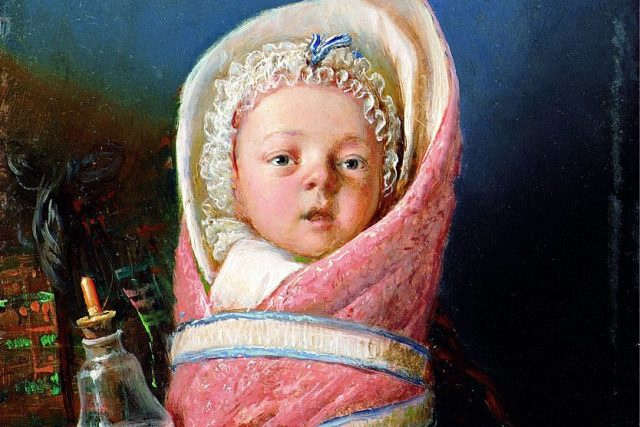
Painting by Josef Grandauer (1857). Getty





I followed all the natural-birth instructions. As my due date ticked past I did the meditations, bounced on the balls, and drank mugfuls of raspberry-leaf tea. None of it worked, and in the end her arrival could not have been less crunchy. All the things I didn’t want to happen happened, one after another. I’ll spare you the gory details but I spent a week afterward, nil by mouth following complications, wondering if either of us was going to make it.
All of this is a preamble to asking: how did Britain end up as the C-section capital of the world? One in four births in Britain is now an emergency caesarean. Add to that the 20% of births that are by elective caesarean, and almost half of all babies in the UK come, as they say, out of the sunroof.
This is one of those topics that’s difficult to discuss without someone feeling attacked. Birth gets routinely moralised into the defensive arms race of “mummy wars”. On the one hand, snarky insinuations about being “too posh to push”; on the other, being smugly “natural” or even putting your baby at risk by declining medical help. This isn’t that article. The truth is, most mums just want themselves and their babies to come out alive and well.
In this context, though, what does a C-section rate of almost 50% mean? I don’t think there is a simple answer. It is probably partly attributable to changing life patterns; and partly to fear, and control, and the poverty of spiritual ministry in corners of “Our NHS” where, in truth, nothing else will do.
My own C-section makes me a statistic: I gave birth for the first time in my late thirties, tracking an overall long-term rise in the average age of first-time mothers, a group more at risk in pregnancy and childbirth, and more likely to give birth as I did, by C-section. This has a cascading effect, too: natural birth after a C-section comes with additional risks, and women who have had one will often opt for another for subsequent pregnancies. It’s also likely that declining overall health plays a part. But none of these factors account for how much of an outlier Britain has become. As The Times reports, other European countries have C-section rates ranging from below 15% of births in Norway to 32% in the USA. But in the UK, C-sections now surpass the proportion of spontaneous vaginal (“natural” in old money) births.
Average life patterns in Europe don’t differ that much from ours. So what’s going on? Clinicians suggest that the common factor is fear, among both healthcare staff and expecting mothers. In the wake of multiple scandals over neonatal care, bombarded by critical government reports, and entrusted with the inherently high-stakes business of safely delivering babies, clinicians default to the relatively controllable option of C-section.
It should surprise no one if public discussion of poor perinatal care contributes to a proportion of mothers fearful of risk, and requesting an elective caesarean. At least that way, you can have your baby to a schedule and with some idea of what to expect.
Perhaps this points in turn toward the heart of the matter: an untenable mismatch between the capabilities of a human-run, bureaucratic healthcare service such as the NHS, and the intensity of the experiences these institutions are tasked with handling — birth and death most of all. It’s sometimes flippantly claimed that “Our NHS” has become a kind of church or religious dogma for Britain. But this is truer than we realise, and in more ways than one.
In Christian history, healthcare and spiritual ministry have been deeply linked. This is natural: hospitals routinely comfort and tend to people in every imaginable form of acute suffering and need, and this has always been at least as much the domain of priests as of healthcare staff. Premodern English hospitals were inextricable from the Church, and after Henry VIII dissolved the monasteries, reformed Christians remained active in caring for the poor and sick including in medical practice. Later, with the upheavals of industrialisation, public health again became a focus of Christian social reformers.
The architecture of the often-Christian charitable healthcare they created would later be nationalised after the Second World War, becoming the NHS: an institution whose creation was opposed by some Roman Catholics at the time. Cardinal Bernard Griffin negotiated an opt-out for the small number of Catholic hospitals then in operation, arguing “It will be a sad day for England when charity becomes the affair of the state”.
This is an unfamiliar attitude in the Britain we’ve grown accustomed to since then. But it reflects a view that charity, properly understood, is orthogonal to the intrinsically instrumental, bureaucratic outlook adopted by governments. From this perspective, the proper role of Christians is not campaigning for uniform, nationalised care delivered by secular institutions, but playing an active role in providing such care. This reflects a longstanding Christian view that “care” may refer to practical, physical help, but not always. Sometimes it can also mean noticing and tending to less concrete needs, or simply being present with someone.
But while this kind of accompaniment flows organically from a religious perspective, the NHS is organised so as to sublimate this aspect of healthcare, as much as possible, into secular procedure. Most hospitals have chaplains, but the hospital environment itself is arranged as though they are never needed. Pain and need call forth process, and metrics, not (unless you insist) accompaniment or prayer.
Accordingly, this kind of ministry is typically found in the NHS more in spite of its approach than as a naturally-occurring feature. I will, for example, never forget the healthcare assistant on that intensive ward, who, after my daughter’s birth, stopped to chat every day as I recovered and, once I was well enough, showed me how to breastfeed in the most practical possible way: grabbing a handful of me and then positioning my baby properly. It was a wordless lesson, surely impossible without the gentle relationship-building that preceded it. And it transformed my relationship with my baby.
The ancient world used to treat women undergoing childbirth as on a par with men going to war, not least as the dangers it entailed could be as grave. Even with today’s far lower perinatal mortality, having a baby is probably the most dangerous thing an ordinary woman will ever do. This is reflected in the way new mothers often revel in swapping birth stories, the gorier the better. It’s like retelling your time at the front. And, in the same way, birth stories also speak at least obliquely to that uncanny feeling that surrounds birth, of being catapulted out of secular time.
You get a sense of this even visiting a mother and newborn. In the presence of a new mother-baby dyad, time goes wonky. A moment can last for hours, or days flash by in a heartbeat. If you’re the one giving birth, that feeling is even more pronounced, not least because you’re probably sleep-deprived as well. It’s like the luminous inverse of the equally eerie atmosphere that accompanies being in the presence of death. And just as cultures around the world have rituals that acknowledge this aspect of death, there are numerous examples, cross-culturally, of rituals that acknowledge this around childbirth too, from lying-in and name-giving practices to rituals designed to welcome the child into its spiritual community or protect it against evil.
Like war stories, mothers swap birth stories because having a baby is as much a brush with eternity as encountering death. Pregnancy and motherhood is a kind of hero’s journey. And yet the secular world expects all of us to pick and choose how — or even whether — we acknowledge this dimension at all. If you speak to doctors (at least after a couple of drinks) they’ll tell you all about what folklore would call the thin places: moments or spaces where the line between this world and the next becomes porous. But the NHS as an institution has, by design, nothing to offer those on those high, strange roads.
No wonder, then, that many find this isn’t enough, especially when confronted with the straitened capabilities of the NHS in practice. So perhaps we shouldn’t blame those who respond by reaching for maximal control — a C-section — as though the solution to the absence of spiritual ministry from the NHS is to demand even more NHS.
But what’s the alternative? It definitely isn’t claiming that maternity is risk-free, so long as we give birth “naturally”. The “natural birth ideology” that is, confusingly, imputed to the NHS alongside the over-caution that incentives C-sections supposedly pressures mothers to eschew “medicalisation”, leading to avoidable harms. I knitted all my own birth mantras from organic kale, and we both still nearly died. I’m grateful for every “unnatural” intervention that saved our lives.
But perhaps the error is imagining we can solve a spiritual problem through procedural or technological means. Safety is an abiding cultural obsession in modern Britain; but of all its institutions, the NHS most fully embodies the national yearning to find a basket of procedures that might eliminate risk altogether, forever. That is, implicitly, managing away every encounter with the thin places. And yet, as I learned, even with skilled practitioners and the best will in the world there’s no way of purging risk and danger from childbirth.
Nonetheless, every day, ordinary women face those risks to bring babies into the world. Every mother who has given birth, whether “naturally”, or with assistance, or indeed “through the sunroof”, has walked the thin places between everyday life and eternity. Facing this, fear is natural; we could surely do more to acknowledge the courage it takes to embark on that journey. For that, you need other mothers; rituals; all the other forms of ministry that support medical care, including the spiritual kind.
Celebrating women’s bravery is obviously not a substitute for healthcare. But in conjunction with excellent perinatal wards, we could and should do more to honour and accompany those women who risk their own lives to reach across the veil and bring us the next generation.
