




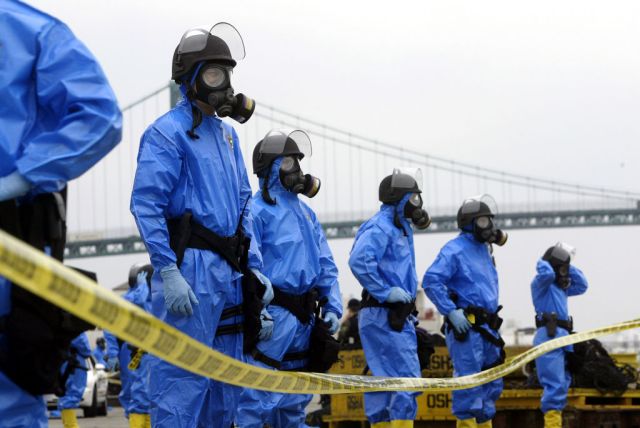
Technology is bringing deadlier pathogens within reach. (David McNew/Getty Images)





Vaccines are our best defense against infectious disease, saving millions of lives each year. We desperately need better therapies, faster. But that does not make them a panacea, especially against weaponized pathogens. And weaponized pathogens are not hypothetical.
The Soviet Union, for instance, ran a top-secret bioweapons program for decades. Tens of thousands of researchers sought to enhance many different pathogens. They even developed a weaponized strain of the smallpox virus, accepting the likelihood that use in war would also impact the Soviet population.
A subsequent smallpox outbreak in Aralsk in 1971 triggered an emergency lockdown and vaccination campaign, and was only later linked to an aerosolized smallpox test on an island in the Aral Sea. The Soviets signed the Biological Weapons Convention the following year, but maintained its bioweapons program nevertheless. The smallpox outbreak was concealed for decades. Defectors alleged that the same program sought to engineer bacteria such as plague to resist antibiotics.
Last week, Russia reportedly quarantined hospitals, dispatched FSB security agents, and deployed personnel in protective suits following the death of a single researcher studying plague at a weapons-lineage Irkutsk laboratory. Given the lab’s protocols and DNA sequencing capabilities available, I would expect Russian authorities to have identified the responsible pathogen, but they have yet to publicly share any relevant information.
Since Russian plague researchers are routinely vaccinated and would normally be treated with antibiotics following an accident, a researcher dying from natural plague would be extremely unusual. The authorities’ stringent quarantine response, which has continued after they claimed the death was due to a “pneumonia of unknown etiology” rather than natural plague, implies they believe there is a substantial risk of an outbreak of something else.
This means we are dealing with either inaccurate reporting, major safety failures, an engineered vaccine-evading and pan-resistant plague strain, or a different pathogen entirely. In other words, there is a nontrivial chance that the responsible pathogen might be an engineered biological agent more transmissible than the moderately contagious pneumonic plague.
What does this mean for the rest of us? Could Western defenses withstand an engineered pandemic agent? Judging from recent meetings of the National Academies, much of the medical and political establishment appears to believe that better vaccines and therapeutics can protect us from engineered pandemics. Unfortunately, defenses that typically work against blind evolution will fail miserably against a competent attacker who can see and design around them.
I specialize in biotechnology and ecological engineering: the creation of genes and organisms that can persist or even spread on their own in the wild. I’m keenly aware of the dangers of uncontrolled exponential growth. For this reason, when I invented CRISPR-based gene drive, a way for a single researcher to engineer entire wild populations, I withheld the technology until I could be confident that it favored defense: gene drive is slow, conspicuous, and capable of countering itself. Pandemics need not be slow or conspicuous: they can spread fast like SARS-CoV-2, or stealthily like HIV. A good guy with a pandemic cannot counter a bad guy with a pandemic.
Imagine that Covid-19 had killed 80% of those infected. Nations would have collapsed long before we had enough vaccines. While many countries now aim to approve new vaccines within 100 days of spotting a novel disease, and the United States hopes to manufacture enough doses for every resident within 130 days, that won’t be enough. To understand why biomedicine will reliably fail against deliberate pandemics, consider a game of darts.
Picture a pub with a back wall covered in dartboards. Imagine that damage to any board corresponds to human casualties, and there are many boards — one for every type of pathogen capable of spreading efficiently in humans. The player represents evolution by natural selection: blind, amoral, and possessed of near-infinite darts — pathogens — but primarily limited to repeating strikes on or near targets it has already hit.
Covid-19, regardless of its origin, was caused by a stray dart unexpectedly striking a new region of the coronavirus board. Evolution followed by tossing a flurry of darts nearby: first at the same location, representing the ancestral virus spreading across the world, then expanding outwards incrementally with variants — Alpha, Beta, Delta, Omicron, and so on. As infections accumulated, acquired immunity built up padding around points of impact, reducing the damage from subsequent darts that landed nearby. The Covid vaccines added padding, but had to be constantly updated as the variants moved further away.
Our vaccine strategy only works because evolution is blind. It generates enormous numbers of constantly mutating darts, but it has no idea how far away it needs to launch them to avoid the padding. This is why vaccination can keep pace against natural threats. Even a rapidly mutating virus — a series of darts moving steadily away from the initial strike — takes months or years to approach the edge of the padding.
But an intelligent player, sighted, will immediately throw darts outside the padded regions. In our metaphor, a dart’s mutations determine whether it is functional enough to strike the board, and whether it is sufficiently different from earlier darts to land outside of any padding. The most important reason we haven’t yet seen any deliberate pandemics is the lack of known, functional, accessible darts. Even some historically successful darts like the 1918 influenza virus, called the “mother of all pandemics”, would be unlikely to spread today due to population immunity triggered by modern descendant strains. Still, we should not mistake “isn’t widely known” for “doesn’t exist.” And AI is learning.
Earlier this year, a lab seeking new ways to eliminate antibiotic-resistant bacteria trained an AI model on thousands of genomes of harmless bacteria-infecting viruses called phages, carefully excluding all human-infecting viruses. Sixteen of 300 AI-redesigned darts struck the target: they could infect and kill bacteria. Imagine if the experiment were repeated using a future model trained on human-infecting viruses. Even if almost every design were to fail, it’s easier for a skilled researcher to make a “library” of a thousand distinct pathogen variants in parallel than to make 10 individual variants.
The core lesson of evolutionary engineering is that there’s no need to know which design will work. Make them all, and let evolution sort it out. Worse, some well-intentioned researchers have built and shared preliminary AI models intended to predict which combinations of mutations in an existing dart would hit the board in an unprotected region; their results have been published in the most prestigious journals. In a world where nature is the only enemy, that’s a great plan: we could improve vaccine designs to absorb more of nature’s subsequent strikes. But it’s a terrible idea if anyone is malicious. While current models probably aren’t accurate enough, sufficiently improved versions would allow a single skilled individual to generate libraries of immune-escaping variants of many human viruses — including those that have been safely controlled by vaccines for decades.
We might prefer to believe that we live in a world where no one would do such a thing. The evidence suggests otherwise. A key question is whether there is a limited number of possible immune-escaping variants. The answer appears to be no: biological sequence space is unimaginably vast, and experiments have demonstrated that very different sequences can encode the same function. That means there are extraordinarily many different ways to redesign the surface of a pathogen so that it can escape immunity and still cause a pandemic by hitting the board in an undefended location. Most are never explored by evolution, which relies on small mutations, and therefore tends to proceed in steps rather than via huge leaps.
Now combine near-limitless variants with evolutionary engineering. A skilled attacker with a sufficiently predictive AI model — better than any that exists today, but likely to be trained within a few years — could synthesize and throw immune-evasive functional darts faster than we could possibly add padding with vaccines. A reactive vaccine strategy is nearly useless against anyone capable of continually releasing new pandemics.
But escaping immunity is only part of the danger, for not all darts are created equal. Evolution optimizes for replication rather than harm, yet even it occasionally throws something devastating by accident. The myxoma virus killed over 90% of initially infected rabbits and crashed their populations across multiple continents. Still, it was not designed to cause as much harm as possible.
An intelligent enemy intent on destruction would make the darts explosive. Suppose one were to take a hollow dart and fill it with an explosive that detonates upon impact. If it strikes, the explosion will cause far more damage than any natural dart.
In my professional judgment, there are many potential explosives available. No such explosive is publicly known to work with any particular dart, and establishing which combinations are effective would pose a grave security risk: once scientists identified a compatible pairing, the resulting weapon would become just as accessible to skilled individuals as the dart alone.
We can try to prevent misuse by controlling access to anything that could plausibly be turned into a functioning dart, including relatively harmless respiratory pathogens that could be re-surfaced by AI. This wouldn’t stop Russia, but it could seriously impede extremists. Yet most gene synthesis firms, which manufacture bespoke DNA molecules for their customers, do not employ effective screening. My laboratory recently showed that it is possible to legally purchase all of the DNA pieces required to recreate the 1918 pandemic influenza virus, even though it is a “select agent” supposedly under lock and key. Such pieces can now be assembled by anyone with common laboratory skills.
Software tools capable of detecting attempts to acquire the relevant DNA are freely available, but their use is not legally required in any nation. While some laws have been drafted, they don’t specify that screening must be able to detect AI-assisted acquisition using modern DNA assembly techniques. Until that changes, we won’t be able to control access to the biological materials — the hollow darts and explosives — necessary to create pandemic weapons.
Absent physical controls, our primary defense is ignorance: we lack publicly credible examples of hollow pandemic-capable darts, let alone explosives to fill them. But I doubt that we scientists will be able to restrain ourselves from investigating alleged hollow darts and explosives and openly publishing our findings. Most of us still assume that all knowledge is worth having and best shared freely.
The moment someone publicly identifies a compatible dart and explosive, all those thousands of people with the relevant laboratory skills would likely be able to build a pandemic weapon. Add an AI capable of generating immune-escaping functional variants, and an attacker could produce an arsenal of explosive darts. Even if vaccines could somehow both withstand the detonation and be made much faster than they are today, we would have to keep designing, manufacturing, and distributing new ones as the attacker changed the target area.
I am deeply alarmed by this trajectory. But I’m also exceedingly biased. I specialize in playing nature’s replication game in unorthodox ways. I’ve evolved molecular tools by harnessing viruses that infect bacteria, invented methods of editing animal populations, and performed the early research into the invasive potential of mirror-image bacteria. I’ve also worked in security, building and testing DNA-synthesis screening systems and “red-teaming” AI models to see how readily they can be used to cause harm. To me, competently designed weapons appear considerably more obvious and easier to build than they actually are.
But difficulty and obscurity are not reliable defenses. Good security practice assumes that the adversary is more cunning than you, possesses capabilities you have never imagined, and knows of every defense you’ve prepared. They can choose when and where to strike. Given a sufficiently powerful weapon, they need only succeed once. And AI is democratizing competence.
None of which guarantees catastrophe. What I see as obvious and imminent could take many years, and very few people want to cause widespread destruction. But even a small annual probability adds up. We must prepare, then, for someone to accidentally or deliberately release a competently designed pandemic weapon. If that day comes, it would be profoundly unwise to rely on biomedicine alone.
As a life scientist, it’s painful to admit that my field cannot solve the problem of deliberate pandemics. We can’t rely on developing and distributing a new vaccine or treatment after each attack. Instead, we should avoid becoming infected in the first place.
Stockpiled protective equipment can filter out viruses and bacteria before they’re inhaled; and they can be killed mid-air by far-UV light (radiation that kills pathogens without harming human tissue) and glycol vapors (a gaseous, odorless component of stage fog). These technologies can suppress airborne pathogens without first needing to recognize them. But they’re neglected by a biomedical establishment intent on fighting the last war.
The solution is to stop installing germicidal defenses in buildings to fight every kind of respiratory disease. Evolution throws millions of darts each day, causing widespread misery, lost economic productivity, and thousands of deaths. We don’t need to sit here and take it. The more spaces equipped with germicidal defenses to block routine infections and seasonal flu, the fewer our sick days and the lower our medical bills. If recent history and the developing situation in Irkutsk are insufficient to spur action, the ongoing toll of infections and resulting chronic diseases should be reason enough to act.
Safeguarding civilization begins with fighting the common cold. Let’s screen off the dartboards with germicidal curtains as fast as we can — before an intelligent enemy throws an explosive dart.