




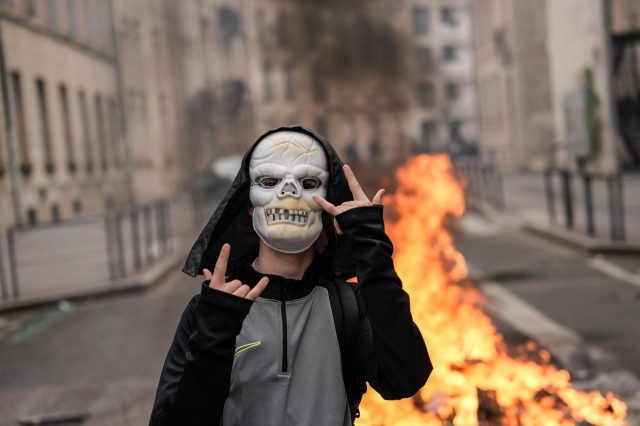
"Bof" (Muhammed Said Tako/Getty)





If, like me, you studied French at a Scottish comprehensive in the Eighties, you will have heard of Créteil. It’s the Parisian suburb where a gormless fictional schoolboy called Thierry Garnier used to wander about, saying “qu’est-ce que c’est?” and “où est l’hôtel de ville?” and — most hilariously to our juvenile minds — “Bof!”. Today, Thierry would probably be out on the barricades; for the protests now gripping France began with a blockade in downbeat Créteil. “We’re not asking for the moon, we’re just asking for a functioning school,” one pupil told the local press last month.
I wasn’t surprised when I heard about the location: first, because national school protest waves always seem to start off in the Parisian suburbs, and second, because in the Nineties, I spent a year as a language assistant at a lycée nearby. Marcelin Berthelot in Saint-Maur-des-Fossés was, and still is, a feeder institution for the top universities, known collectively as the “grands écoles”. The high-achieving students there were extremely diligent, reserved, and polite, except during a countrywide protest in the Spring term, when they suddenly started running up and down the corridors breaking classroom windows. Footage from earlier this month shows armed police trying to deal with teens amassing in front of my old workplace. Plus ça change and all that.
Further back in 1990, as a teen myself on a gap year, I was supposed to be attending a Strasbourg lyćee during another massive national round of demonstrations; though the fact I can’t remember it is probably due to the fact I spent most of my time bunking off, wandering around the city center, smoking and shivering and attempting to look like Betty Blue. (For some reason I also can’t recall, I didn’t have a coat.) By then, sometimes violent protests of lycéens had been a feature of the French landscape for at least 20 years, and university demonstrations for longer than that. The latter feature in Flaubert’s Sentimental Education, set in 1848, where the hero Frederic asks a stranger why groups of students are facing off with policemen: “I haven’t the least idea,” replied the other, “nor have they, for that matter! ‘Tis their fashion just now! What a good joke!”
So despite Trump’s latest in-depth analysis, there is a lot more happening here than another simple tale of mass migration gone wrong. A quarter of public schools are now involved, and — though French law strictly forbids data collection on race or ethnicity — press footage of the crowds show white faces very much to the fore. In truth, a familiar script is being rehearsed, albeit with a somewhat more diverse and volatile cast than in former productions. And certain narrative elements remain indispensable.
First, you need an impeccably conscientious pretext, as if some swotty committee were running protest HQ — which in some sense they are, since French lycées are unionized. This year, the justification for direct action is a lack of teachers and crumbling facilities; in 1990, it was a lack of adequate security and resources; in 1998, it was overcrowded classrooms; and in 2005, it was proposed reforms to the baccalauréat exam. One tries to imagine British school kids self-organizing over such worthy matters, as opposed to joining riots initiated by others. One fails.
Next, you need resistance to spread, something that happens a lot faster now with the help of the smartphone. You also need a classically over-the-top police response early on, preferably involving riot shields, tear gas, pepper spray, and water cannon, so that the kids can more easily imagine themselves as heroes and keep going. Turmoil must ripple outwards through already tense banlieues and Northern cities, where immigration and deprivation are high and police skirmishes common. The ensuing aggression by opportunistic casseurs will introduce a note of extremity and chaos, nicely furnishing Right-wing headlines, which will in turn be recycled as galvanizing proof you are on the spiritually correct track.
As media attention arrives, some rich white boys from fancy lycées will become confident spokesmen for the movement, hoovering up attention while talking grandly of equality and fraternity with minorities. And, as with the avuncular presence of Jean-Luc Mélenchon — the leader of socialist party France Unbowed — there must be old socialists and communists hovering around for the photo ops, praying that working-class revolt will soon be sparked. During the fabled student protests of May 1968, still glorified by ancient hippies today, what started as university sit-ins culminated in 10 million workers walking out on strike, and an attempt to set the Paris Stock Exchange on fire.
Naturally, along with these hackneyed elements, there is also some youthful sincerity and idealism. French student movements often begin with a genuine grievance, for the state is massive, sclerotic, and haughtily self-satisfied, often resulting in frustrating indifference to young people’s interests. In 1968, universities were overcrowded, impersonal, dilapidated places, and the original uprising at Nanterre made reasonable demands. In 2026, the young people also have a point: demoralized teachers are leaving the public school system in droves; classes are overcrowded; 56% of schools were built before 1970, and many are now unfit for purpose. A senate report from before the crisis estimated that renovating them adequately would require 1.5 billion euros every year til 2050. Of course, thanks to recent arson and vandalism, the bill will now be a lot bigger, but adolescent minds lost in anarchic ecstasy are unlikely to join the dots.
Conscious reasoning aside, there are deeper currents too. As an interested Francophone, over the years I have mused about what makes les Français so prone to radical acts. Along with a lot of others, I’ve concluded that the national tendency to sentimentality has something to do with it. As Edmund Burke told France, the nation has been “long misled” by “high and romantic sentiments”; and many others have pointed out the connection between revolutionary carnage and the romantic rejection of austere Enlightenment ideals. In the run up to the blood-soaked 1790s, Diderot was calling for a tear-soaked theater, with plays that would liberate tender feelings after years of repressed neoclassical fare. Greuze was painting queasy pictures of little girls mourning dead birds. Rousseau was emoting all over the page and urging others to do likewise. Love was supposed to undo oppressive social hierarchies; self-love, romantic love, love for one’s fellow man. Shortly afterwards, the impossible imperative to lovingly embrace millions of unknown fellow citizens would produce quite a lot of hatred in practice. Who knew?
But even after all that, the appeal of transforming sentiment into something immensely lofty lingered. It is still there in all of those twinkly eyed French films featuring unlikely romantic couplings from across the tracks; or the ones that present emotionally unhinged women as romantic leads (like that frankly bonkers arsonist Betty Blue, in fact). It’s also evident in the camp delivery of French television presenters, always chasing “des petit moments d’émotion” for their audiences, and sometimes even crying uncontrollably on screen. And it is also present in the inherited mythology of school protests, as generation after generation pretend to themselves that sowing some civic chaos is an expression of solidarity and love.
The kids presumably have read their history; even May 1968 was mostly over by June. They know they are unlikely to gain much power collectively, though a few will become media personalities. There is no long-term plan of engagement here, nor genuinely revolutionary intent. They are mostly doing an enjoyable reenactment of the country’s greatest hits, but with the safety catch firmly on. Though there have been some horrible incidents — a hand blown off and a jaw fractured by police — with the sheer numbers of people involved, personal chances of self-destruction are slim.
Thankfully, although there are plenty of protests in the UK, they are not a crucial part of our national mythology. Equally, despite its uptight reputation, British culture still lacks the precise formality and impersonality of the French version, to which all that sentimental excitability seems to be a reaction. Even now, there are lots of unspoken rules: you must say “Bonjour” or “Bonsoir” when you enter a place; you must not use “tu” for the wrong people; you must not eat on public transport; you should not hug strangers but only kiss them (a norm which to awkward English people seems completely the wrong way round). As a clueless 20-something in Saint-Maur, I once phoned up the local council about an administrative matter, and made the mistake of asking for a particular person without prefixing her name with Madame. Three decades later, I can still hear the stinging rebuke.
So I suspect that in France, protest stands to mannered formality as adultery stands to marriage: both are time-honored ways of letting off some steam. Had the country rarely seen mass direct action from the young like this, it would be a lot more shocking; but actually, it is almost touching in its conservative recreation of the past.
Sooner or later, politicians will promise a tiny bit more money for school improvement; the disorder will peter out, and kids will troop back to class. The taxpayer will foot the bill for cleaning up, and immigrants will do most of the work. Rich boys from nice parts of Paris will move on to grands écoles like their parents before them; and, like their parents before them, they will now have a war story to tell. Deprived suburbs will revert to being places where violence against authorities doesn’t get a particularly noble framing. As Thierry Garnier might have said with a Gallic shrug: bof.
