




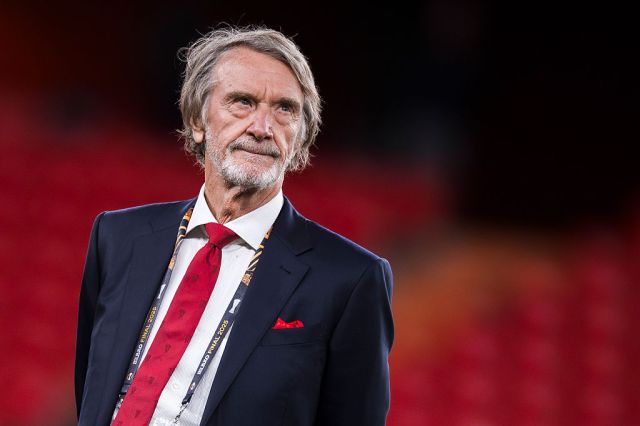
“The chemicals magnate Jim Ratcliffe.” (Nicolò Campo/LightRocket/Getty)





In 2019 the businessman James Dyson, famed for his bagless vacuum cleaners, found himself at the center of a different kind of cyclone. He was facing a storm of criticism for moving his company’s headquarters to Singapore, soon after a Brexit referendum in which he had argued that leaving the EU would boost British enterprise and trade. The Daily Mirror accused him of hypocrisy; he was so insulted that he fought an unsuccessful libel suit against the newspaper.
The controversy raised salient questions about the role of footloose billionaires in British politics. Must they meet some benchmark of commitment to the country before we consider their views? Or is their willingness to leave further evidence that we are not paying enough attention to the needs of business?
Over the past year, Britain has witnessed a succession of wealthy businessmen fuming at the mismanagement of the country and dabbling in politics, often from a position of opulent exile. The chemicals magnate Jim Ratcliffe, another prominent Brexit supporter who moved his tax residency to Monaco in 2020, has not been shy about criticizing his home country. Last month, Ratcliffe declared that Britain was “on the slide”. At one time, he recalled, “we had the greatest empire in the world, we were a great people. We won two world wars.” Today, by contrast, Britain suffers from high taxes, a “green eye towards wealth”, and a failure to control immigration and welfare spending. Above all, Ratcliffe has complained about “ridiculously high” energy prices, which have recently led his company, INEOS, to mothball three chemicals plants in Hull.
These comments provoked a response from the wealth manager Peter Hargreaves, also a Brexit-backer, who started his company from a bedroom in the Eighties. Hargreaves quipped that Britain “isn’t on a slide, it’s slid… This country is never, ever coming back, it’s finished.”
Meanwhile, it was recently reported that David Reuben, the real estate tycoon who, together with his brother Simon, possesses Britain’s second largest family fortune, relocated to Monaco over the summer. The brothers tend not to comment on politics, but they donated £100,000 to Reform UK this year, having previously given just shy of £1 million to the Tories. This story has since been called into doubt, with evidence that David has already been resident in Monaco for over a decade, but there has been no shortage of super-rich individuals leaving Britain in recent years. Analysis of the Bloomberg Billionaires Index suggests that more than half of the country’s billionaire wealth has moved away since Labour took power in 2024. Hedge fund manager Christopher Rokos, steel magnate Lakshmi Mittal and shipping tycoon John Fredriksen have all left recently.
It is naturally somewhat embarrassing for the government that successful businessmen are leaving the country like rats fleeing a sinking ship, in some instances taking hundreds of millions of pounds of annual tax revenues with them. Yes, Britain’s prosperity and public finances depend far more on raising economic productivity than on wealthy individuals, but insofar as a dim view of Britain’s prospects makes such individuals less likely to invest here, the two are not unrelated. Yet the problem of unhappy capitalists is surely priced-in by a Left-wing government, which can to some extent turn it to their own advantage. Look at these self-interested billionaires, they can say (making sure to utter the word billionaire with a sneer), they would rather abandon us than pay their share.
By the same token, since many of these truculent expats are either Brexit supporters or Reform and Conservative donors, their interventions pose a problem for the Right. For parties promising to put British people first, it is awkward to be receiving financial and rhetorical support from ultra-wealthy individuals whose commitment to the country often does not extend to actually living here. This reinforces what Janan Ganesh has called a “patriotism problem” on the Right: figures like Nigel Farage claim to love Britain, but have almost nothing positive to say about the country as it actually exists. Then again, that stance is what endears Reform to the section of the electorate that thinks the country is fundamentally broken. For those voters, the fact that billionaires share the same analysis may matter more than their tax residency does. Their decision to leave the country is, after all, a powerful confirmation of the narrative.
A greater contradiction lies in Reform’s attitude to the wealthy in general. Farage, whose career began as a commodities trader in the midst of the Thatcher revolution, speaks proudly about his ability to earn money, and to attract it. His party has received tens of millions of pounds — the largest political donations in British history — from another pair of expat billionaires, the cryptocurrency magnates Ben Delo (until recently a Hong Kong resident) and Christopher Harborne (who has acquired Thai citizenship). Both have now returned to Britain after Labour attempted to block their contributions. Over the summer, Farage defended his monied backers as “men who’ve gone off around the world as entrepreneurs and succeeded — the sort of people we used to admire over centuries”. Yet his party appeals to struggling blue-collar workers and lower middle-class sole traders and small business owners, many of whom feel the deck has been stacked against them and in favor of the rich. Last week, Robert Jenrick criticized the Conservatives’ proposed inheritance tax reforms as “offering handouts to multi-millionaires”.
Wealth, however, may not be as important as we might assume. Dyson is an intriguing figure in this context because he has long argued that Britain’s problems are tied to the character of its elites, who esteem knowledge work and cultural literacy above the hands-on business of technology, invention, entrepreneurship and trade. In 2004, he even stormed out of his post as chairman of London’s Design Museum, complaining that it had become a “style showcase” chasing visitor numbers with frivolous exhibitions about flower-arranging and designer shoes, rather than a place to promote serious engineering.
In many Western countries, there is now a prominent dividing line between, broadly, managerial cultures and entrepreneurial ones. The former are those employees in institutional settings — corporations, the public sector, NGOs, and what Dyson calls an “Oxford-Westminster bubble” — who value credentials, are fond of rules, and assume that the world is shaped by ideas and narratives. By contrast, those of an entrepreneurial persuasion are interested in the material facts of how things actually work, while chafing against rules and prizing innovation and individual ambition.
Consider the coalition that voted for Donald Trump in 2024. It included people who work in traditional industries involving cars, machinery or oil and gas, as well as those who do business outside of corporate structures, such as family-owned enterprises and venture capitalists. These groups were united in their resentment of a professional managerial class, stereotypically inhabiting a world of yoga studios and DEI policies, which stifled them with regulations and liberal mores.
The revolt of Britain’s entrepreneurs indicates that a similar tension has emerged here. Terms of opprobrium such as “lanyard class” and “the Blob” try to capture a middle-class, managerial ethos that now runs through the country’s institutions like a stick of rock. Its priority is not how the economic and material underpinnings of modern life operate, but ensuring that they conform to the appropriate standards mandated by equalities law, environmental regulations and progressive cultural etiquette. There is an utter disconnect between this worldview and, for instance, the cowboy capitalism of post-Soviet Russia where the Reuben brothers originally made their fortune trading aluminum, or INEOS factories producing nasty chemicals and spewing out carbon emissions, or disruptive and potentially dodgy technologies such as cryptocurrency.
The important thing to note about this conflict is that, while it is primarily expressed as a fissure within Britain’s elites, it is fundamentally a question of attitudes and social environment, and can therefore provide the basis of a much wider division. Less privileged staff at managerial institutions are likely to absorb the dominant assumptions of those settings, while people of widely differing means and backgrounds can identify with a message of self-reliance, ambition and scorn for meddling bureaucrats. Seen in these terms, there is a political logic in Reform courting crypto-billionaires, fossil fuel-reliant industries and broader swathes of voters who sympathize with an anti-establishment sentiment. Likewise, there is a logic in parties of the Left treating these things as threats to be resisted.
The fundamental problem for the Right is that, 10 years on from Brexit, it is no closer to a viable program for the dynamic, free-trading Britain envisioned by its entrepreneurial supporters. That would mean lowering taxes on business and wealth — paid for by welfare cuts — and deregulating everything from planning laws to wages and the financial sector. It would mean, moreover, explaining to the public that they must struggle for survival in a highly competitive global economy, something which only Liz Truss has attempted in recent years, and she only succeeded in making the idea less palatable. British politics has become increasingly insular in recent years, focused on domestic stability and reluctant to compromise with a wider world that appears to be largely a source of insecurity and danger. This suits the Right when it comes to territorial and legal sovereignty, with both the Tories and Reform converging on a platform of tighter borders, withdrawing from international treaties and curbing multiculturalism at home. Yet neither party has found a way to reconcile its business-friendly instincts with a public that still desires a protective state.
Kemi Badenoch’s new Conservative manifesto, The Right Way, is at least somewhat forthright in its diagnosis, emphasizing the need for Britain to be “competitive” in the conditions it offers to businesses. Yet details are notably scarce when it comes to the goal of reducing strategic dependency on China, a rather large and complex caveat to the statement that “free trade should be the presumption”. More importantly, this return to the Conservatives’ free-market, small-state default, greeted with a profound sigh of relief from what remains of the party faithful, is essentially a concession of electoral defeat. It marks the end of Tory efforts to compete against Labour and Reform in working-class, post-industrial regions.
But nor has Reform reckoned with the degree of state subsidy that rebuilding British industry in these areas will actually require, or how this can be squared with Farage’s belief that, vis-à-vis Brexit, “we have not taken advantage of the opportunities to deregulate and become more competitive”. The answer, we are told time and again, is that scrapping Net Zero taxes and cutting wasteful government spending will boost industry and the exchequer alike, yet this simple solution belies the complexity of the problem. Even if an anti-establishment coalition spanning billionaires and tradesmen can work electorally, it will soon come under pressure from the conflicting interests and power disparities within it. The prodigious sums donated by Delo and Harborne suggest that a Reform government would likely follow a similar course to the second Trump presidency, beginning with ineffectual support for blue-collar workers before swerving into the warm embrace of global tech capital.
Strangely, it is Andy Burnham’s Labour Party that looks best placed to capitalize on Britain’s siege mentality. The party’s identification with multiculturalism, and its instinctive support for immigration, has left the residual impression that it is an outward-looking political force. In fact, Labour now trumpets its pride in a diverse Britain while viewing the wider world with a mixture of suspicion and apathy. Burnham is the most domestically-focused prime minister in recent memory. Though his desire to invest in the country’s economic foundations is welcome, his big-state program offers no meaningful role for business or entrepreneurship. Labour has many antagonists — Donald Trump, American tech oligarchs, Russia, Israel — but few real friends. Rejoining the EU is increasingly the limit of its global imagination, and insofar as that vision does not account for the bloc’s own serious economic and political difficulties, it is an imagined one.
The irony is that Burnham’s comforting insularity is only possible thanks to the degree to which globalization is already part of the grain of British society. This is a country that can afford an expensive commitment to national decarbonization, driving away industrialists like Ratcliffe, because it has resigned itself to dependency on China’s coal-powered factories. It can fund its social expenditures because the markets, even if they charge an ever-greater premium, continue to buy its debt. And it can produce a leader like Burnham because, as the recent scandal at Manchester City FC has reminded us, his municipal fiefdom was regenerated with oil and gas money from Abu Dhabi.
Clearly, this strange settlement cannot go on forever. The chancellor is preparing for a budget in two weeks where neither borrowing nor taxes can sustainably go much higher, while the need to control runaway welfare spending and ease pressure on businesses is becoming pressing even from a soft-Left perspective. It has been easy to ignore billionaires lamenting Britain’s lack of competitive drive when relying on others has been so easy. That may not be much longer.
Wessie du Toit writes about culture, design and ideas. His Substack is The Pathos of Things.
 wessiedutoit