




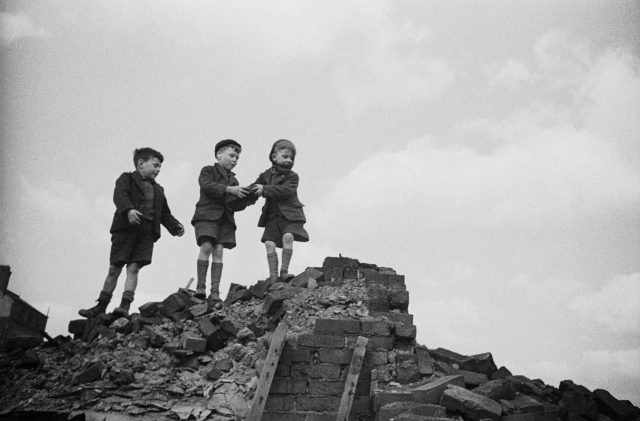
In the postwar period, children used to play on bombsites. (Charles Hewitt/Getty)





I have a recurring fantasy. It’s 3:45pm and I’ve just got back from school pick-up. The kids swap their school shoes for sneakers and run out the front door to join their friends in the street. I hang on to the doorframe while I shout: “Be back in time for dinner!”
Maybe they’d head out on their bikes, maybe they’d take a soccer ball, maybe they’d find a stone that became a gem that became a pet and have the kind of free-ranging adventures that I had when I was growing up. There would be injuries, definitely, and at least a couple of arguments. But still, I fantasize, as I intercept a row between my own kids over Netflix, they would be playing, without me having to organize or pay for it.
Iona Opie, the folklorist who spent decades closely observing British children at play, wrote that the peaks of a child’s experience were not trips to the cinema or even family outings to the seaside, but moments when they escaped “into places that are disused and overgrown and silent”. For Opie, the important word here is escaped. Children’s play was something that happened beyond the adult gaze: in streets, wastelands, playgrounds and patches of ground whose very lack of purpose made them attractive.
Yet we have spent decades making it increasingly difficult for kids to exercise this basic autonomy — and meanwhile wonder why rates of anxiety and depression have soared along with obesity rates; why so many children seem unable to sit still in class; why medication is being prescribed at record-breaking levels. Of course, play alone won’t solve the ADHD crisis or halt childhood obesity. But providing children with more time and space to play might at the very least help.
According to a survey by Save the Children, only 27% of kids now regularly play outside their homes, compared to 80% of children in the recent past. England’s first and only National Play Strategy was launched by the last Labour government in 2008 — an Andy Burnham initiative, backed by £235 million of investment. It was scrapped under George Osborne’s austerity program in 2010, and there has been no national play strategy since.
The right of a child to have a patch of grass on which to kick a ball — let alone a swing or a basketball hoop — might seem like a luxury, particularly when set against more measurable areas of childhood. Yet alongside gains in academic scores, a recent University of Exeter study found that those who played outdoors more frequently between the ages of two and four were less likely to have emotional and behavioral difficulties through age eight. This is not evidence that a lack of outdoor play causes anxiety. But it is a useful reminder of how strange our priorities have become, increasingly concerned with the measurable problems of childhood — but not the things that make childhood childhood.
Screens are another big barrier to play. In British Summertime Begins, her oral history of British childhood, the writer Ysenda Maxtone-Graham dates the “end” of the free-range childhoods she and her contemporaries enjoyed to 1980, when TV and then video games took hold of children’s attention. These now seem like quaint concerns compared to smartphones and tablets. As Ofcom found, children between the ages of eight and 14 spend an average of three hours a day online.
There is another, more practical, obstacle to children playing outside: traffic. In 2025, 2,432 under-16s were killed or seriously injured on Britain’s roads. It is true that child road deaths have fallen dramatically: in 1986, 450 children were killed; in 2025, that figure was 45. But there is another way of reading this success. Between 1971 and 1990, the proportion of seven- and eight-year-olds allowed to get to school without an adult fell from 80% to just 9%. In other words, roads became safer partly because children were no longer on them.
All this is shadowed by a broader change in the basic culture of play. According to that Save the Children survey, one-in-four children had been told to stop playing outside by an adult, while 30% had been told to stop making noise while they did so. No less striking, campaigners recently found 7,000 “no ball games” signs in public spaces across London; there’s one of them on the grassy patch next to my neighborhood’s sole playground.
The gradual enclosure of childhood is taking place within schools too. Key Stage One children, aged between five and seven, have on average 23 minutes less per day than they did in 1995. It’s also not unusual for children from the very youngest to have their lunchtimes curtailed further for “intervention”. A euphemism for “work”, this is often mandated because a child has been identified as needing help keeping up with some benchmark or other. At some schools, playtimes are shorter for crowd-control purposes: individual classes go out at staggered points during the afternoon, so that they have more room to play.
Space has been at a premium since Margaret Thatcher’s government permitted local authorities to sell off school grounds — 10,000 playing fields were lost between 1979-97. Tony Blair’s Labour government vowed to stop this, but, by 2008, a further 187 had been sold. The Conservatives then removed regulations that stipulated that schools with 600 pupils had to have 35,000 square meters of playing fields. There are now no statutory guidelines for school playgrounds.
Play by its nature should be egalitarian — but it’s working-class children who often miss out the most. Wealthier kids are more likely to have private gardens; more likely to live in the leafiest areas; more likely to have parents with the money to pay for add-ons and the capacity to act as a taxi service. In the summer term of the last academic year, I found myself paying for nine extracurricular clubs. How, I wondered, had I reached this level of expenditure and insanity? In part, because I live in North London, so the booming extracurricular market has convinced me that I can give my child a more enriching life, if only I pay a bit here and there.
But actually, I just want them to have something to do. To have exercise, yes, to get away from the screens too — yet also to have something that challenges them and shows them their capabilities in a way that math or phonics can’t.
But aside from the obvious unfairness of turning play into a middle-class luxury, is it even a substitute for what we might call free play? No, says Peter Gray, a research professor of psychology and neuroscience at Boston College, who has spent decades studying the evolutionary importance of play and self-directed learning. “It should be no surprise that natural selection endowed our children with an incredibly powerful drive to play with other children,” he tells me. For Gray, the crucial quality of play is that it is self-chosen: children decide what to play, how to play it, and when to stop. As Gray puts it: “That’s where the enjoyment of play comes from.” There is only so much of this that adults can engineer.
Children also need periods beyond direct adult supervision, Gray argues, in which they learn that they can manage their own lives; without it, it’s hard to develop what psychologists call an “internal locus of control” — the sense that “I can manage things. I can control my own life.” Children need opportunities to discover that they are capable of making decisions, resolving conflicts and dealing with the world without an adult standing behind them.
One Reception teacher I speak to agrees. “You can teach a child about emotions,” says Lydia Lopez, “but it’s a very abstract concept until they’ve gone through it and understood how to deal with it themselves.” The best way to do that, she adds, “is through interacting with other children, through play.” Lopez says the play-based approach was highly valued by the early years team at her school: but they had to fight for it. The marketization of the childcare and education landscape means that a school’s optics — how it looks — can take priority over how it serves its pupils. In this case, the headteacher was worried that when prospective parents toured the school, it may not be immediately obvious to them that the youngest pupils were learning anything.
Given Andy Burnham was a driving force behind the only play strategy any British government has ever attempted, Play England wrote him an open letter when he became Prime Minister, asking him to finish what he started: develop a play strategy once more; create play sufficiency legislation; and pledge £125 million a year.
There has been no official answer yet — but there have been other inroads. For instance, the National Planning Policy Framework now protects both formal and informal play spaces. Parliament debated whether to make play a statutory part of the Key Stage One curriculum. There has been no official follow up, but murmurings seem positive.
The point is not that children need to be sent back to some imagined golden age. The streets of the Seventies were dangerous; schools cannot simply ignore safeguarding; and parents have good reasons to worry about what happens when they let their children out of their sight. Nor is play a magic cure for anxiety, obesity or ADHD. But there ought to be some part of childhood that is not being optimized, assessed, supervised or sold back to us as enrichment. All they need is some time, some space and a few friends.