




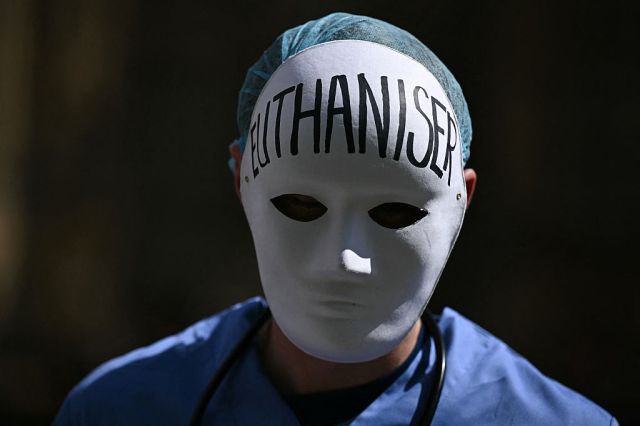
“Very young children can now be euthanized.” (Ben Stansall/AFP/Getty)





Last month, the Netherlands pushed its euthanasia rules just a little further, with the Public Prosecution Service announcing that it won’t prosecute a doctor who last year ended the life of a toddler. The child was born prematurely, and had brain damage and epilepsy. They could barely see, and suffered through coughing fits and a swallowing disorder, leaving them constantly short of breath. Certainly, this child couldn’t consent to their life being ended — yet that no longer matters. As a 2024 rule makes clear, very young children can now be euthanized, as long as their parents are consulted and the child’s suffering is sufficiently severe.
This is just the latest shift in a bewildering series of changes to Dutch euthanasia laws. Two years ago, a 17-year-old girl called Milou Verhoof became the first underage person in the Netherlands to be euthanized not for any physical ailment — but because of severe psychological suffering. The number of people euthanized here rose 10% in 2024, with 2025 seeing another jump.
Little wonder Dutch citizens are feeling increasingly uneasy about their country’s ethical frontiers. While there is broad support for euthanasia generally, a study from July 2026 shows that figure falls to about half when discussing very young children. It’s a similar story when it comes to that other progressive nostrum: transgender policy. As a poll from August found, two-thirds of citizens think the Netherlands is too radical in giving hormone treatments to children who doubt their gender.
It all suggests that Dutch hyper-liberalism is increasingly threatened. Yet if that’s an unsurprising reaction to decades of radicalism, the country’s old centrist parties thunder on as usual. Given the rising power of far-Right alternatives in The Hague and elsewhere, that cannot end well.
The Netherlands is often seen as a pioneer when it comes to freedom of thought and action. Postmodernism, which emerged in the late Sixties, found very fertile ground here — as citizens and politicians alike dismantled old truths around religion, science and even the nation state itself. Suddenly, everything seemed possible, and everyone could choose their own fate. Your identity? You decide that for yourself. Your death? Up to you.
These attitudes are typified by “15 Miljoen Mensen” (“15 Million People”), a 1996 song that revels in its liberalism. First sung by a musical duo called Fluitsma & Van Tijn, it’s since become a kind of alternative national anthem. “15 million people / On that tiny piece of earth,” proclaim the song’s lyrics. “They shouldn’t be forced into a straitjacket / Leave them alone.”
How these ideas became so popular is partly a matter of geography. Flanked by swamps and river deltas, and without many resources of its own, the Netherlands has traditionally been a trading nation. Along the way, the Dutch developed a tolerant national character: you can believe what you want, be who you want, as long as we can trade without problems. The fact the Netherlands pioneered freedom of religion in its 17th-century Golden Age is a good example of this attitude, as was the country’s studied neutrality during the First World War. At the same time, the Dutch talent for pragmatism can be attributed to our eternal struggle against the sea. We still talk about our “polder model”: originally referring to the collaboration needed to maintain the country’s dykes, but which now implies a culture of consensus-making across politics, business and the trade unions.
These deep historical trends are shadowed by more recent developments, not least the decline of so-called “pillarization” (“verzuiling”). For all their self-proclaimed tolerance, the Dutch largely self-segregated until the Second World War. Catholics only associated with Catholics, Protestants with Protestants, socialists with socialists. An individual’s whole social life — which church they attended, which newspaper they read — was organized around a single “pillar”.
After 1945, however, this pillarized society fell apart much faster than elsewhere — largely a function of lightning-fast secularization. In the early Sixties, the Dutch were still churchgoers, but a few decades later the nation was largely secularized. The transformation was hardly unique to the Netherlands, of course, but it was unusually rapid and far-reaching. In 1971, only 23% of Dutchmen were non-religious; by 2023, 48% were.
This cultural revolution might be explained by material factors. From 1945, the Netherlands experienced an enormous jump in prosperity. The new model of social welfare duly made personal development and quality of life more important. Combined with that old liberal tradition, issues like women’s emancipation and sexual emancipation became hugely important, as the Dutch wallowed in their individualistic reputation.
Postmodernism brought us abundance, choice, freedom and tolerance. These were the values that made us, as Fluitsma and van Tijn had it, “the country of a thousand opinions”. But because of that rampant secularization, the Netherlands had relatively few conservative counterforces, certainly compared with more religious countries such as Poland or Italy. This is clear enough in Dutch politics: even Christian Democratic Appeal — nominally conservative, and which dominated parliament for decades — has now embraced postmodern progressivism.
The results of all this are increasingly stark, not least in politics itself. The Dutch establishment now chases individualism in every sphere of life — in appearance, in gender, in how people choose to die. Shared values have fallen away. In their quest to promote this liberal utopia, government systems have become over-regulated and top-heavy, with new laws rushing ahead of public feeling.
A case in point is Mark Rutte, prime minister from 2010 to 2024. He was then replaced by a conservative coalition — including the New Social Contract, a party I co-led in 2025 — but across his long tenure, Rutte and his colleagues increasingly viewed ordinary people with distrust, and dismissed their concerns. If this finally explains the state-sanctioned killing of a toddler, the views of voters be damned, it’s an attitude that’s infected other policy areas too. When, for instance, 44,000 parents receiving childcare benefits were wrongly labeled as fraudsters, the establishment ignored their plight for years, with devastating consequences for families.
If the establishment is still happy with the progressive consensus, voters themselves have started hunting for new values. Or rather, they’re returning to old ones: around community, responsibility, discipline. That, in turn, is pushing increasing numbers of people away from mainstream politics. It’s telling that in recent times a number of Dutch anti-establishment parties have risen in the polls, with New Social Contract just one example.
In the end, the Right-wing cabinet we formed following Rutte’s departure did not last long. Our differences on the rule of law with the PVV, Geert Wilders’ far-Right party, ultimately proved too great. Not that the centrists, now back in power once more, seem to have learned much from their defeat. On they go with the same progressive ideas, even as we’re on the eve of a new values-driven era.
This establishment blindness is clear across politics. Despite plenty of resistance, hospitals can now terminate pregnancies up to 24 weeks. If the baby is nevertheless born alive — babies are viable at that stage — care is taken that their life ends “without suffering”. A generous transgender policy, which two-thirds of Dutch citizens are against, is nonetheless continuing unchanged, while the Senate is also considering a bill that would allow the artificial cultivation of human embryos.
If “sensible” centrist politicians keep on this path, taking no account of the values that ordinary voters are asking for, they will only add fuel to the anti-establishment fire. In our dealings with Wilders and the PVV, I saw how dangerous that could be in the long term. Nor is my country alone. Next year, elections are being held in Germany, France, Italy and Poland, among others. People across the political spectrum will rightfully worry about the rise of the far-Right. But defeating that threat will not come from simply ignoring what voters are saying — on euthanasia or anything else.