




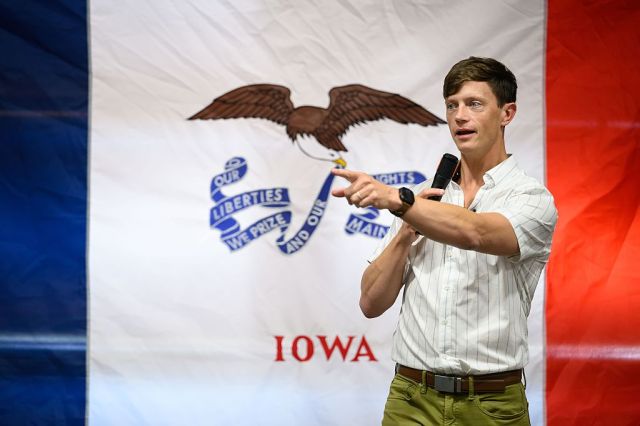
The Democrats’ gubernatorial candidate in Iowa, Rob Sand is pro-gun and anti-trans sports. Credit: Getty





In the past week, a tidal wave of bad news has crested for Republicans. Ruby-red states like Texas have shifted to “lean Democrat” on pollsters’ spreadsheets. In Iowa, Democratic prairie populists are gaining momentum. Abdul El-Sayed still leads the polls in Michigan, despite having campaigned with controversial figures like Hasan Piker. States that have trended to the Right over the last decade are now causing Republicans to bite their nails in nervous anticipation for the midterms.
Have these red- and purplish-state Democrats found the winning message not just for today, but for 2028? What are they doing right — and what can the party learn from them? The short answer is that, with a few exceptions, these nominees are breaking with the party’s ultra-progressive messaging on cultural issues.
Consider Iowa, a state hard-hit by the bad trade deals of the past, alienated by the cultural Left, and now hurt economically by President Trump’s war in Iran. There, two self-described “prairie populists” are in close races. Barack Obama won Iowa in 2008 and 2012. Since then, it has been solidly red — aside from one candidate who became state auditor in 2022.
But Iowa isn’t a conservative red state — it is what I call “populist red.” The state has areas that vote red, but aren’t traditional Republican strongholds the way, say, South Carolina is. Populist red states switched to Republican because Trump dropped the GOP’s neoliberal orthodoxies on immigration and trade. This, even as the Democrats began catering aggressively to college-educated professionals at the expense of their historic blue-collar constituencies.
That combination — a Republican president who could sound remarkably like the old labor Left and a Democratic Party that didn’t — proved disastrous for the Dems in places like Iowa. Rob Sand, the Democrat running for governor, seems to understand this dynamic.
Sand has broken with his party on several issues. He has advocated against “political agendas” in children’s schools, arguing instead that basic education fundamentals should be the central focus. He supports Iowa’s law barring biological males from competing against women and girls in sports. He is pro-gun. This might make him sound like a “moderate,” but his economic policies mirror those of his populist GOP opponent, who wants to regulate data centers and ban limited liability corporations from buying Iowan land. Sand combines economic-populist ideas with Left-coded ones that are also populist — raising the minimum wage and legalizing cannabis to cover the state’s looming fiscal crisis.
Like Rob Sand, the Democrats’ nominee for US Senate, Josh Turek, has also broken with the national party on the trans sports issue. But on gun rights, Turek toes the party line, and is on record for wanting to ban assault rifles. Other red-state Democrats like Amy Acton, running for governor in Ohio, and Annie Andrews, running for Senate in South Carolina, have broken with the national party on trans ideology. Both women have stated that biological boys can’t compete in girls’ sports and have come out against trans surgeries for minors. Both have also faced substantial backlash. The Ohio Democrats Progressive Caucus, for example, released a statement criticizing Acton’s remarks — even suggesting some may not vote or canvass for her.
Annie Andrews’s ad, released this month, in which she came out against trans surgeries for minors, was reviled by progressives online. Cory Archibald, a powerful progressive activist, wrote: “Democrats who throw my trans siblings to the wolves will never get a dime out of me or a minute of my time.” Democrats like Acton, Sand, and now Andrews are paving the way for reining in the party’s excesses on issues like gender ideology, which proved consequential for Kamala Harris in the 2024 election. Progressive activists who criticize red-state Democrats for diverging on these issues often live on the coasts, inside blue bubbles, detached from the realities of working-class and rural areas; much of their success comes from electing progressive candidates in blue districts.
These activists dismiss issues like biological boys in girls’ sports, insisting that it only affects a small minority of people and that Democrats should stop playing into “Right-wing hysteria.” They contend that Trump’s defining political ad against Kamala Harris was an economic argument and had very little to do with gender ideology. But by taking the wrong side of an 80-20 issue, Democrats undermine their authority on health care and the economy, too. Voters in red states see these views as “lacking common sense” across the board, and espousing them discredits Democrats on all other issues, even when the party may genuinely have better ideas than the other side. Trump’s poll numbers are in the gutter right now, but the Democrats’ brand tracks even lower. Winning the midterm elections on backlash to the affordability crisis and the Iran war alone is not a long-term strategy for Democratic politicians, especially those in red and purple states.
El-Sayed, the progressive firebrand running for the Senate in Michigan, is an exception to this trend. He’s solidly on the Left when it comes to economics. But unlike his counterparts in Iowa and Ohio, El-Sayed has remained unapologetically progressive on most cultural issues. In a Fox News interview, for example, he stuck to the progressive line on gender, and he has made little effort to critique 2020-style peak woke-ism. “Not all of those were bad ideas,” he told one interviewer, referring to the Democratic Socialists of America’s “abolitionist” positions on prisons, borders, and policing.
For progressives, El-Sayed’s campaign is do-or-die. Winning in a purple state like Michigan will be a powerful sign that the progressive agenda is viable beyond deep-blue districts. Progressives will use this energy to advance their policy goals into the 2028 presidential contest, the same way they did in 2020, when 10 presidential candidates ran on AOC’s Green New Deal. AOC herself recently declared: “If Abdul can win in Michigan, anybody can win anywhere.”
Another (partial) exception is James Talarico, who is running a surprisingly competitive race for the Senate in Texas. Campaigning in far redder territory than El-Sayed’s Michigan, Talarico has been largely unwilling to separate himself from the national Democratic Party brand — saying he was against biological boys competing in girls’ sports if it is “unfair” but quickly reversing his position after receiving backlash from his own party. But even Talarico has come out against gender surgeries for minors.
Given the political climate, candidates like Abdul El-Sayed, Rob Sand, Josh Turek, and James Talarico have a real chance of flipping red states. But if the likes of El-Sayed and Talarico lose while Amy Acton and Rob Sand win in Iowa, it should be a glaring sign to the party that winning in areas they used to win but no longer do requires rethinking progressive culture stances.
That is the central lesson. In my experience, progressive operatives are unlikely to heed it. In Texas, they will blame Elon Musk for Talarico’s loss. In Michigan, they whine that the establishment media sabotaged El-Sayed by focusing too much on Hasan Piker. They will blame everyone else before confronting their own unpopular ideology. On the other hand, as one Democratic strategist told me: “If Amy Acton, Josh Turek, and Rob Sand win — it proves you can tell LGBTQ activists to go take a hike.”
Evan Barker is a former Democratic campaign operative and the author of the New York Times best-selling book Nothing Left.
 evanwch